Recursos
Resumen
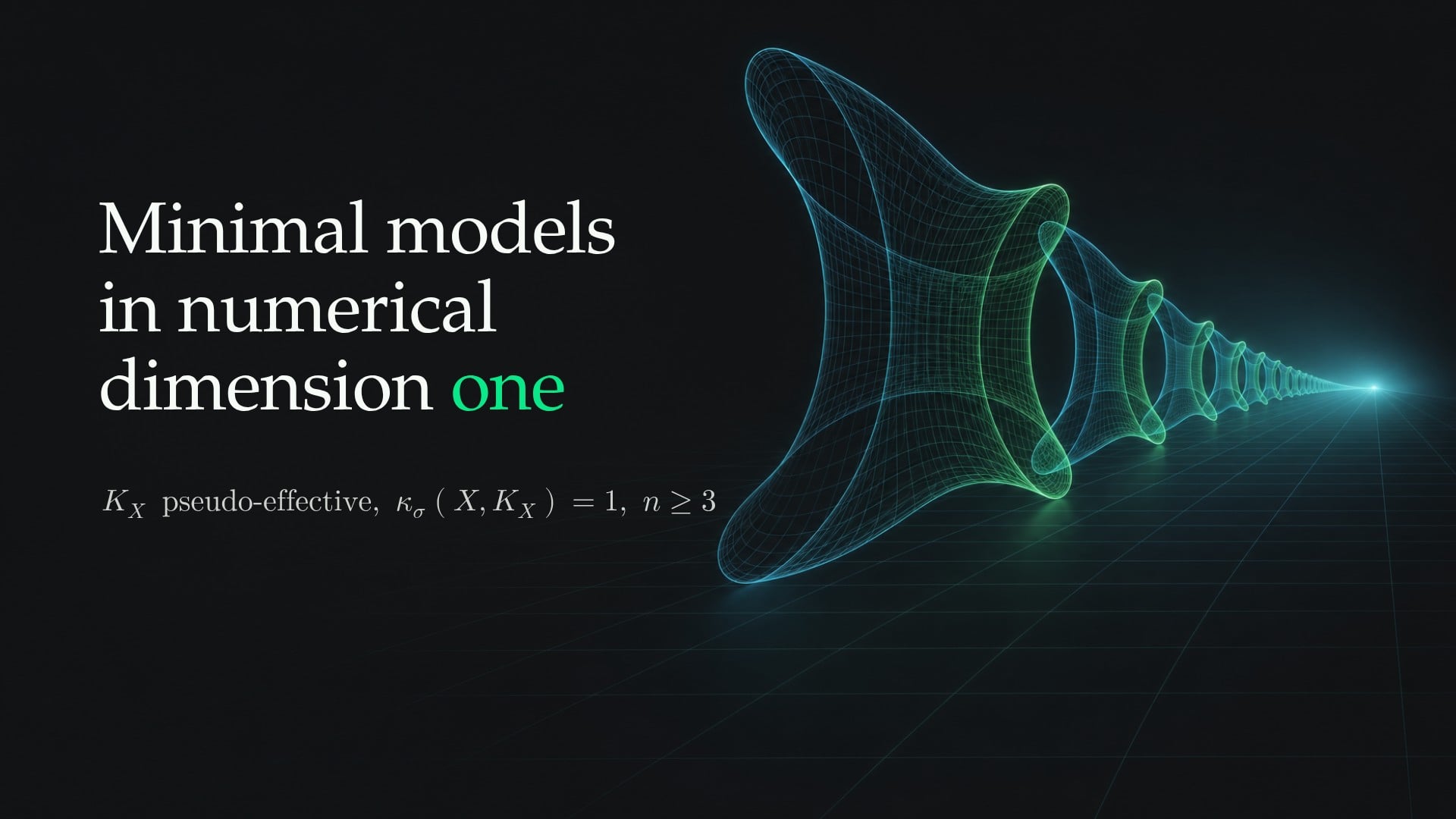
Take a smooth projective variety of dimension at least three whose canonical divisor is pseudo-effective with κσ = 1. You should be able to explain why it has a minimal model, and why the familiar BCHM approach needs new ideas when the perturbation shrinks to zero.
Why finite programs are not enough
Add an ample boundary B. Every K_X + tB is then big, and BCHM runs a finite program for it [0:52]. If you shrink t through 1/2, 1/4, 1/8, …, each stage is finite, but glued together the stages need not stop at t = 0 [0:58]. The hypothesis is Nakayama's κσ, which measures how fast sections of mK + A grow for one fixed ample twist A. κσ = 1 rules out quadratic growth [1:17]. The intersection formula ν(D) is not used here, because it needs nefness first [1:42].
The route of the proof
- Stabilize in codimension two [2:21]. Divisorial contractions lower the Picard number. A discrepancy argument lets each original divisor be flipped to only once. A flipping locus with a codimension-two component strictly lowers dim 𝒜ₙ₋₂. So after a finite prefix X ⇢ Y, every later step changes only codimension ≥ 3. On Y, the divisors M_j = K_Y + t_jB_Y are generated outside sets Z_j of codimension ≥ 3 [2:52].
- First surface S [3:22]. A very general complete intersection surface misses every Z_j, so K_Y|_S is nef and K_Y²·Hⁿ⁻² ≥ 0. Nadel vanishing extends sections with one fixed twist P, and Riemann–Roch gives growth of about (m²/2)·K_Y²·Hⁿ⁻².
- Think-first [4:11]: if that square were positive, the comparison pK_X = qK_Y + E would carry quadratic growth back to X, which contradicts κσ = 1. So the square is zero.
- Second surface T [4:41]. Take T through a point of a hypothetical K_Y-negative curve. The sections vanish to order ≥ ck at one fixed point. The Hodge index theorem makes the fixed exceptional part's square ≤ −εk², which keeps M_j²·T uniformly positive while it also tends to zero. That is a contradiction, so K_Y is nef.
The key is uniformity: the surface, its resolution and the exceptional curve are all fixed before j moves [5:47].
When a limit t → 0 will not terminate, fix the model where the tail no longer matters, test the limit on surfaces, and let the growth hypothesis force the square to zero. The next question is abundance: is that nef K_Y semiample? [5:52]