Recursos
Resumen
Pick any step of the proof that nef log canonical divisors are semiample in characteristic zero, and say which part of the dimension induction it serves and what it turns into what.
The statement
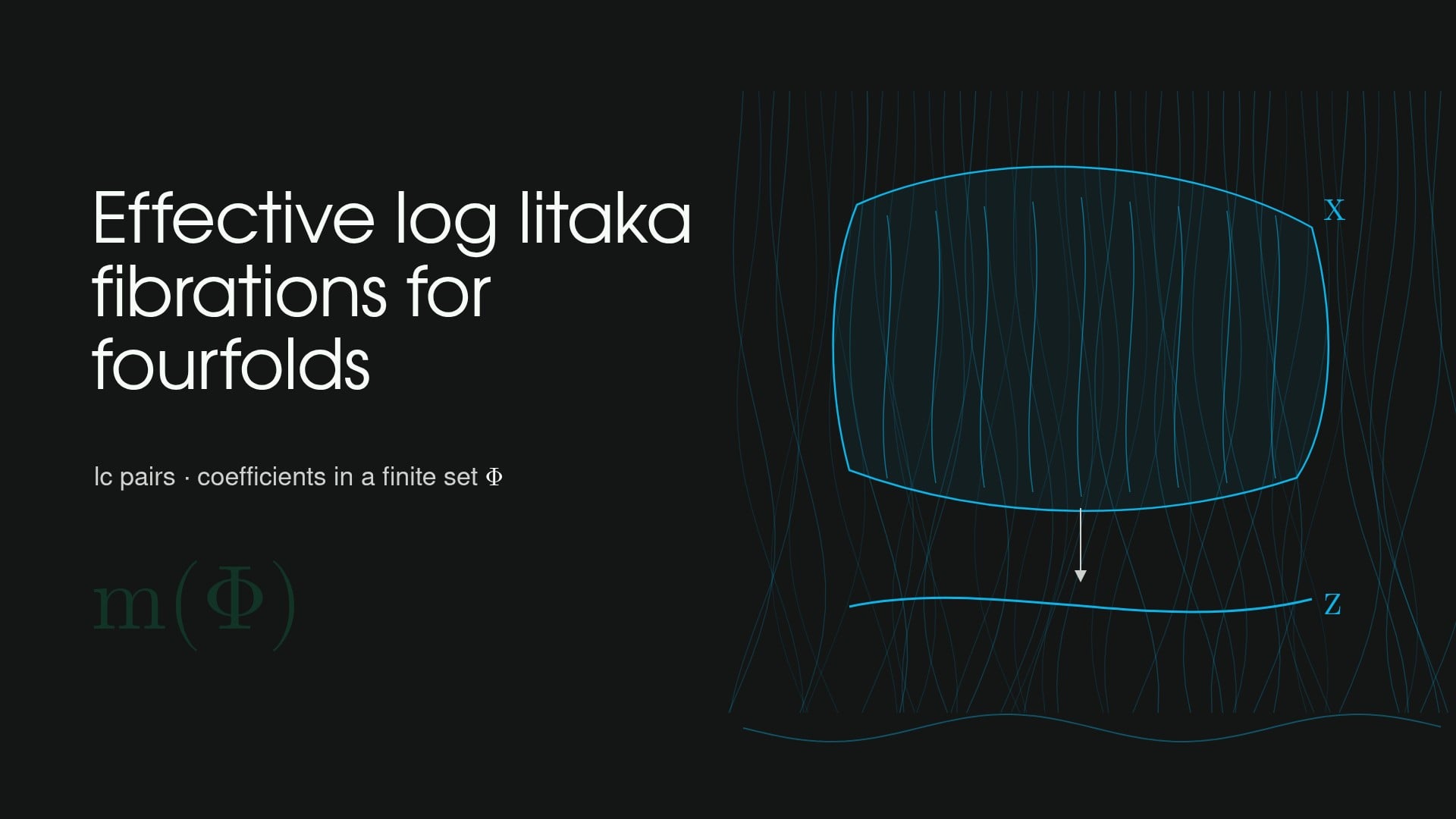
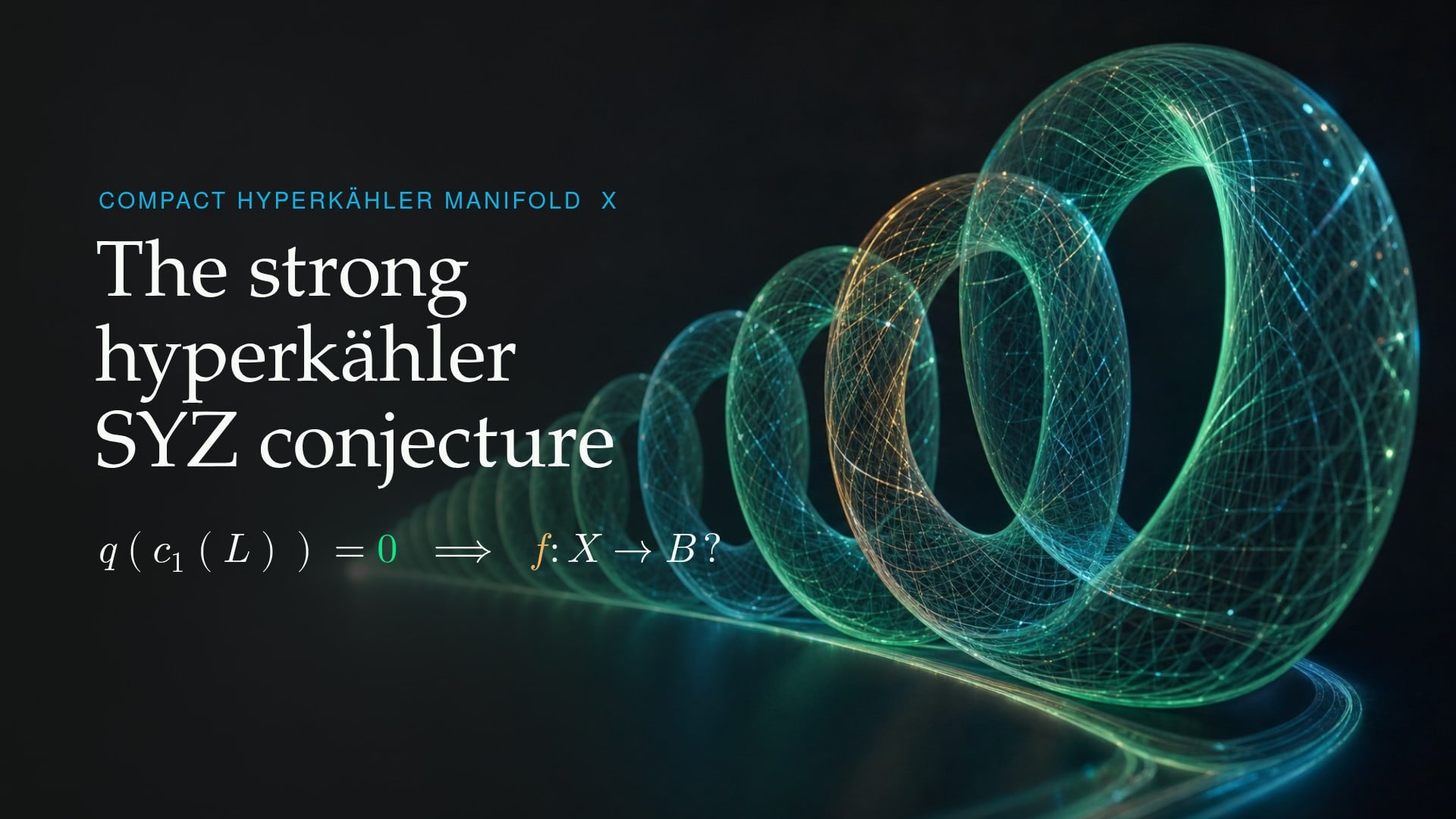
A nef divisor passes a numerical test: it has nonnegative degree on every curve. A semiample divisor has a positive multiple generated by global sections, and those sections define a morphism, so X becomes a fibration [0:15]. Log abundance (Theorem 1.1): for a normal projective lc pair (X, B) over an algebraically closed field of characteristic zero, with B effective and rational and K_X+B ℚ-Cartier, if K_X+B is nef then it is semiample. Over ℂ the proof also gives smooth canonical nonvanishing [0:48].
How the induction is built
The induction proves a stronger claim, good log minimal models (GLM). Each rung in dimension n does two things [1:22]:
- NV_n: GLM below n, together with log Iitaka subadditivity, gives nonvanishing. The engine is the Frobenius comparison: fixed data from a hypothetical counterexample is reduced mod a large prime p. One determinant must vanish to order at least 3R/4, but the movable curve caps that order at R(80ε+O(1/p)). Those two bounds contradict each other [3:56].
- GLM_n: GLM below n, together with NV_n, gives good models. The hard case is κ = 0, which the signed criterion handles [2:16]. Base and transverse parameters are lifted through every infinitesimal neighborhood. Each obstruction lies in a negative twist of the lowest Hodge piece F₀M, and that space has no sections [2:41]. The fiber then moves off D, the nef reduction gives κ = ν, and the rung finishes [3:19].
- Semiampleness of L on the boundary is handed up from lower dimensions [4:57].
Your reading rule
For each step, ask three questions: which dimension does it live in, which task does it serve, and what did the dimension below hand it? If you want one self-contained piece, start with Theorem 9.1 (the Frobenius part). Sections 3–5 are the signed criterion [5:36].