Recursos
Resumen
Take one moduli-divisor coefficient in the canonical bundle formula and trace it down to the weight of a log pluriform over a curve. That tells you what a uniform Iitaka degree m(d, Φ) needs: bounded Cartier denominators of the moduli divisor.
The problem [0:08]
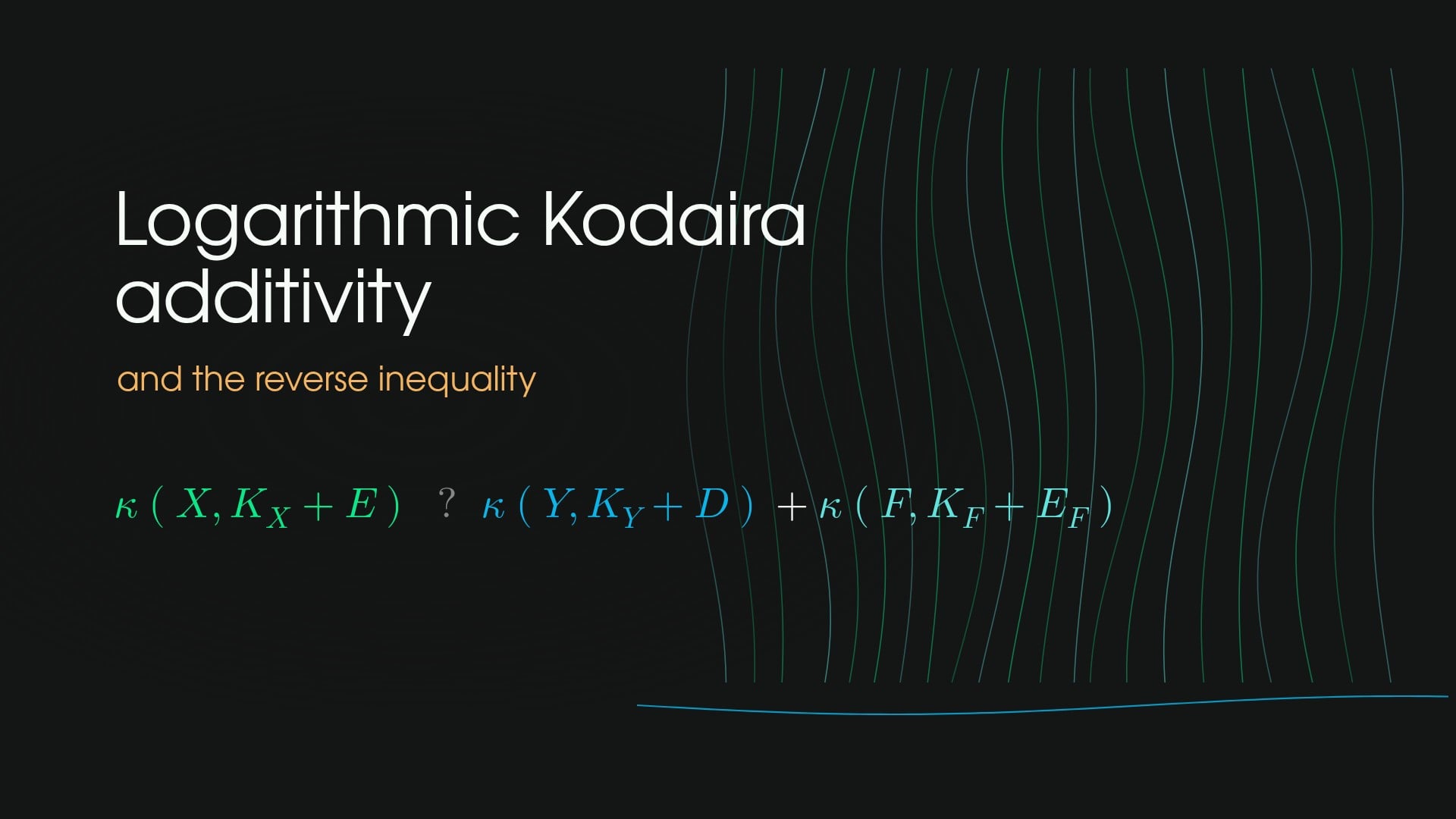
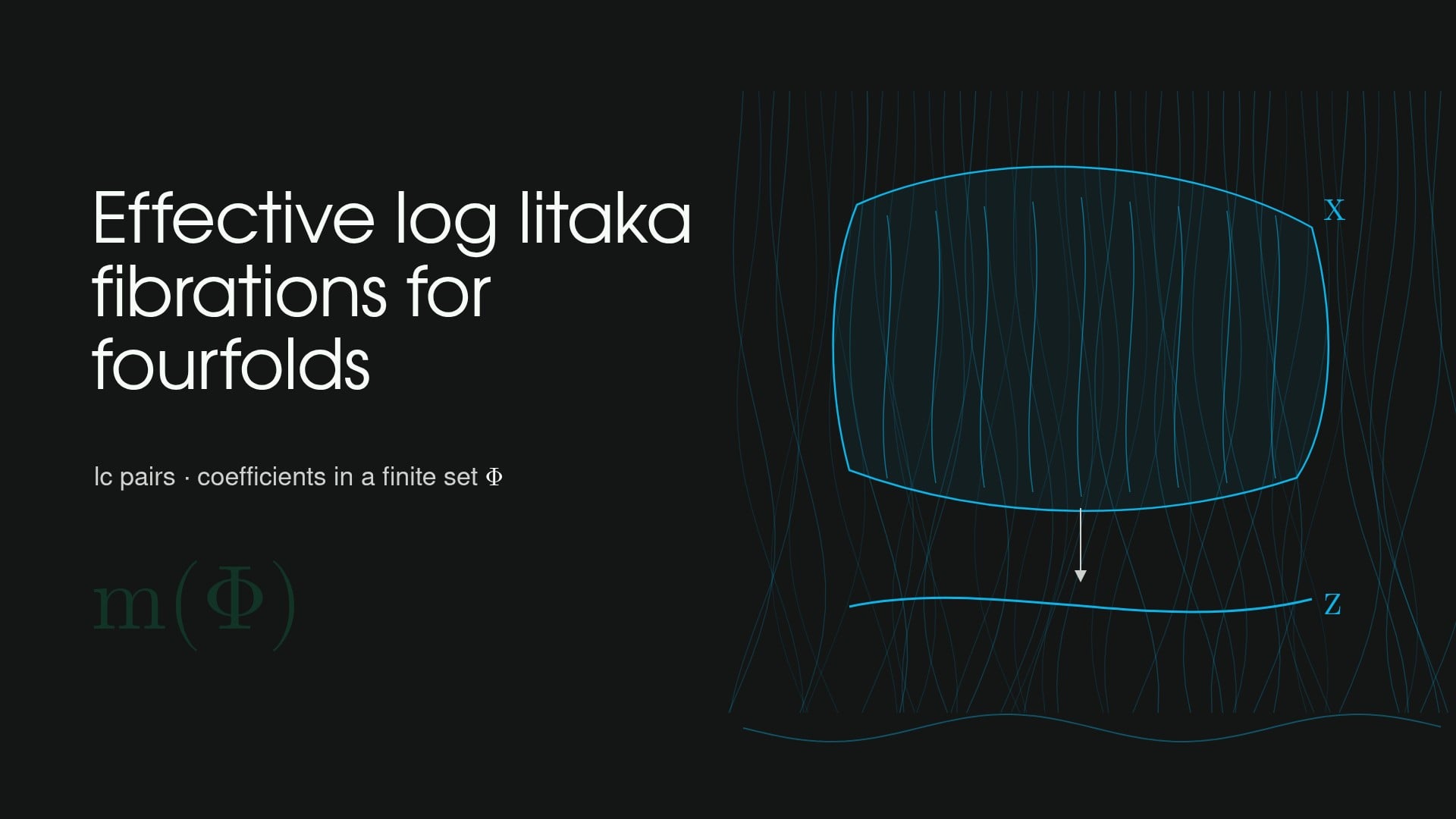
For an lc pair with D = K_X + B and κ ≥ 0, the ratios of sections of the multiples of D generate the Iitaka field K(D). The theorem: if d ≥ 5 and the coefficients come from a fixed finite set Φ, then one degree m(d, Φ) gives a nonzero complete rounded system, and its ratios already generate all of K(D). On the base, the formula D_Z = K_Z + B_Z + M_Z splits the difficulty in two [0:55]. The discriminant is tame, since its coefficients lie in a DCC set. Effective birationality needs p·M_W to be nef Cartier for one uniform p. A bounded index on the generic fibre does not give you that: the ramification of semistable reduction is uncontrolled.
From coefficient to weight [1:46]
Cut the base with a general curve C that crosses the divisor P at a point c. The weight w_z(φ) is the minimum, over the fibre components, of (ord Ω + m) / (m · ord z). Then coeff_P M_W = w_z(φ) − (an integer), so the weight's denominator is the moduli denominator.
- Worked case [2:37]: m = 2, with components (multiplicity 1, order 0) and (multiplicity 2, order 1). The quotients are 1 and 3/4, so the weight is 3/4 and 4 | p.
- Your case [3:20]: m = 3, with (1, 1) and (3, 2). The quotients are 4/3 and 5/9, so the weight is 5/9 and 9 | p. Large multiplicities push denominators up.
Why the denominator stays bounded [3:57]
q(s, m) clears every weight and depends only on the fibre dimension and the degree. There are two routes:
- If there is a horizontal component with coefficient one, take a residue: the dimension drops and induction runs.
- In the klt case, use a product cover with inertia acting on each factor. Ramification e multiplies the weight, but e·w = ord(v)/a. Once the characters of inertia have bounded order [4:41], the unbounded ramification cancels.
Then take p = lcm(p₀, q(s, p₀)). This makes pM_W Cartier and nef, the system on the base becomes birational, and F_m(D) = K(D) [5:07].
The rule to keep [5:46]: slice the base by a curve, read the coefficient as a weight, and bound the weight's denominator using only s and m.