Recursos
Resumen
Take a point [t] of K₁ᴹ(F)/p for a field F = κ(x, y) of characteristic p and decide where it sits relative to x: on the projective line through [1] and [x], only inside the field C(x), or outside C(x). Then say which step of the reconstruction proof detects each case. That decision is the core of the proof that K₁/p and K₂/p determine the field.
The setting
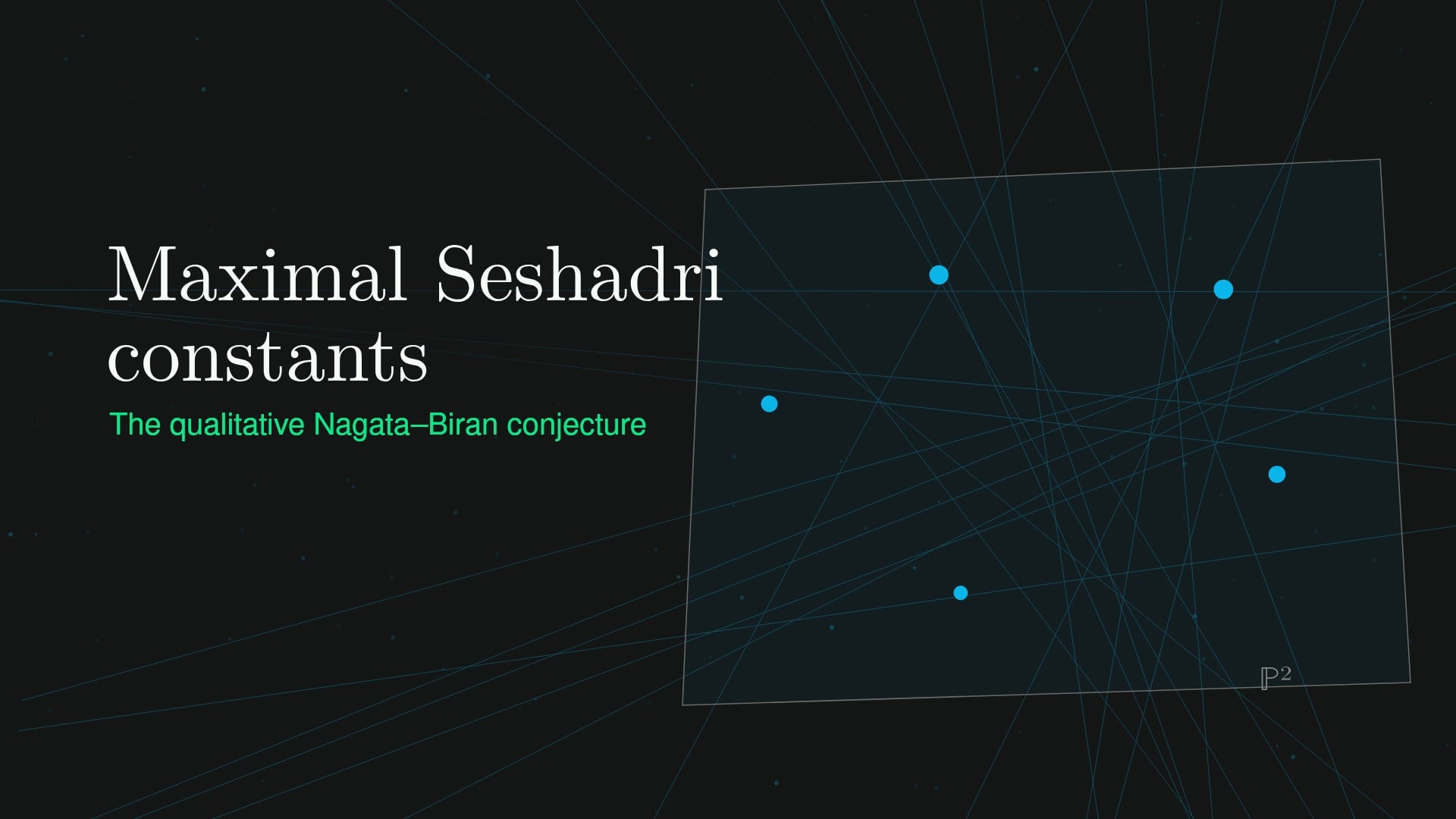
- V_F = F^×/(F^×)^p is the projective space P_C(F) over C = F^p, because (F^×)^p = C^× [1:04]. The class [f] is the subspace C·f. The line through [1] and [x] is C + Cx.
- Running case: p = 3, F = κ(x, y), C = κ(x³, y³), so [F : C] = 9 [1:32].
- The theorem: every compatible Θ (one that preserves the Steinberg relations) is a field isomorphism times one scalar in F_p^× [0:45].
The decision rule
- Vanishing symbol ⇒ degree-p field. Points on an affine line give vanishing symbols: {t, c + dt} = 0. Conversely, if s ∉ C and {s, t} = 0, then t ∈ C(s). The determinant of logarithmic derivatives kills the Steinberg relations and sends {s, t} to 1 [1:45].
- That is not yet the line. C(x) has dimension p, not two. Here [x + y³] is on the line, and [x²] is in C(x) with {x, x²} = 0 but lies off the line. Since y ∉ C(x), the symbol {x, y} ≠ 0 [2:31].
- An intersection fixes the exponent. The crossroads u = x + a, v = y + b, z = bx − ay gives vanishing symbols that Θ preserves. The intersection X·C(Y/X) ∩ U·C(V/U) then forces a unique n with Uⁿ ∈ C + CXⁿ [3:25].
- Why n is needed. A scalar bends lines. For p = 3, (x+1)² = x² + 2x + 1 ∉ C + Cx² [4:14]. One n spreads across a connected graph, and nΘ maps lines onto lines.
- Back to the field. Projective lifting gives a semilinear map, and the group law makes it a field isomorphism. Finally ∩ F^{p^m} = κ recovers the base field [4:56].
When you read a reconstruction argument, ask three questions in order: what does a vanishing symbol force, which intersection fixes the exponent, and which line does that exponent give back?