Recursos
Resumen
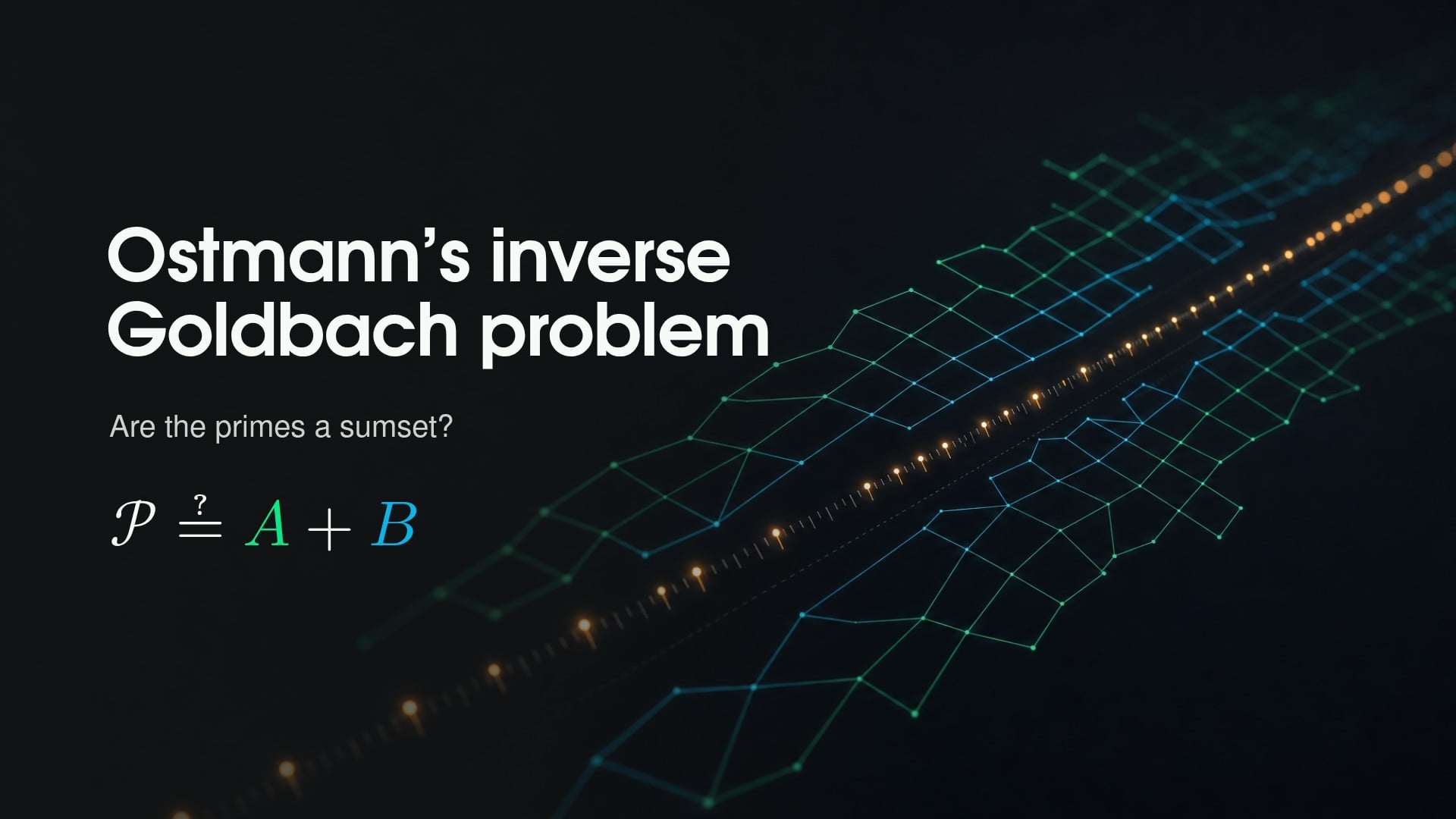
Suppose someone hands you two sets A and B whose sumset matches the primes past some point. You should be able to say which step of the claimed proof breaks it, and which hypothesis that step uses up: exclusion (every large sum is prime) or coverage (every large prime is a sum).
Two hypotheses, two jobs
- The reduction [0:59]: take A = {0, 2} and let B be the lower twin primes. Every sum is prime, but 23 and 37 are never reached, so coverage fails. Lemma 2.2 turns this into a rule: both summands must be infinite.
- Exclusion becomes residues [1:38]: write D = −B. If a ≡ d (mod p), then p divides a + b, and a + b is composite. So the residues of A and of −B never meet, and together they split 𝔽p into S_p and its complement. Worked check: mod 5, if A sits in {1, 2}, then B must avoid 3 and 4.
- Why that alone is not enough [2:27]: the square-root counting bounds still leave room above the coverage floor x/log x. The collision estimate then forces σ_p ≈ ½, with each summand spread evenly over its own part.
From structure to contradiction
- Sections 3–4 rule out correlation with translated multiplicative characters. The quadratic case uses a moment argument plus Poisson summation. Higher orders use repeated Cauchy–Schwarz with anchor variables [2:58].
- Coverage, on its own, makes the normalized transforms non-sparse (Prop. 5.1): γ_p ≥ δ₀ on a positive harmonic share of primes [3:22].
- A positive statistic becomes the amplitude η through Poisson summation. Each transfer squares η, and induction gives the lower bound |η_k|² ≥ e^{−2Brm} [3:45].
- Symmetrization averages η over all arrangements of the bulk prime variables. Pairs of arrangements with many overlap components are rare, so the upper bound gains a fixed fraction of log r per variable while the lower bound loses only a constant. Fix the depth k first, then let the scale grow: the upper bound falls below the lower bound [4:21].
Reading rule: label every step with the hypothesis it uses, and check that the depth is fixed before the scale. This is the claim of a 2026 preprint, so verify it yourself, starting with Section 2. Then ask how the finite-field tree comparison in Section 6 controls the squared diagonals.