Recursos
Resumen
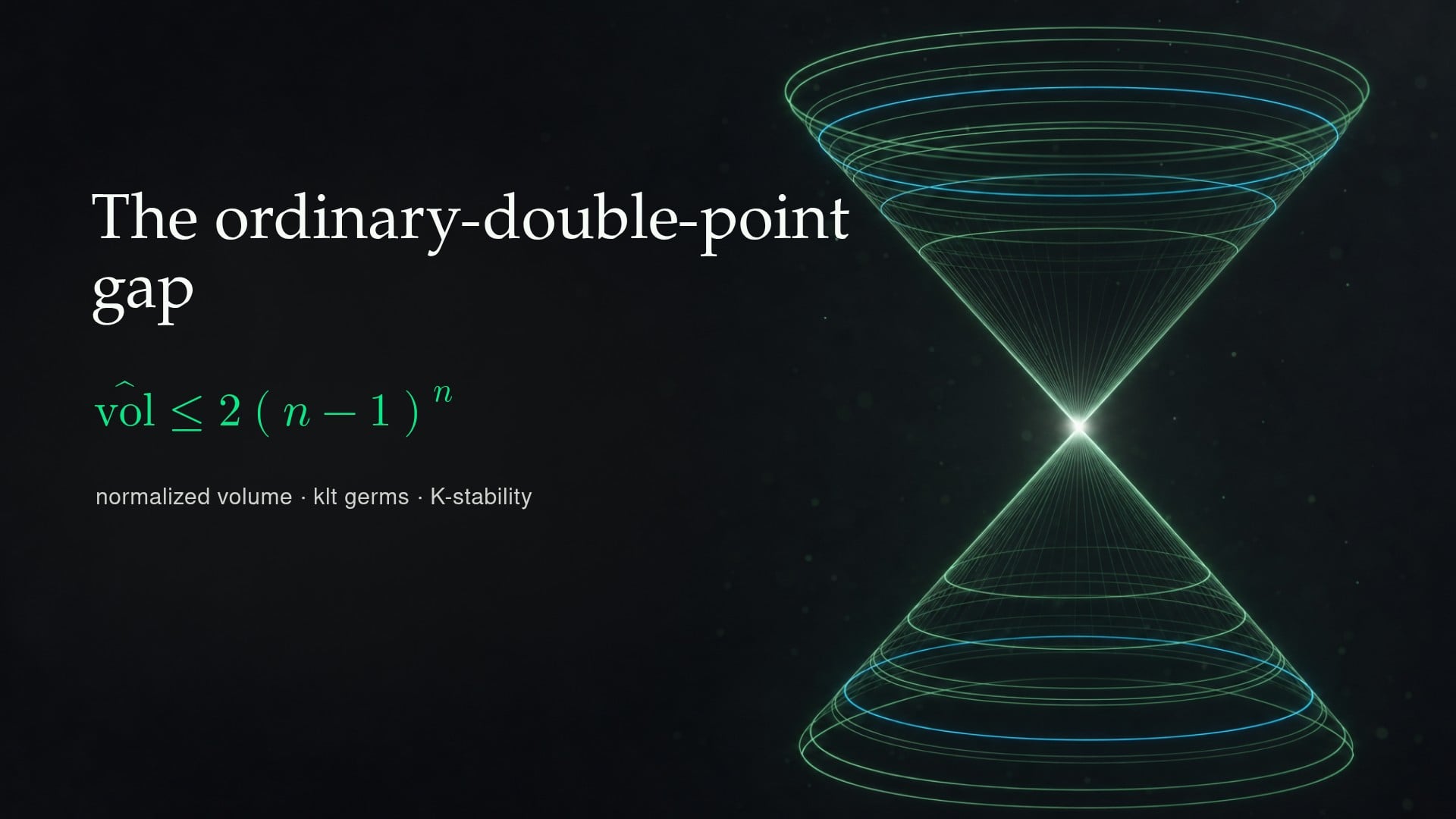
Take an irreducible integer polynomial of degree 4 to 8 and say what its (d−2)-power-free values look like: which power to exclude, whether the local condition holds, what the density is, and why the very large primes are the hard part.
The prediction and the theorem
The sieve gives the guess [0:12]. For each prime p, throw out the n with p^k | f(n). The Chinese remainder theorem makes these conditions independent, so the surviving proportion should be a product of local factors. Earlier methods proved this only for larger exponents or higher degrees (Ricci, Erdős–Hooley, Nair, Heath-Brown, Browning). That left degrees 4–8 at exponent k = d − 2 open, Erdős's n⁴ + 2 included [0:43].
The paper's Theorem 1.1 [1:18]: if f is irreducible of degree 4 ≤ d ≤ 8, with k = d − 2, and ρ_f(p^k) < p^k for every prime p, then the count of n ≤ X with f(n) k-power-free is c·X + o(X), where c = ∏_p (1 − ρ_f(p^k)/p^k) > 0. You don't need any sign or primitivity condition.
Worked case and practice
- x⁴ + 1 [2:03]: k = 2. The factor at 2 is 1, and so is the factor at any prime p ≢ 1 mod 8. Each p ≡ 1 mod 8 has four roots and gives 1 − 4/p². The paper shows c₈ > 3/4. My own numerical evaluation puts it near 0.98.
- 4x⁴ + 4: every value is a multiple of 4, so ρ(4) = 4 and the factor at 2 is 0. The condition fails.
- n⁴ + 2 [3:05]: f(1) = 3 and f(0) = 2, so every prime has an input that escapes. The density is positive.
Where the difficulty lives
The CRT handles small primes exactly, and Hensel lifting handles primes up to X. The hard part is the tail p > X [3:36]. The key proposition bounds it by X^(1−δ). It uses three tools: the surface f(x) = y z^k, the factorization α^k β = μ(n − θ) in K = ℚ(θ) into two balanced boxes, and determinant cuts with adaptive auxiliary primes. Quartics need extra geometry on top of that.
Recipe for a new polynomial: set k = d − 2, check the finitely many primes that could break the local condition, and write the product. For d ≥ 9, Browning's theorem gives the same conclusion.