Recursos
Resumen
Take any first-moment sum of cubic Gauss sums over Eisenstein primes and say whether it has a main term at the scale X^(5/6)/log X, and why. Kummer's sums from 1846 lean positive, even though they are equidistributed on the unit circle. This class shows how both facts can be true.
Why a uniform cloud can still lean
- Equidistribution works at the prime-counting scale X/log X. Patterson's bias is smaller by a factor of X^(-1/6): at X = 10^12 it is one hundredth of the count [0:24]. Think of waves and the tide.
- Theorem 1.1, proved unconditionally: the sum of G(π) over primary primes (π ≡ 1 mod 3, conjugates counted) with Nπ ≤ X equals (6/5)c* X^(5/6)/log X + o(X^(5/6)/log X), where c* = (2π)^(2/3)/(3Γ(2/3)) [0:57].
Where 6/5 comes from
Replace G(π) with the elementary model c* N(π)^(-1/6). By the prime ideal theorem there are about y/log y primes of norm up to y. Partial summation turns the sum into ∫ u^(-1/6)/log u du. Integrating u^(-1/6) gives u^(5/6)/(5/6), and dividing by 5/6 is the 6/5 [1:27].
Non-example: twist each term by θ_ℓ(π) = (π/|π|)^ℓ with a fixed ℓ ≠ 0, and the sum cancels. The bias lives only in the radial mode ℓ = 0 [2:22]. Because G(π)^3 = −π/|π|, powers G^k with 3 ∤ k and |k| > 1 cancel too.
How the proof reaches a sharp cutoff
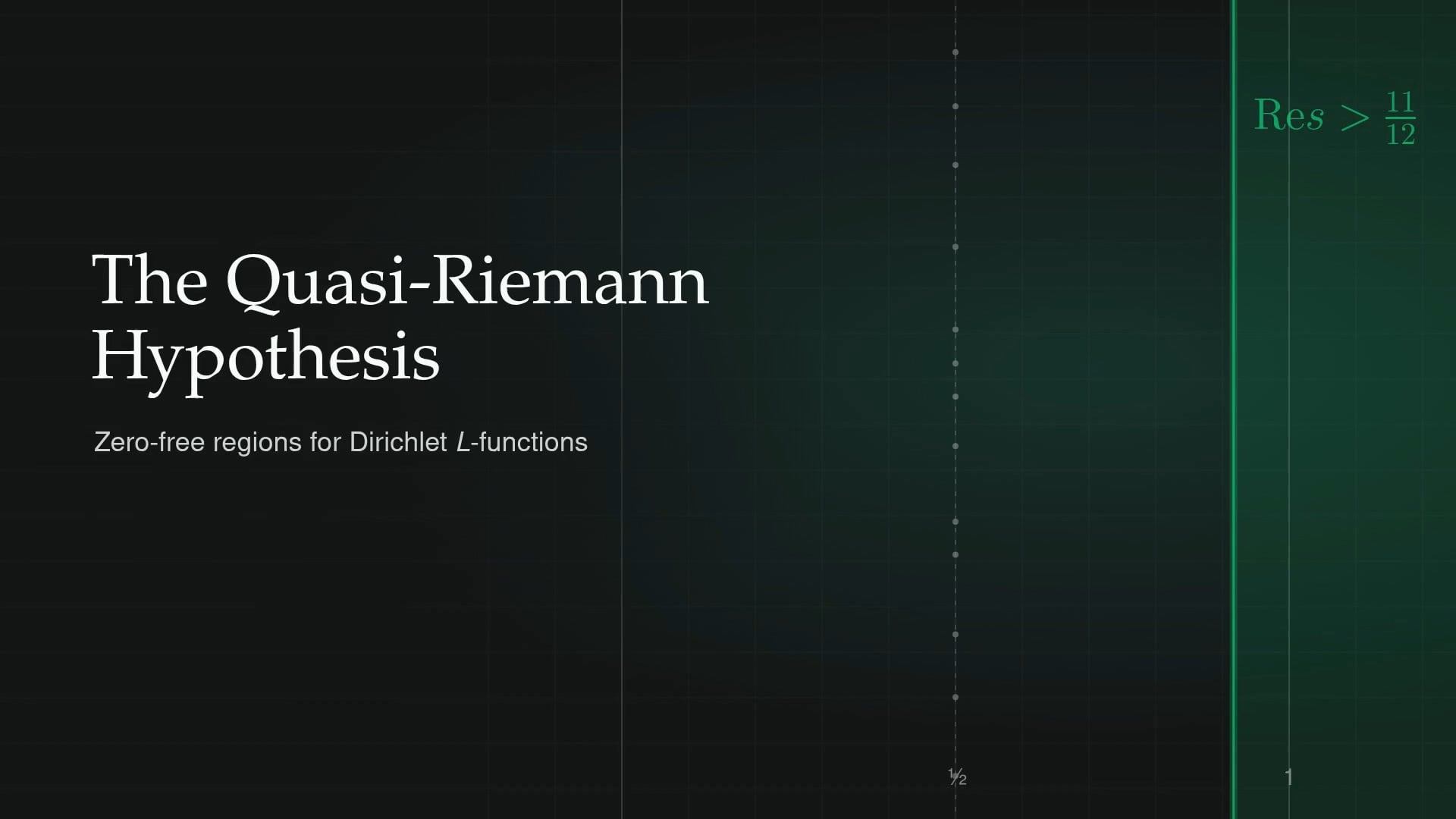
Smoothing the cutoff brings in Mellin heights up to X^(1/6+ρ). Earlier work proved the asymptotic only under GRH [3:11]. Three devices remove that hypothesis:
- Corrected dispersion: the cube frequencies in Poisson summation rebuild the model term, so the method subtracts it. Large sieves control the rest [3:41].
- Exact prime decomposition: sort factors into norm bins and stop when a running product crosses a threshold. A binomial weight splits the final bin exactly, which keeps the coefficients independent [4:10].
- Two exceptional configurations: moments of several lengths and an off-diagonal Gram estimate rule them out [4:45].
Your test [5:06]: find the elementary model, sum it with the prime ideal theorem, and ask which angular mode carries it.