Recursos
Resumen
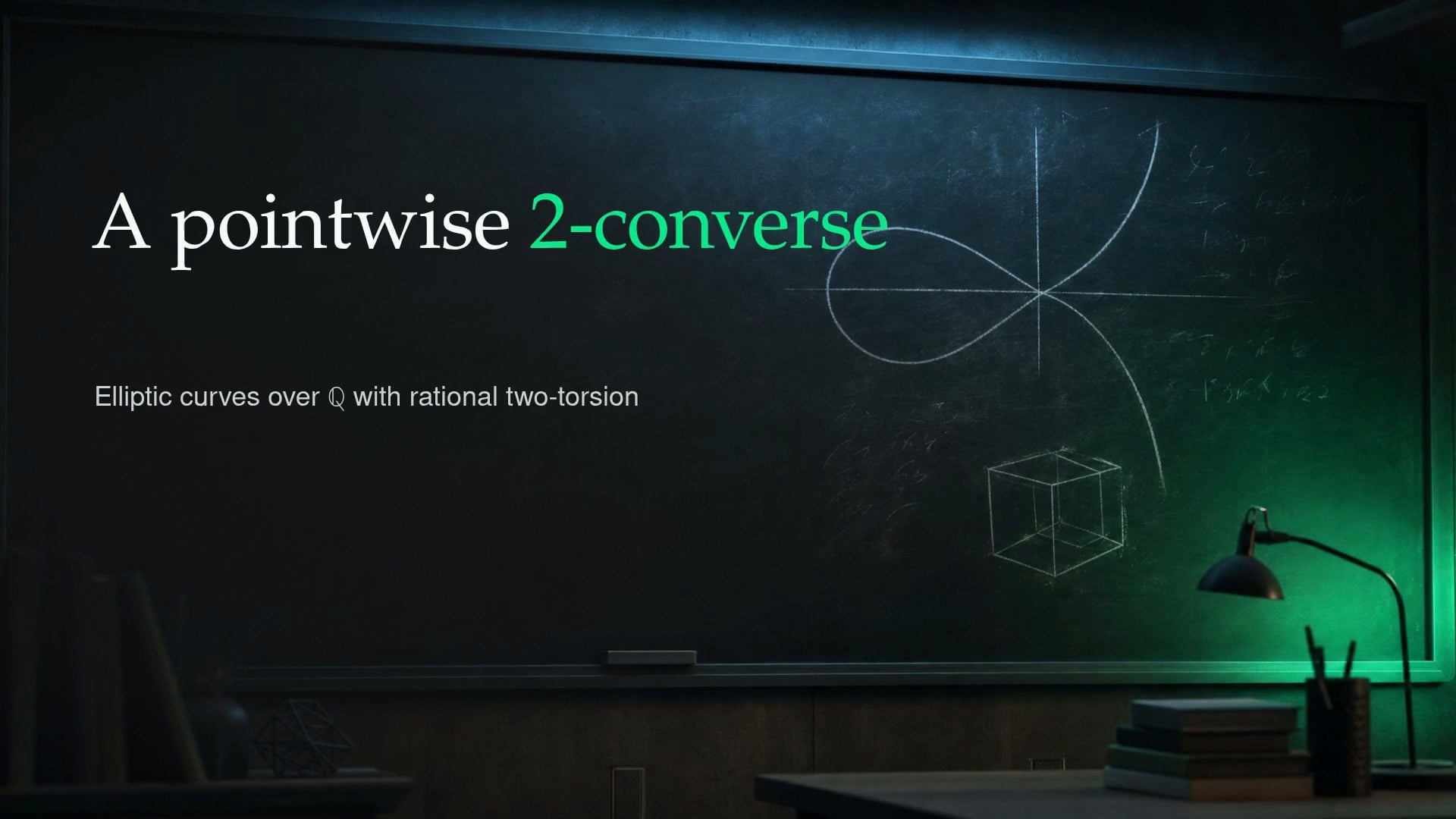
You need a single finite étale cover of a p-adic hyperbolic curve that stays trivial on a whole exterior region U but has degree divisible by p over every removed disk Vᵢ. After this class you can explain how the paper builds that cover, and which step makes each condition true.
Three moves, two primes
- Loops from ℓ [1:28]. Resolution of nonsingularities (Mochizuki–Tsujimura) places positive-genus vertices inside each disk. A path Pᵢ joins two lifts of them. Positive genus means Jac(D)[ℓ] ≠ 0, so you can choose a connected ℤ/ℓ-torsor on both endpoint components. Each endpoint then has one vertex above it, while each edge has ℓ lifts. Edges multiply faster than vertices, so b₁ ≥ ℓ − 1 > 0 [2:32]: a cycle appears above every disk.
- Wrap with p [3:07]. Cut a cycle Cᵢ once, take p copies, and glue copy a to copy a + 1 (the spiral staircase). The cut must sit at an irrational, type-three point ηᵢ, where τ⁻¹(ηᵢ) = {ηᵢ}. Then the image of the exterior under retraction misses the cut, and the cover splits over U_Z [3:28]. A rational, type-two point can carry side disks, so it gives no such guarantee. Lemma 2.6 of [2], proper GAGA and base-change invariance then make the cover algebraic over k̄.
- Quotient by a stabilizer [4:12]. Take the fibre product of all these covers and their conjugates to get T, with G = Gal(T/X) and P = Gal(T/Z) ≅ (ℤ/p)ʳ. If H stabilizes an exterior component, then H ∩ P = 1. Every disk stabilizer B satisfies B ∩ P ≠ 1.
Reading off the two conditions
Set Y = T/H. A component with stabilizer B has degree [B : B ∩ H] [4:50]. For the chosen exterior component B = H, so the degree is 1 and that component is isomorphic to U: condition (i). Over a disk, N = B ∩ P is a nontrivial normal p-subgroup that meets H trivially, so |N| divides the index: condition (ii).
The play to reuse [5:26]: create topology where you need nontriviality, cut where the exterior cannot see, and quotient by the stabilizer of the sheet you want to keep.