Recursos
Resumen
Given a polarized surface and a number of points, you can now say why the multipoint Seshadri constant can never exceed √(L²/r), test whether one curve keeps it below that value, and explain how a recent proof forces equality once r is large enough.
The bound and how a curve breaks it
- The multipoint Seshadri constant is the smallest ratio L·C / Σ mult over curves through the points. In blow-up terms, it is the largest λ for which π*L − λΣEᵢ stays nef [0:16].
- Counting gives the bound [0:49]: sections of kL grow like (L²/2)k², and vanishing to order m at r points costs about r·m²/2 conditions. While m < k√(L²/r), some section survives, so ε ≤ √(L²/r).
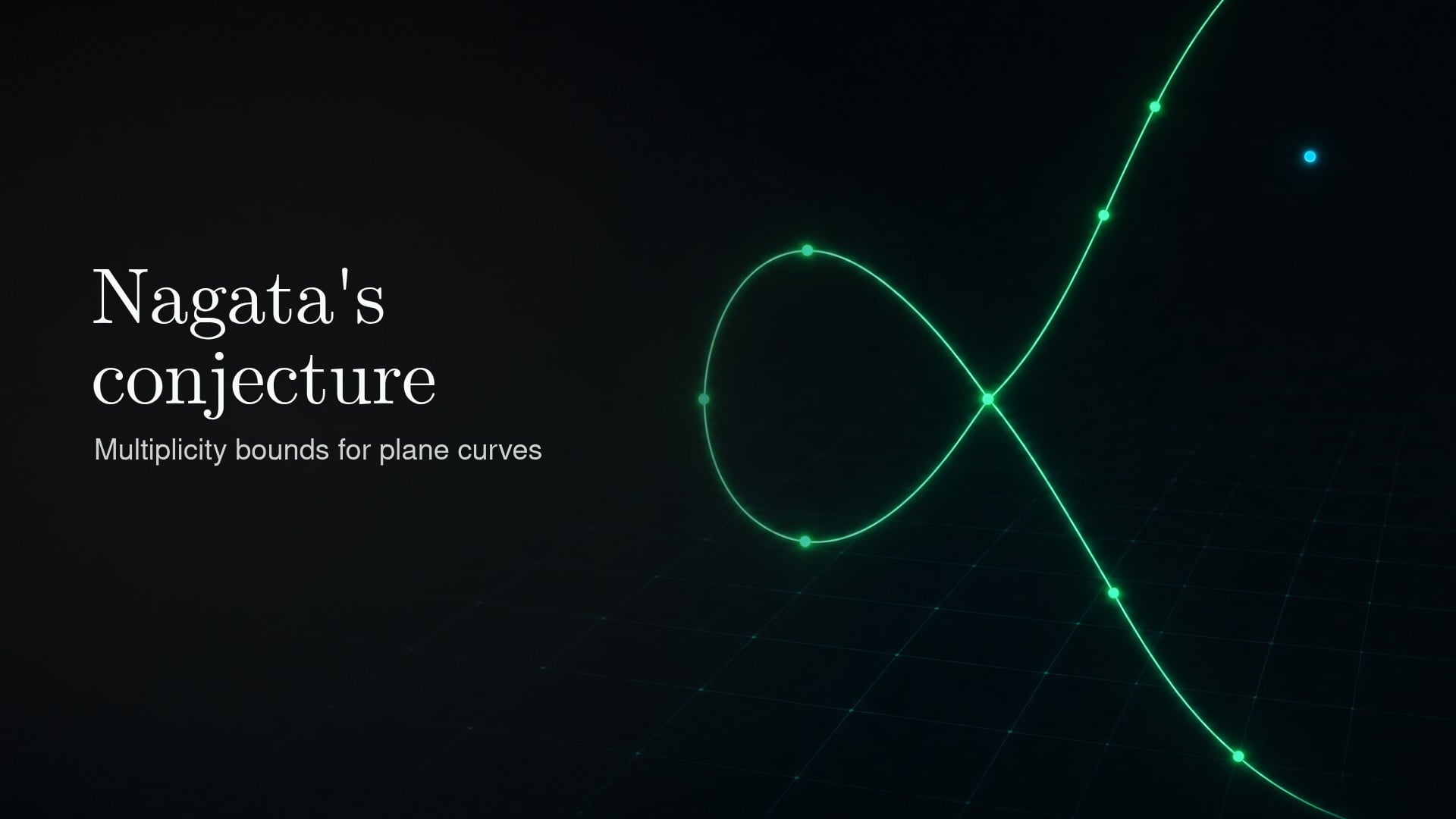
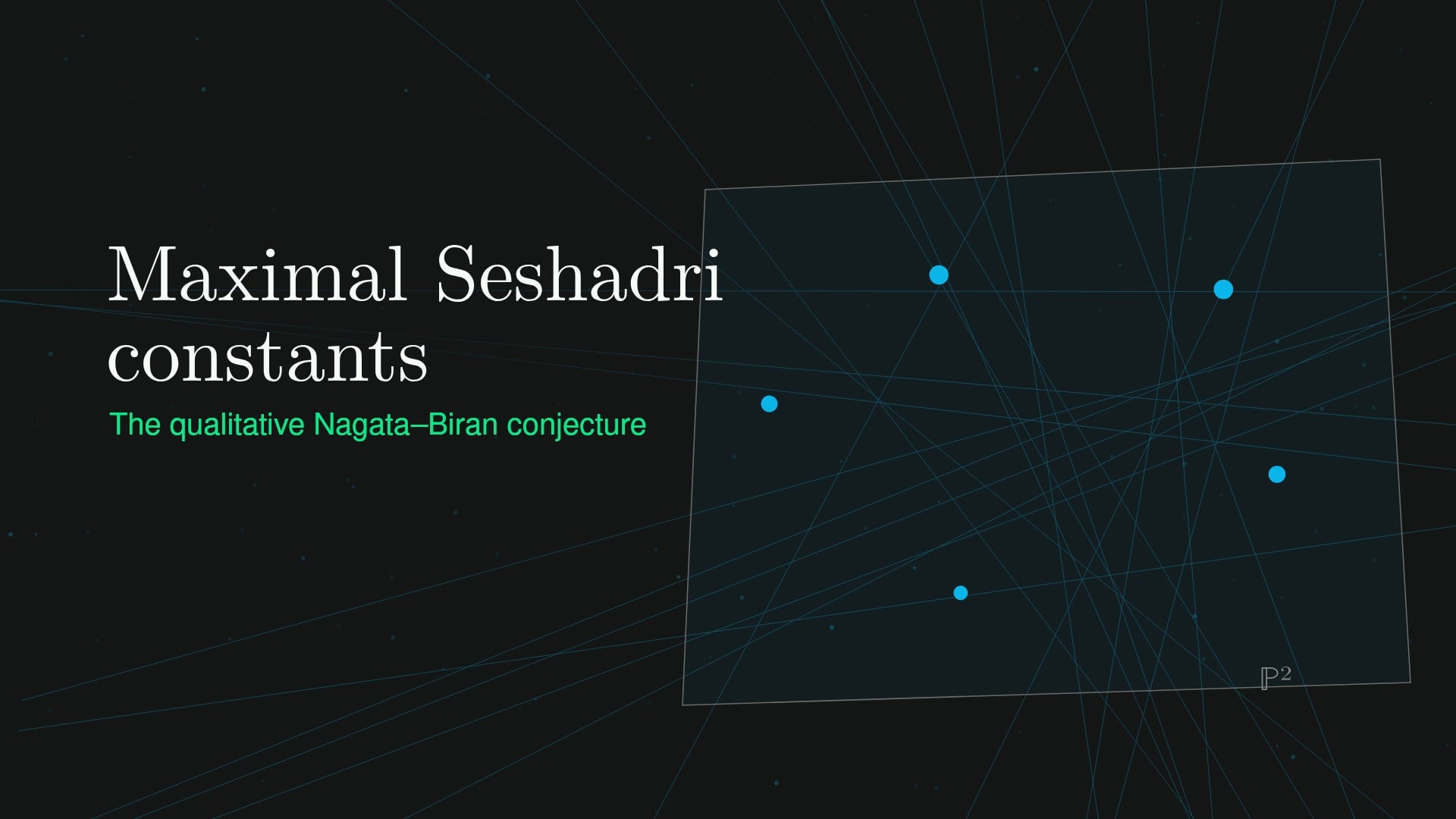
- Think-first case [1:27]: in ℙ² with L² = 1 and five general points, the bound is √(1/5) ≈ 0.447. The conic through the points gives 2/5 = 0.4, so at r = 5 the bound is not reached.
The theorem and its three moves
- Theorem [2:01]: for every (S, L) there is a threshold r₀(S, L). For every r ≥ r₀, at very general points, ε = √(L²/r). Think of it as packing: enough points use up all of L².
- Move 1, the triangle [2:34]: a nodal divisor V ∈ |dL| bounds the leading exponents of sections inside a quadrilateral. Sliding each diagonal slice down to height zero turns it into a triangle of area L²/2.
- Move 2, the subgroup test [3:10]: take a finite subgroup of the torus with exactly r points, cut out by two monomial equations (an index-r lattice, not necessarily a square grid). Averaging splits polynomials into pieces lying in triangles of height kw, with w = √(L²/r). Slicing shows their order at the identity is at most kw, so the jet test is injective.
- Move 3, Riemann–Roch [3:50]: if some curve C met π*L − wE negatively, subtract δC and raise w to s. Riemann–Roch then gives a section that vanishes to order ks > kw, which the jet test forbids. So the class is nef.
Your check [4:25]: compute √(L²/r), then look for one curve whose ratio falls below it. Below r₀ you may find one. Beyond r₀, the theorem says you never will. Its exact value is still open.
Maximal Seshadri constants: the qualitative Nagata–Biran conjecture

Clase 93 / 100