Recursos
Resumen
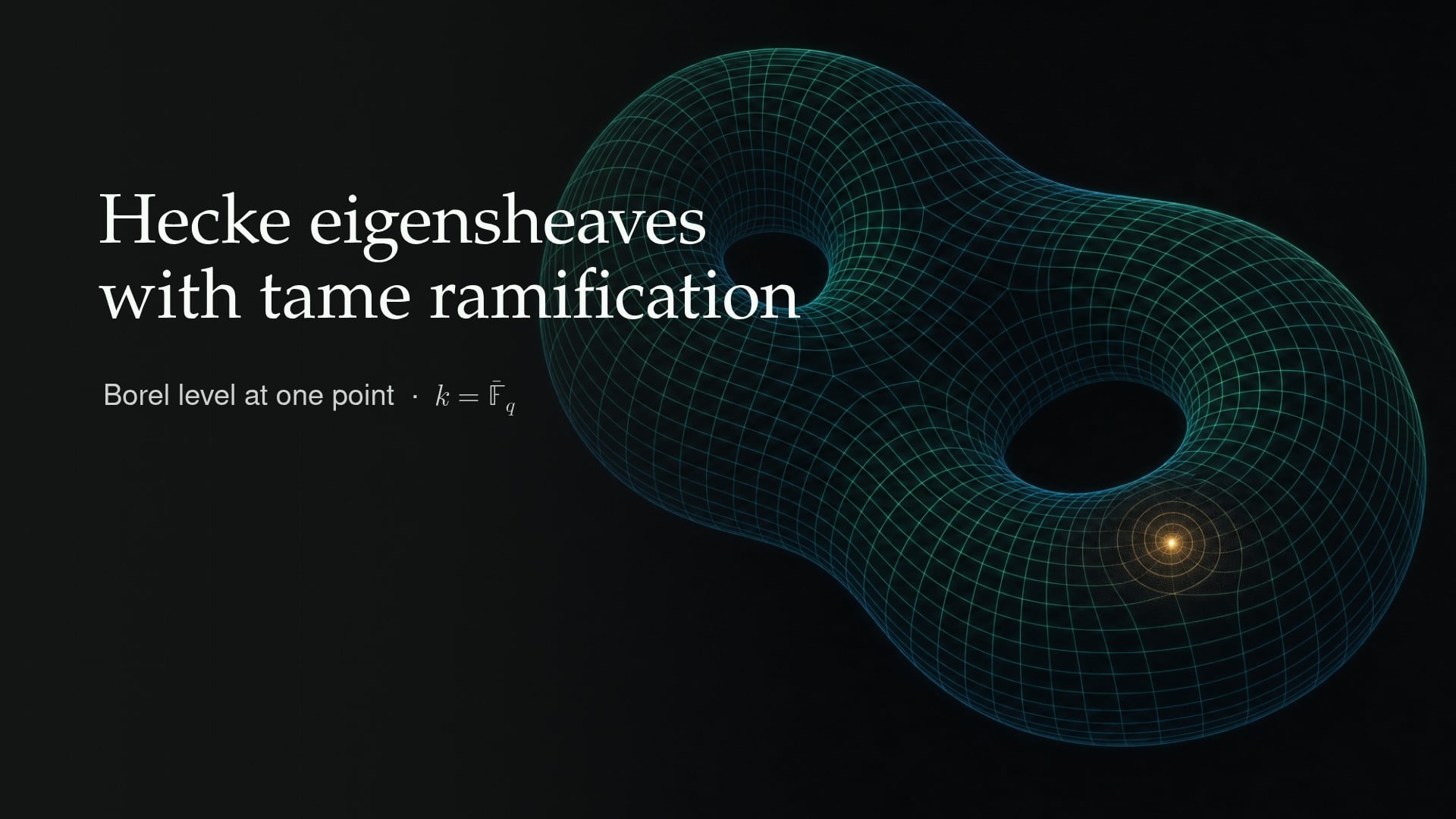
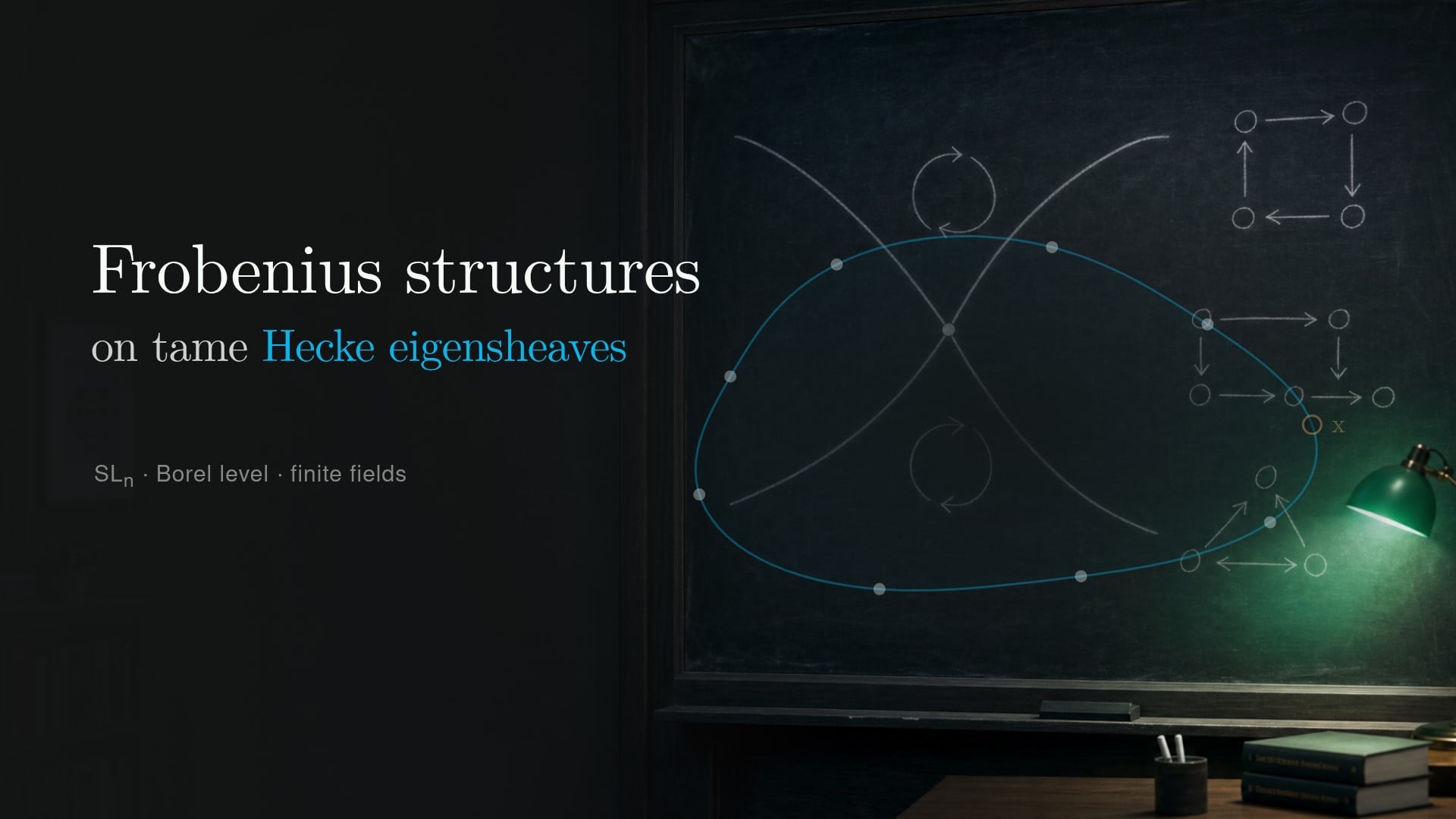
Take a geometric Hecke eigensheaf construction and trace where Frobenius lives at every step, so that the eigensheaf and all of its eigenisomorphisms end up as Weil objects over a finite field.
The demand
An arithmetic local system over 𝔽q carries more than its geometric restriction: it also specifies Frobenius. So the eigensheaf needs a Weil structure, an isomorphism between its Frobenius pullback and itself. That isomorphism must also respect every eigenisomorphism, including units, permutations and all fusion diagonals [0:23]. For SLₙ with Borel level, a dense tame PGLₙ parameter with regular-unipotent monodromy, genus ≥ 2 and p > n, the result is a nonzero perverse Weil sheaf over 𝔽_{q^m} with singular support in Λ_par [1:00].
The route: through characteristic zero and back [1:25]
- Lift [1:57]: the torsor tower of ρ extends over root stacks and lifts over W(𝔽q). The lifted tower carries φ. At the puncture, A N₁ A⁻¹ = q N₁.
- Glue at a separating node [2:31]: the two branches act by u and by u^{−e}. You need one conjugator P that intertwines them, commutes with A, and lies in a compact group. Inverse monodromies alone don't guarantee this.
- Rank-two check [3:16]: with A = diag(q,1) and P = c(−1/e) = diag(−1/e,1), P is diagonal, so it commutes with A. It sends −eN₁ to N₁. And −1/e is an ℓ-adic unit because ℓ ∤ e.
- Recognition [4:09]: an invariant parameter does not automatically give an invariant eigensheaf. On the one-point spectral component, the skyscraper's object is pinned down up to a shift. An invariant polarization kills the shift, and density plus the trivial center of PGLₙ give the full eigenstructure.
- Back down [5:02]: nearby cycles to the node, keep C₁, descend the flags. A power φ^m fixes the needed point, which is where 𝔽_{q^m} comes from. Then specialize to 𝔽q, where nonvanishing and the singular support bound follow.
The rule to take with you [5:47]: at every step, ask what carries φ here, and whether the comparison is natural enough to carry it.