Recursos
Resumen
Take any prime p, factor p − 1, and read the factorization as a unit stick broken into pieces. That picture lets you check claims about the large prime factors of shifted primes against one random model. It also lets you say which part of the proof makes that model the right one.
From p − 1 to a broken stick
- List the prime factors of p − 1 with multiplicity, from largest to smallest. Divide each logarithm by log(p − 1). The pieces V₁ ≥ V₂ ≥ … add up to exactly 1. [0:43]
- Worked case: 1998 = 2 · 3³ · 37 gives 0.475, then 0.145 three times, then 0.091.
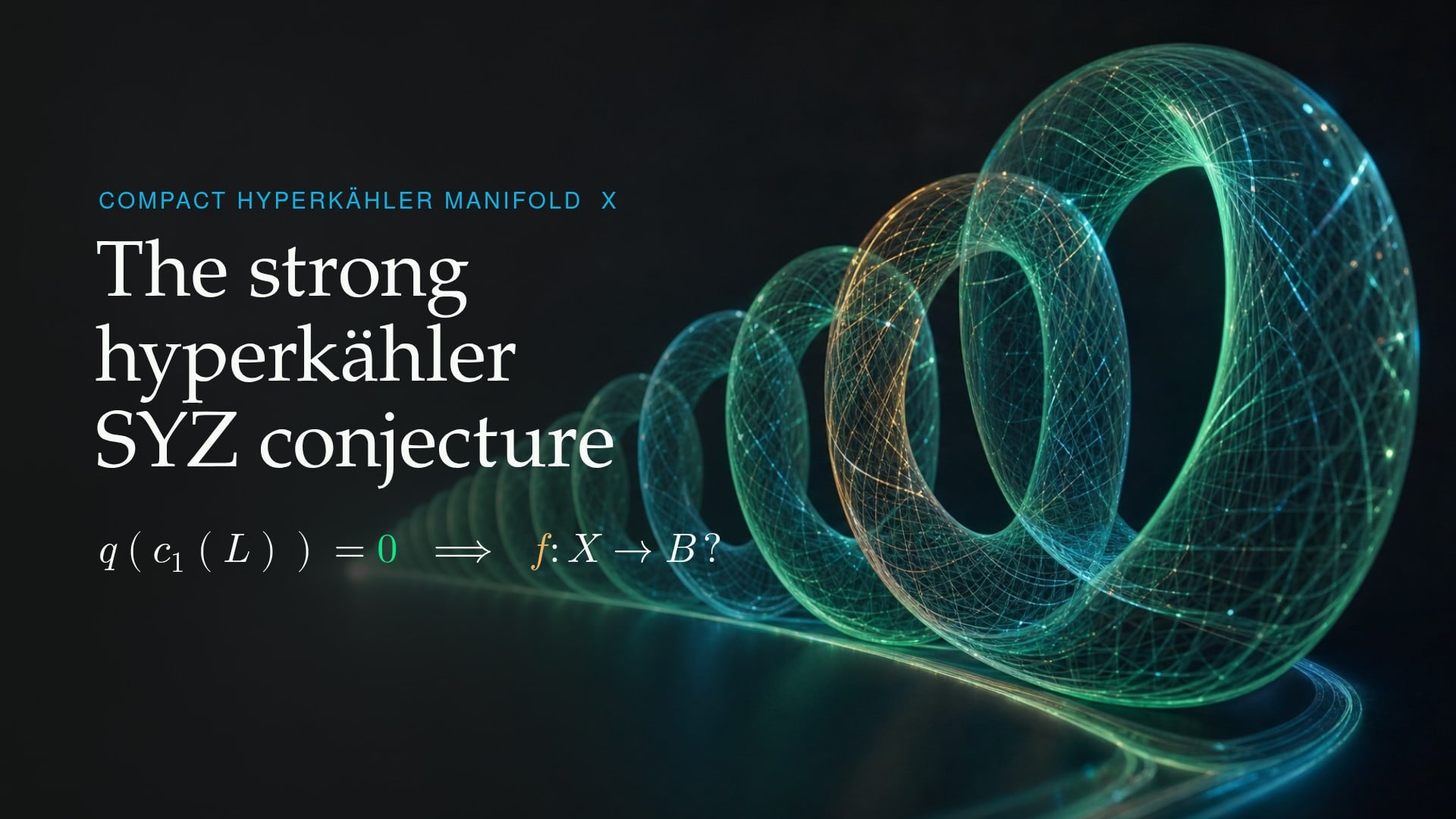
- The random model is stick-breaking with independent uniform Uᵢ, where Bⱼ = (∏ᵢ<ⱼ Uᵢ)(1 − Uⱼ). Sorting the pieces gives PD(1). The theorem says (V₁(p), …, V_k(p)) converges to that law in every finite joint distribution. This proves the conjecture of Ford, Konyagin and Luca. [1:21]
- The largest piece follows Dickman's law. P(L₁ ≤ 1/2) = ρ(2) = 1 − log 2 ≈ 0.31, which is Granville's conjecture for shifted primes.
- Practice case: 4002 = 2 · 3 · 23 · 29 gives V₁ ≈ 0.41 and V₂ ≈ 0.38. [2:06]
Which stage supplies what
- One-sided marked Type II estimate [2:29]: only the predecessor mn − 1 carries marks. A prime m can be replaced by a rough integer weighted by 1/(V(W) log m), with a saving of any fixed power of log x.
- After Cauchy's inequality, the step reduces to bmn − ars = b − a = det(P, Q)/D. That is a small determinant of two long lattice vectors. [3:10]
- Memory expansion [3:51]: at each prime p, a given projective line has probability 1/(p + 1). The memory carries that line across the gaps between the prime's active runs, so the prime's probability is charged only once.
- Two-sided estimate + extraction [4:27]: together with the one-sided estimate, this gives interior factorial moments, μ_{x,d} → ∏ dtᵢ/tᵢ, on compact pieces of the open simplex.
- Size-biased sampling [4:53]: interior moments alone cannot stop mass from escaping to the boundary. Drawing factors in proportion to their mass gives a density of total mass one, and setting U = 1 − A turns the draws into the stick fragments.
Use it
When you meet a claim about large prime factors of p − 1, turn it into a claim about the pieces of a broken unit stick and test it against PD(1). [5:26] Still open: the recursive independence that the Ford–Konyagin–Luca model of Pratt trees needs for its deeper generations.