Recursos
Resumen
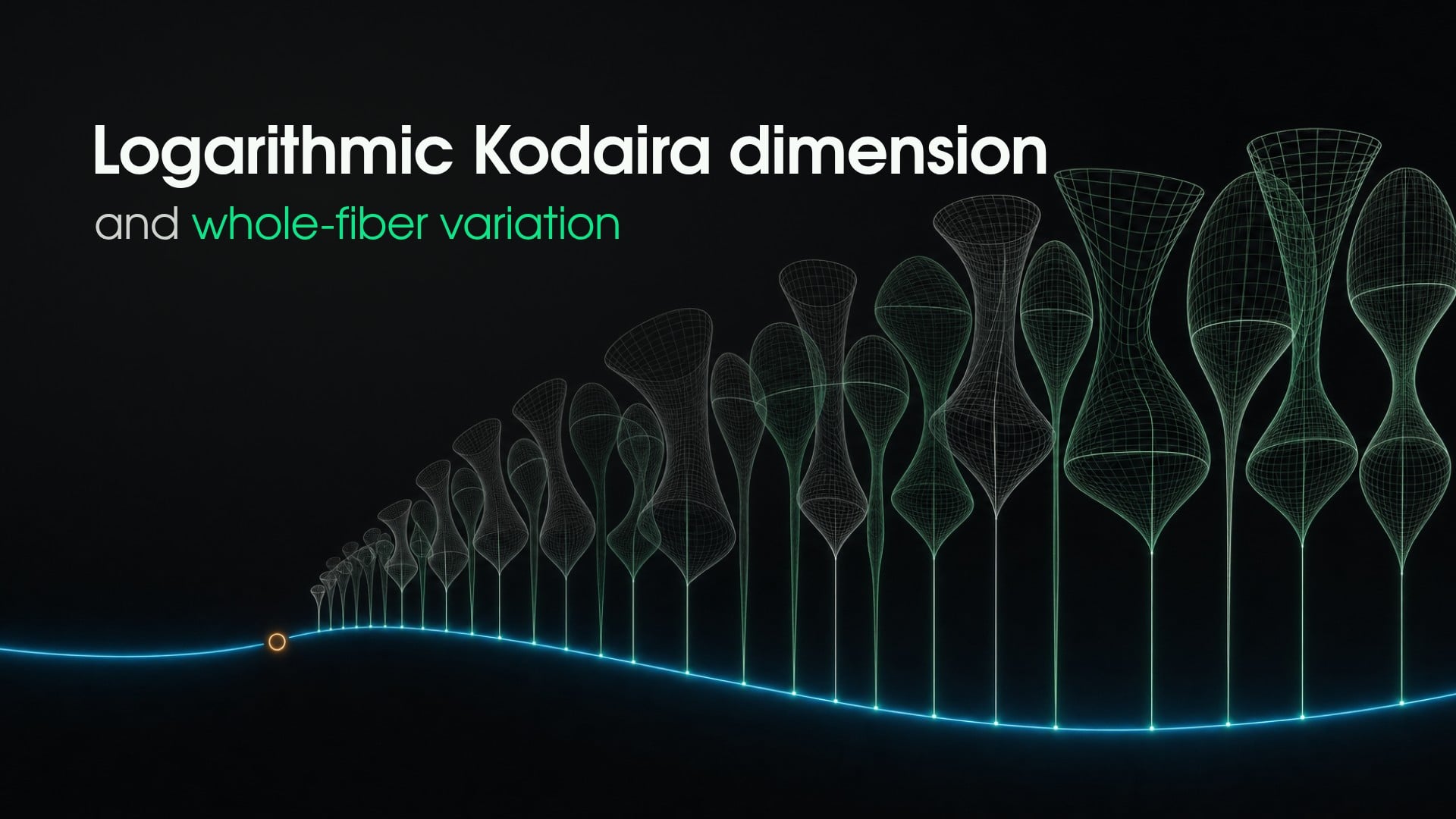
Take a fibration over a curve, read off its multiple fibers and boundary coefficients, and work out what Campana's orbifold subadditivity guarantees for κ(X, K_X + Δ). That guarantee often holds even when ordinary Iitaka subadditivity gives you nothing.
Why the ordinary inequality fails
Iitaka's problem asks whether κ(X) ≥ κ(F) + κ(Y) [0:17]. When the base has κ(Y) = −∞, the right side collapses and the inequality says nothing [0:31]. The information that goes missing sits in the multiple fibers [0:44].
The orbifold base, step by step
- Over each prime divisor D of the base, read the order of every fiber component E that dominates D, and scale it by m_Δ(E) = 1/(1 − Δ_E) [0:51]. A coefficient of ½ doubles it. A coefficient of 1 makes it infinite.
- Take the minimum (Campana's inf multiplicity), not the gcd. For a fiber 2E₁ + 3E₂ you get m = 2.
- Set B(f,Δ) = Σ (1 − 1/m) D [1:27].
- Theorem 1.1 (Fujiki class C, rational SNC Δ, coefficients allowed to equal one): κ(X, K_X+Δ) ≥ κ(F, K_F+Δ_F) + κ(f|Δ) [1:40]. Over a curve the model is already neat, so κ(f|Δ) = κ(Y, K_Y + B).
Worked case [2:27]: elliptic fibers over ℙ¹ with multiple fibers of multiplicity 2, 3 and 7. The degree of K + B is −2 + ½ + ⅔ + 6/7 = 1/42 > 0, so κ(X) ≥ 1. The ordinary bound gave 0 + (−∞). With only two double fibers the degree is −1, and you gain nothing.
Consequences and the proof idea
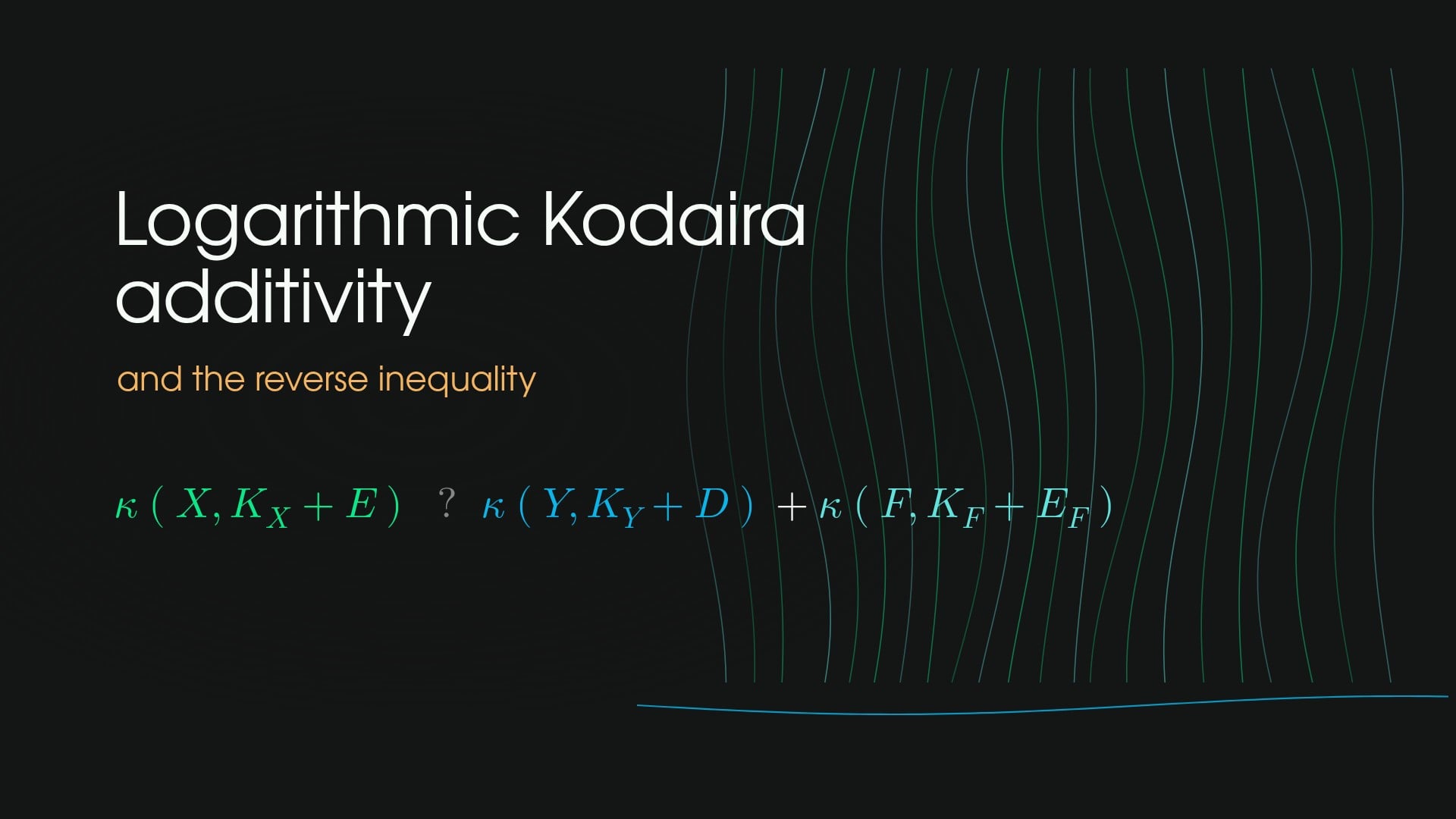
Reduced boundaries give logarithmic subadditivity, and empty boundaries give the ordinary inequality [3:48]. The proof [4:15] uses a relative Iitaka reduction X → W → Y whose fibers have κ = 0. Those fibers produce a Hodge line M on W. Adjoint positivity writes M = p*P with K_S + aP big. Log-general-type addition then delivers k + κ(f|Δ).
Before you quote subadditivity for a fibration of your own, compute its orbifold base first [5:35].