Recursos
Resumen
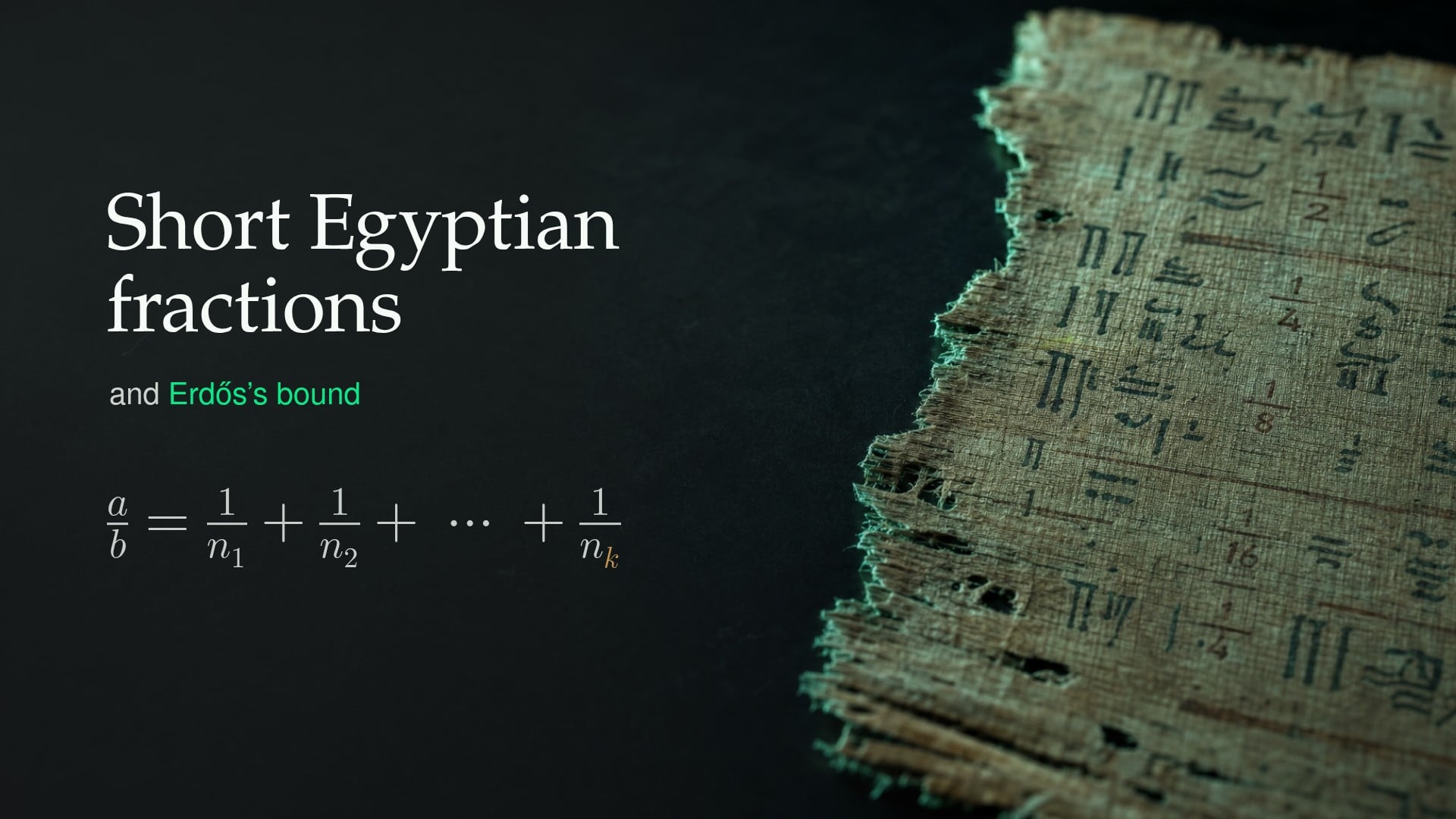
Take a fraction over a divisor-rich integer M and cut it short: pick the divisor whose residue is smallest, peel off one unit fraction, and repeat. That one move is the engine behind the proof that every a/b is a sum of O(log log b) distinct unit fractions.
The divisor step [0:57]
For a divisor t of M, set z = ⌈Qt/u⌉ and h = uz − Qt. Then
u/(MQ) = 1/((M/t)z) + (1/z)·h/(MQ).
One unit fraction pays for replacing u by h, and h is the residue of −Qt modulo u. A smaller residue means a bigger step down.
- Worked case [1:41]: for 97/360, t = 120 leaves 74, which is a poor choice. t = 90 leaves 7, then t = 6 leaves 1. So 97/360 = 1/4 + 1/60 + 1/360.
- Think first [2:19]: for 53/360, t = 45 leaves 8, and 8 divides 360. So 53/360 = 1/8 + 1/45. Note that t = 360 (z = 7) leaves 11, which beats the closer t = 40. Judge a divisor by its residue, not by how close it is to u.
Why the descent stays short [2:44]
M is built from products of primes. Exponential-sum bounds show that the residues of its divisors spread out, so some residue lands far below u. Each step drops the numerator into the next range. With S = log b there are O(log S) = O(log log b) ranges, plus O(log S) greedy steps at the start.
Keeping exceptions under control [3:23]
Some numerators have no good divisor. Every predecessor u of a residue h divides Qt + h, so a uniform moment bound on the divisor count d_X, combined with Hölder's inequality, turns a bad proportion δ into δ^(1−1/r). The recurrence δ_j ≤ ε + A·δ_{j+1}^α, with r fixed before S grows, keeps the proportions tiny at every level. To cover every numerator, the paper splits a multiple gAM into two good numerators and divides by g [4:14]. The same bound gives log log F(k) ≍ k and log log v(k) = Θ(k).
Try it: take any fraction over 720 and list the residue of each divisor. Then read Section 4 of the paper to see how one M works at every level at once.