Recursos
Resumen
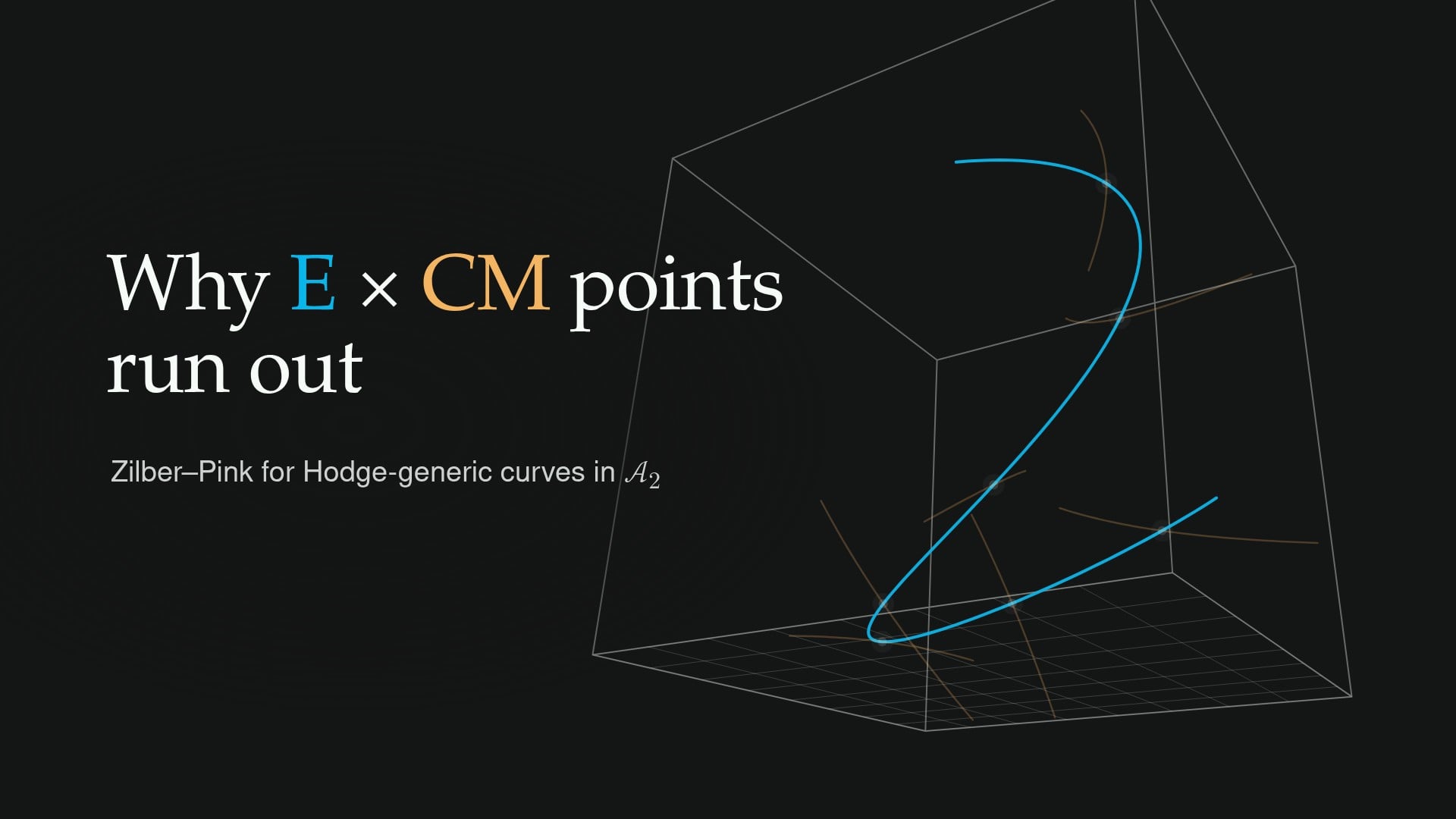
Take one mixed point on a Hodge-generic curve in 𝒜₂ and explain why its Galois orbit has to be large. The reason is a race between two exponents in the gluing integer n, and the winner is what makes the E × CM points finite with no assumption about the boundary.
The setup and the strategy
- 𝒜₂ has dimension 3, so a curve meeting an E × CM curve has expected dimension 1 + 1 − 3 = −1. Every meeting point is unlikely [0:09].
- Pila–Zannier: a subpolynomial point count, set against orbits that grow like a power of the complexity, leaves only finitely many points. Daw–Orr proved this implication for these points with no boundary hypothesis. So the whole job is #(Gal·s) ≥ c·𝔠(s)^{1/42} [0:58].
The two arithmetic inputs
- Gluing: A is a quotient of E × F (E non-CM, F CM) by the graph of θ : F[n] → E[n], with degree n². Complexity: 𝔠(s) = max{n², D} [1:31].
- Degeneration length: at a place where E is a Tate curve, ℓ(A) = log|j_E|/n. The 1/n works like a gear ratio. Inside the height machine, the h(j_E)/n term gets absorbed for large n, leaving the linear bound h(j_E) ≪ n(1+√D) [2:07].
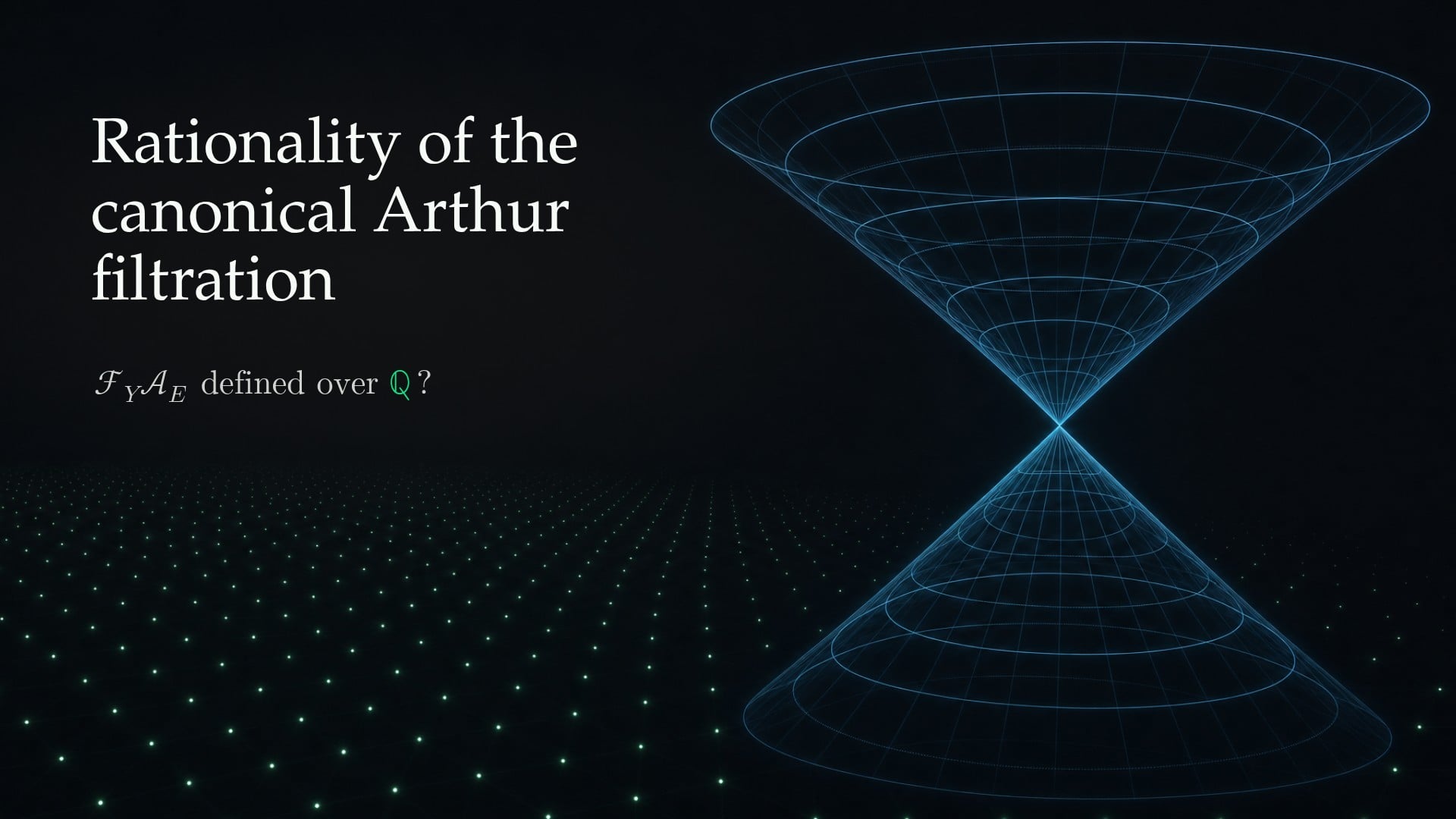
- Essential period: B = (E² × F)/Γ carries ω = (be₁, be₂, f)/n, which contains both periods of E. Weighting by u ≈ y² and v ≈ y and then applying Gaudron–Rémond gives the factor n^{4/3} [3:14].
Who wins the race
n^{4/3} ≪ n·d⁷ gives n ≪ d²¹. Then 𝔠(s) ≪ d⁴², and since d ≪ #orbit, #(Gal·s) ≫ 𝔠(s)^{1/42} [4:14]. If the exponent had been 1, the inequality would be empty. The extra 1/3 becomes the Galois power [4:42]. Daw–Orr then gives finitely many mixed points, and André–Oort (Pila–Tsimerman) covers the case where both factors are CM [5:01].
Rule to reuse: in an unlikely-intersection proof, look for one bound that is linear in the complexity and another with a larger exponent. Turn the gap into a power lower bound for the Galois orbit.
Why E × CM points run out: the exponent race behind Zilber–Pink for curves in A2

Clase 39 / 100