Recursos
Resumen
You can take any candidate limit of sextic torus packets in SL6(Z)\SL6(R), name the step of the proof that rules it out, and say why that step works. That step is the cusp, entropy or root activity.
The setting [0:08]
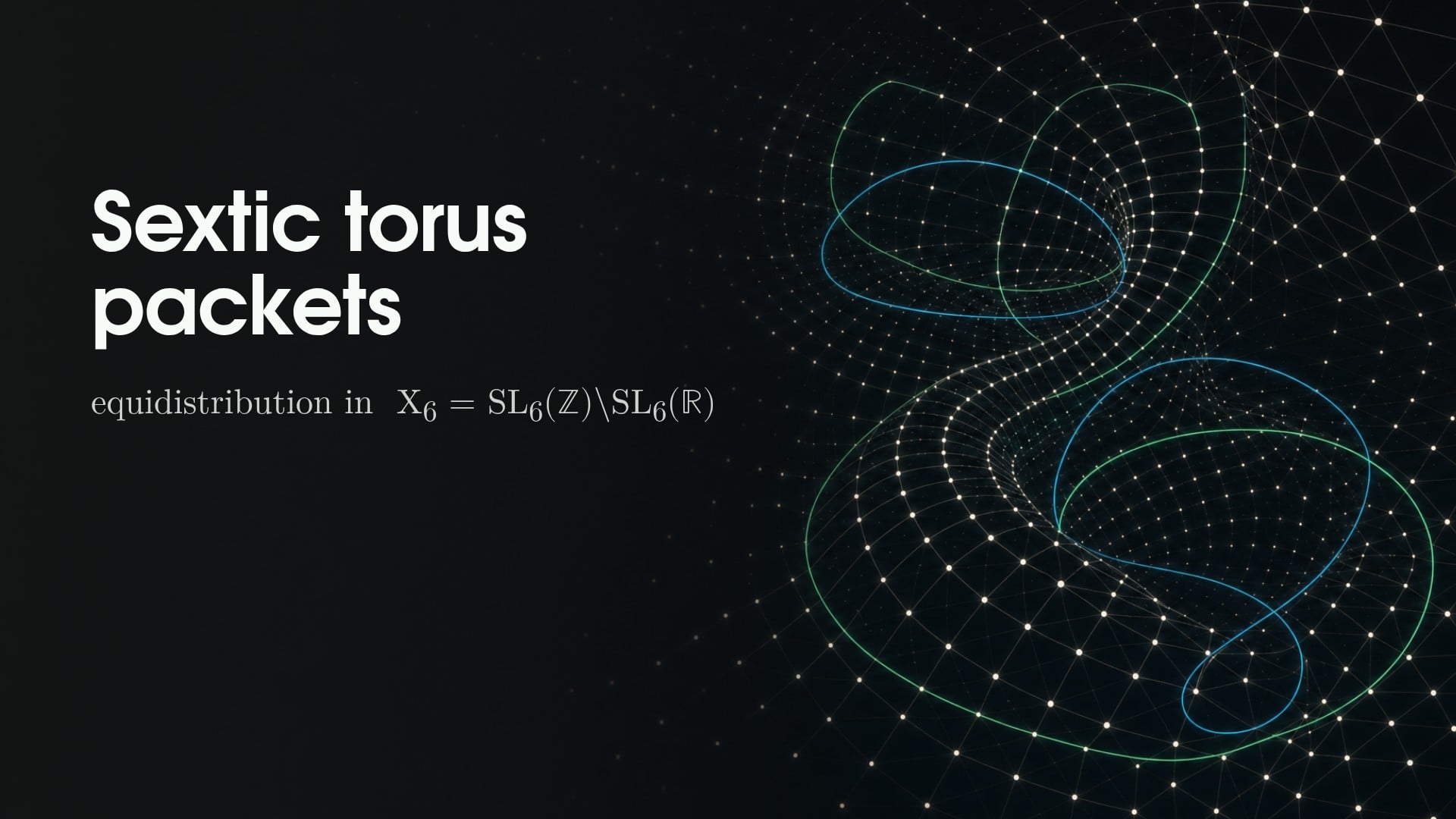
Each ideal of a totally real sextic field becomes a covolume-one lattice in six-space. The positive diagonal group A6 moves that lattice along a compact orbit, and the orbit is compact because of the units. Take one orbit for every ideal class and every sign translate, then weight each orbit by its volume. That gives the packet measure. The theorem says that for primitive fields, as the discriminant tends to infinity, these measures converge to Haar probability with no escape of mass.
Why six is harder than a prime [0:48]
Einsiedler–Katok–Lindenstrauss turn positive entropy into homogeneity, meaning a closed orbit of a block-diagonal group with equal blocks. In prime degree the only options are A itself or the whole group, so the answer is Haar. In degree six, 3+3 and 2+2+2 block groups also carry finite invariant measures, and primitivity alone does not exclude them.
The three gates [1:30]
- Cusp. Counting ordinary lattice vectors gives tightness, so no mass escapes.
- Entropy. The same counts bound a ball of radius r by r⁶, and A has dimension 5. So entropy is positive, which rules out the compact A-orbit.
- Root activity. A proper block orbit is fixed by an algebraic diagonal matrix. A root that crosses two blocks, such as U14, meets the fixed-point pieces in single points, so that root is inactive [2:05]. The two-sided tube bound comes from an ordinary vector times a dual vector, which gives an element of the codifferent, and primitivity separates its partial traces. This bound gives mass at most e^(−t/3) [2:49]. Conditionals at intermediate resolutions [3:38] obey a product rule, and an entropy argument then makes every root active [4:08]. That excludes every block orbit.
Practise on the 2+2+2 case [4:37]: gate 3 stops it, because a crossing root like U13 is inactive. Then use the three questions on your next composite-degree proof [5:04].