













Yo, sinceramente estoy impresionado de que Platzi, pueda crear un curso como Open Math. Considerarían agregar este problema a la lista de cursos: https://github.com/openai/math/blob/main/preprints/Critical-local-smoothing-for-the-three-dimensional-wave-equation-September-24-2026/paper.pdf La situación es que este parece ser la solución en dimensión 3, de un problema ya resuelto en dimensión 2. Pero, ese problema implica Kakeya Conjecture en Dimensión 3. La relevancia consiste en que Hong Wang, una matemática China, recibió este año la Medalla Fields (el equivalente al Premio Nobel en Matemáticas) for resolver ese mismo problema en dimension 3. Así que si un matemático, human@ hubiera resuelto este problema, seguro hubiese receibido ese tipo de galardón.
Recursos
Resumen
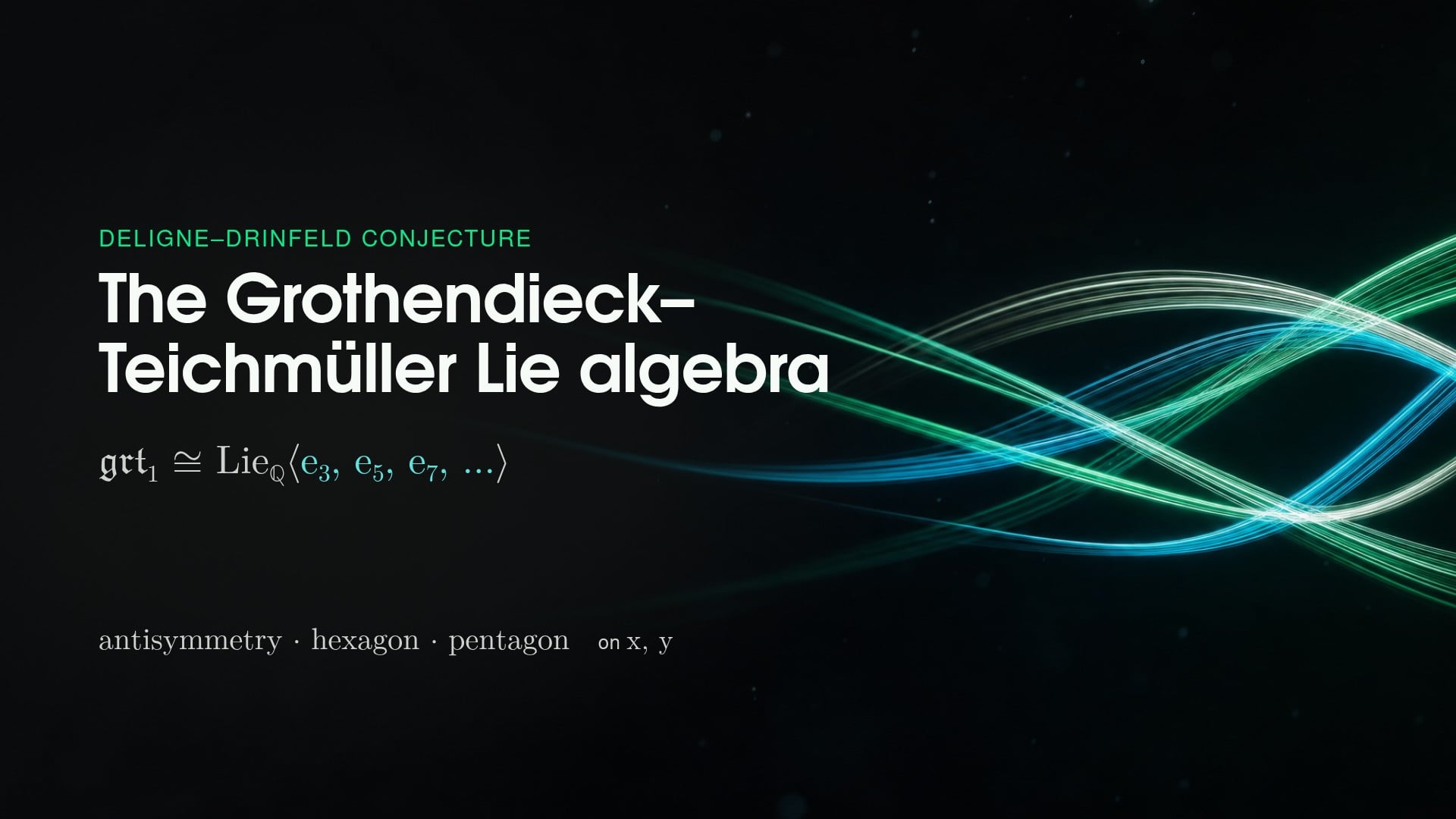
Pick any weight n and work out, with paper and pencil, how many solutions the pentagon, hexagon and antisymmetry equations can have there. The characteristic-two argument behind the Deligne–Drinfeld conjecture turns that count into a short procedure, and this class follows it one step at a time.
The squeeze
The rational solutions form a graded space W ⊂ Lie_ℚ⟨x, y⟩. Brown's motivic work gives a free Lie algebra of solutions from below, with one generator in each odd weight ≥ 3. The new part is the upper bound dim W_n ≤ d_n, where d_n is the weight-n dimension of that same free Lie algebra. Once both bounds hold, nothing else fits [1:05].
The chain, step by step
- Reduce mod 2 without losing dimension. The saturated ℤ₍₂₎-lattice of solutions has a reduction of the same dimension [1:40].
- New letters: A = x², C = [x, y], B = y, with weights 2, 2 and 1. Over 𝔽₂, [x,[x,y]] = [A, B]. The leading words xx, xy, y form a prefix code, so every Lie polynomial of weight > 1 lives in Lie⟨A, C, B⟩.
- Filter by the number of B's, r, so that n = 2m + r. Applied to the leading part, the pentagon degenerates to a relation in the level-two cyclotomic arrangement algebra [2:37].
- Set A = 0. Deletion operators, together with a special identity proved over ℚ, show that this "shadow" is injective [3:04].
- Shift symmetry + Vandermonde. The projected part f is unchanged by B ↦ B + s(C). A Vandermonde determinant ∏(t_b − t_a) ≠ 0 then forces f into the free Lie algebra on g_k = ad_C^k B, which has weight 2k + 1 [3:47].
Counting a weight
To count a weight, list the lengths r with the same parity as n, then count the Lie words in the g_k of weight n and length r. For n = 8, only r = 2 works, giving [g₁, g₂], so d₈ = 1 [4:59]. For n = 11, you get g₅ and [g₁,[g₁,g₂]], so d₁₁ = 2. Length 2 is impossible there, because two odd weights always add up to an even number [5:37]. The other half of the proof, which builds solutions that reach the bound through holonomy, is in Sections 6–8 of the paper [6:14].
The Grothendieck–Teichmüller Lie algebra and the Deligne–Drinfeld conjecture

Clase 14 / 100
