Recursos
Resumen
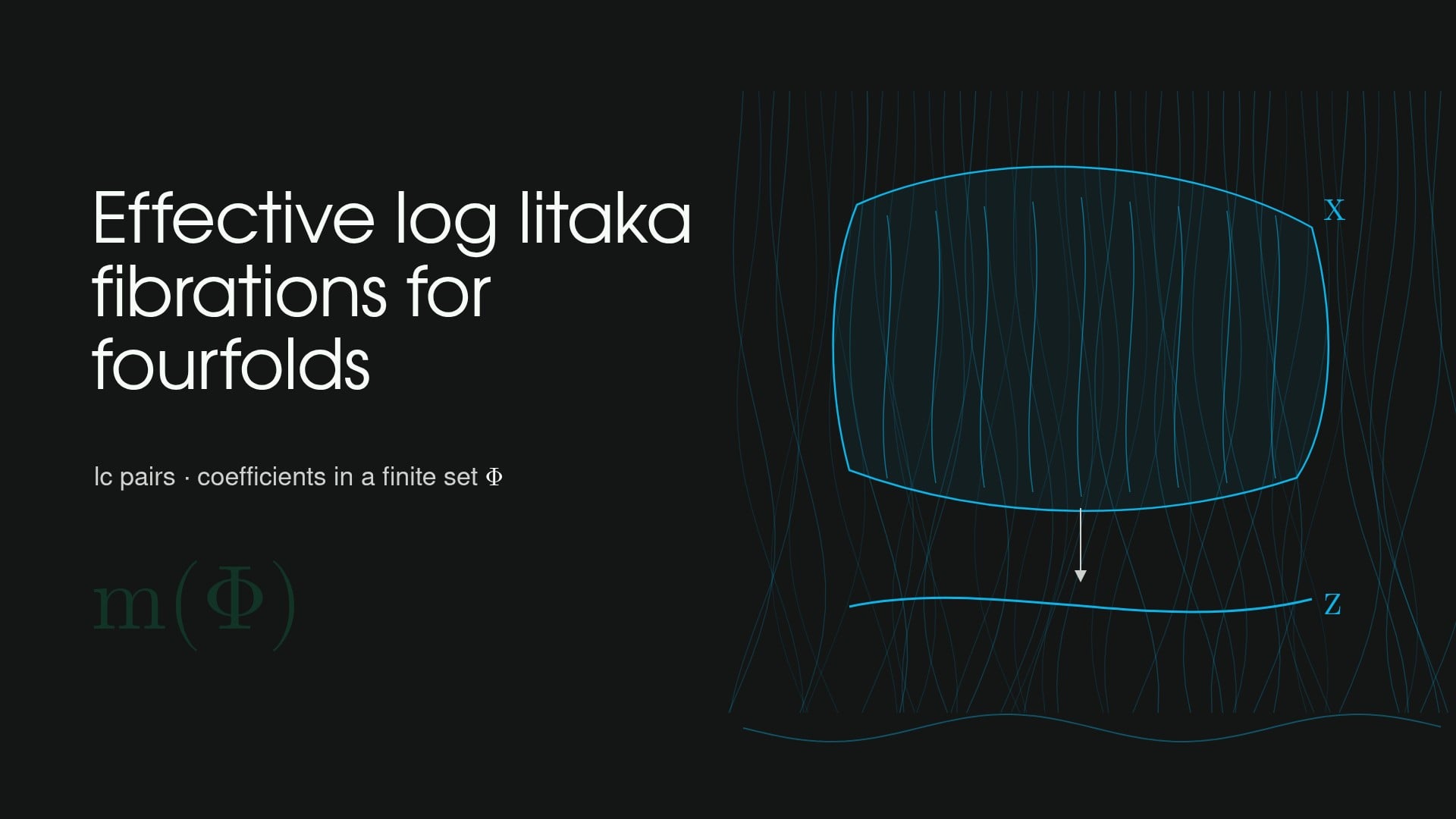
Take a family of log pairs f:(X,E)→(Y,D). You check two hypotheses, then work out κ(X, K_X+E) from the base and the very general fiber, and you say which theorem gives each bound.
The rule
- Check the two hypotheses [0:35]. First the support condition: Supp(f*D) ⊆ Supp(E). Then stratum smoothness: over V = Y ∖ D, X and every stratum of E are smooth. Horizontal boundary is allowed, and nothing is assumed over D.
- Logarithmic subadditivity gives the lower bound ≥. It doesn't need stratum smoothness.
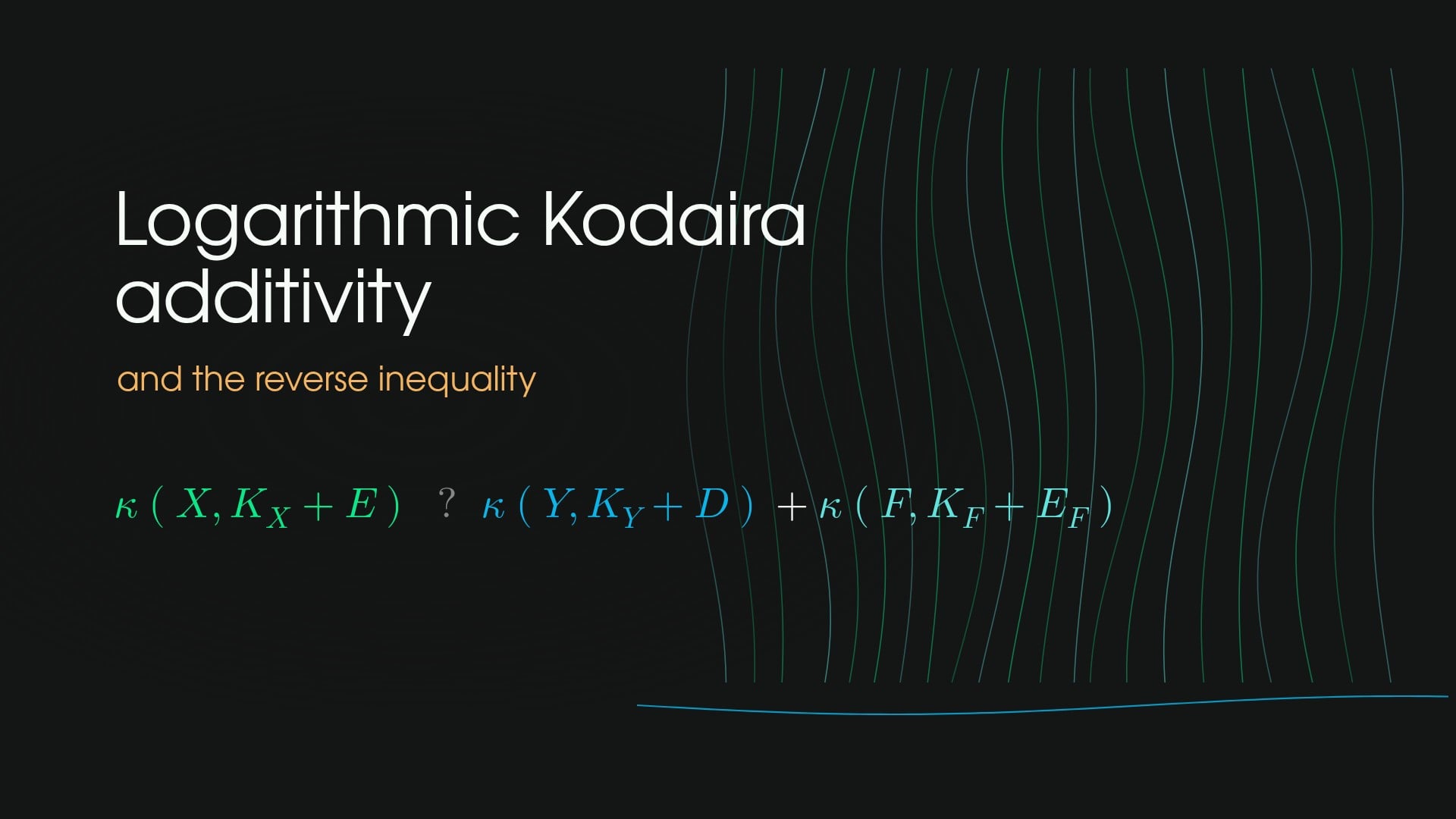
- The reverse inequality [1:00] gives the upper bound: κ(X, K_X+E) ≤ κ(Y, K_Y+D) + κ(F, K_F+E_F). If either term on the right is −∞, then H⁰(X, m(K_X+E)) = 0 for every m > 0.
- Put the two bounds together and you get additivity, an equality. This answers Popa's conjecture in the projective, reduced-SNC, stratum-smooth setting.
Reading cases
- Worked case [1:39]: base 1 and fiber 0 give ≥ 1 and ≤ 1, so the total is exactly 1.
- Your case [1:55]: base −∞ and fiber 2 give −∞. Here the lower bound holds automatically, so all the information comes from the vanishing in the reverse inequality.
- Non-example: one fiber over V gets a node. Subadditivity still holds, but the upper bound is lost.
Why the upper bound holds
- The hard case is a base with κ = 0 [2:39]. Pick a very general point y. If a total-space pluriform vanished on X_y, you could build a base pluriform τ with τ(y) = 0, which is a contradiction. So restriction to the fiber is injective.
- The technique [3:10]: take an m-th root of s on a cyclic cover and project to a pure weight quotient. This gives a highest Hodge vector u. Its coefficients and those of its Higgs iterates are kept in the frames of Ω¹_Y(log D), so no new poles appear and the zero survives.
- There are two outcomes [3:53]. If S is a point, the coordinates of u are actual base pluriforms. If dim S > 0, period positivity makes a divisor big after adding a pullback from S. Comparing the Higgs iterates with the period directions removes that pullback, which forces κ(Y) > 0.