Recursos
Resumen
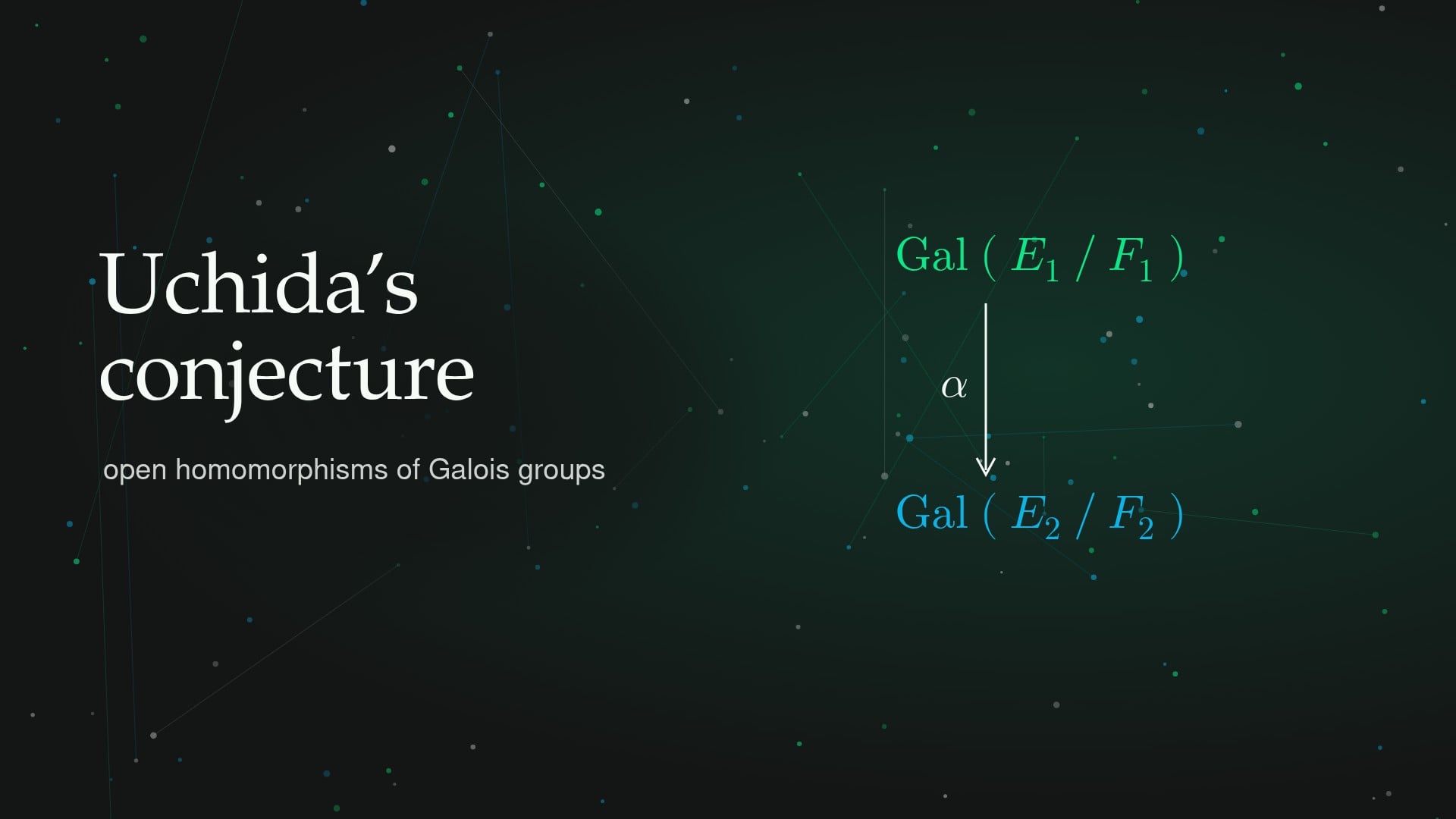
You are handed a continuous open homomorphism between Galois groups of solvably closed extensions of number fields, and you need to tell whether it comes from a field embedding. You should also be able to explain how the proof shows that it always does. The route is: derive Hoshi's cyclotomic criterion from Uchida's partial local correspondences, using one count that does not depend on the auxiliary prime ℓ.
The question and the test
- Neukirch and Uchida: an isomorphism of these Galois groups comes from a unique isomorphism of the fields. Uchida conjectured the same for open homomorphisms [0:20].
- The paper proves it with no condition on the kernel. Hoshi had reduced existence to one test: χ_{E2/F2} ∘ α = χ_{E1/F1} in Ẑ^× [0:37].
The route, step by step
- Partial local correspondence [0:54]: for each odd ℓ, every active source prime v picks a unique target prime w with φ(D_v) ⊂ D_w. This reaches all but finitely many targets, but the exceptional set moves with ℓ, and v and w need not lie over the same rational prime.
- Norm identity [1:37]: (Nv)^{b(g)} = (Nw)^{a(g)} in ℤ_ℓ^×. At a Frobenius, p = q^a.
- Frobenius detection [2:12]: log χ_ℓ∘β − log χ_{k,ℓ} is an additive ℓ-adic character. It vanishes at infinitely many degree-one primes, so it is zero. This is still not enough: the logarithm loses torsion, the result holds only for ℓ in a set 𝓛, and p ≠ q is still possible [2:45].
- Uniform Kummer bound [2:57]: missed primes give independent Kummer classes in one eigenspace of an S-unit group. So at most 2[K:ℚ] + 2 primes are missed at every ℓ, independently of ℓ.
- Separation (think-first) [3:42]: choose one ℓ where every candidate Nv mod ℓ lies outside ⟨q_j mod ℓ⟩. Then no w_j can be active there, and too many primes are missed at a single ℓ. That is a contradiction, so same-characteristic partners exist.
- Identification [4:36]: a = 1, the character pullbacks agree, the maps agree modulo every finite quotient, and compactness gives β = Ad(a)∘σ. The full χ is preserved, and Hoshi's criterion gives the unique embedding.
Rule to take away: when an argument depends on an auxiliary choice, ask what that choice may change, and look for the count it cannot move [5:12].
Uchida's conjecture: from local correspondences to Hoshi's cyclotomic test

Clase 58 / 100