Recursos
Resumen
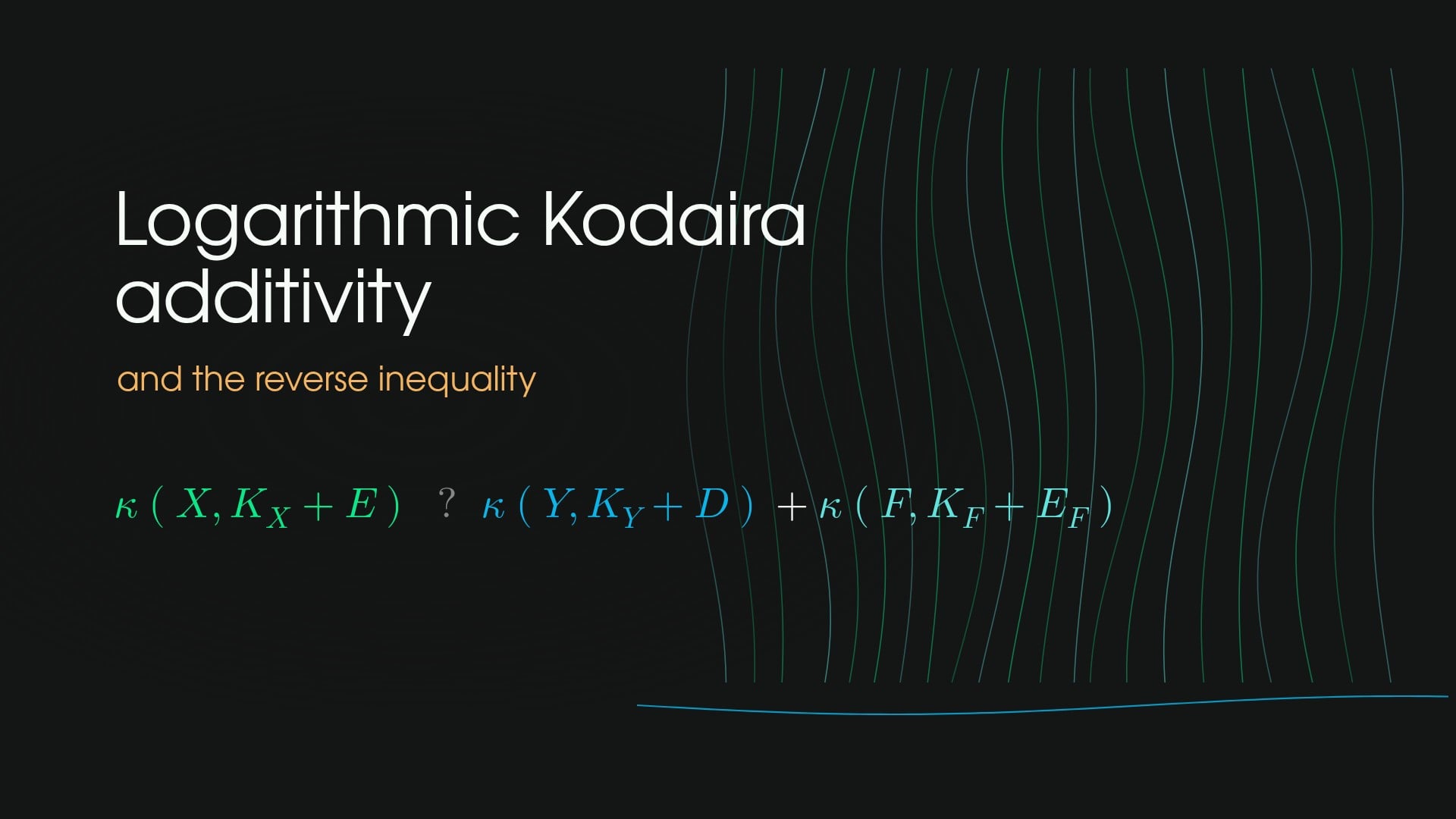
Take a fiber space whose general fiber has Kodaira dimension zero and whose canonical class dominates an ample class pulled back from the base. You can then explain why that purely numerical comparison forces real pluricanonical sections, so that κ(X) = dim Y, and point to the one curve class that makes the argument work.
The setup
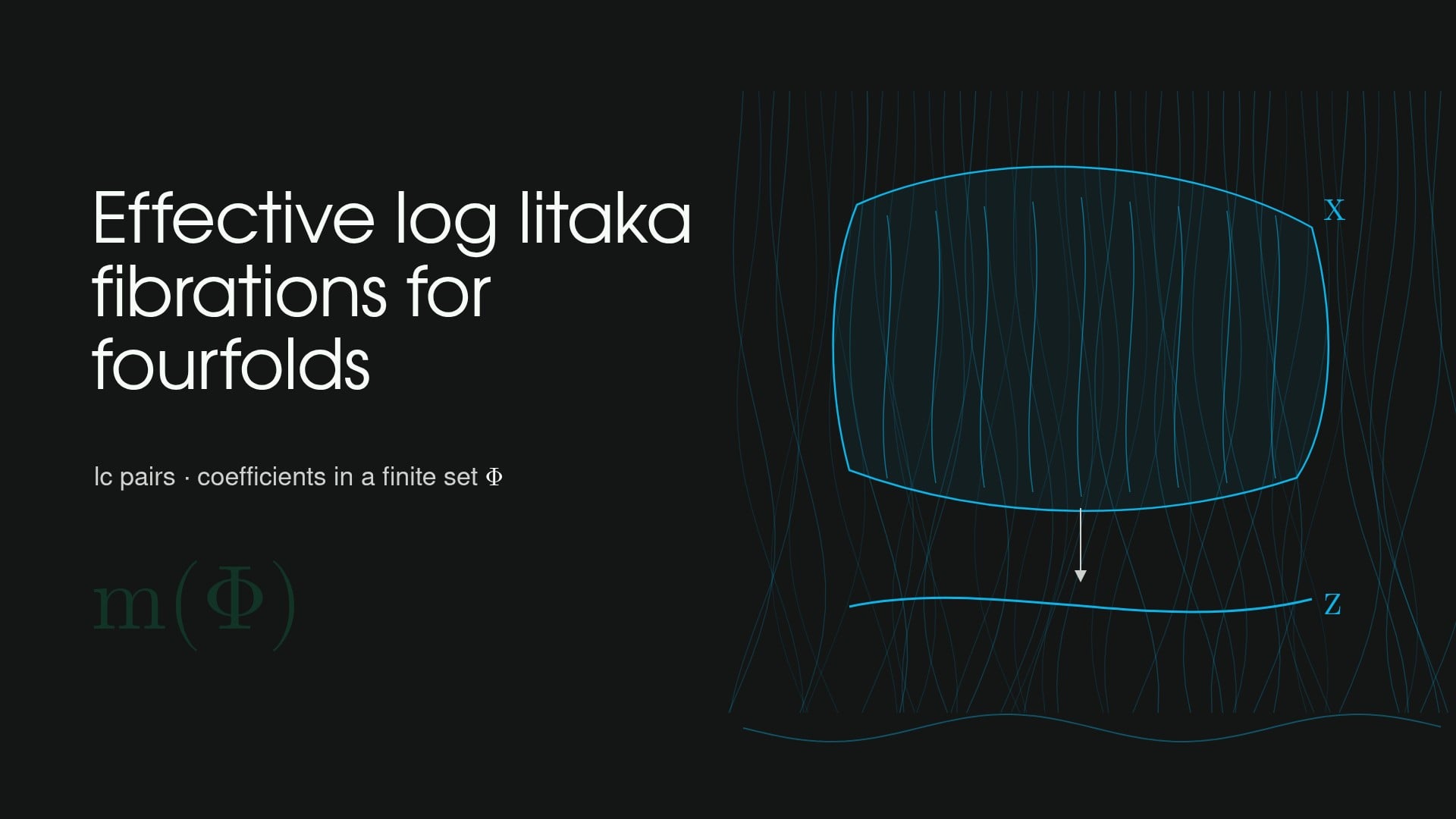
- f : X → Y is an algebraic fiber space, κ(F) = 0, and m₀K_X − f*H is pseudo-effective with H ample. Easy addition already gives κ(X) ≤ dim Y. The question is equality.
- [0:56] Pass to a good minimal model V and a common resolution W. There p*K_X = q*K_V + E, where E is effective and exceptional over V. Sections of rK_V carry over to rK_X with the same image dimension k, so κ(X) ≥ k. All that remains is to show k ≥ dim Y.
The test curve
- [1:38] Suppose k < dim Y. Build C = (q*D)^k (q*A)^{d−k−1}, with D = rK_V and A very ample, using only divisors pulled back from V.
- [2:17] What C does:
- B·C ≥ 0 for every pseudo-effective B, because every factor is globally generated;
- E·C = 0 by the projection formula, since q₊E = 0;
- q*D·C = 0, since (q*D)^{k+1} = 0;
- h*H·C > 0, because the map to Y supplies one cotangent direction beyond the k directions coming from the canonical image.
- [3:08] Non-example: an ample complete-intersection curve on W meets E positively. The error term survives and no contradiction follows.
- [3:32] Pairing the hypothesis with C gives 0 ≤ −h*H·C < 0, a contradiction. So dim Y ≤ k ≤ κ(X) ≤ dim Y.
What it unlocks
[4:13] Combined with the smooth canonical good-model theorem and Schnell's reduction, the argument gives the Campana–Peternell inequality κ(X) ≥ κ(D) and κ(X) = κ(F) + dim Y. When a numerical hypothesis has to produce sections, pass to a good model, build the test curve from the model's own divisors, and find one extra direction coming from the base.