Recursos
Resumen
Take the Satake parameter of a cusp form at an unramified place, read off its exponent λ, and decide which nilpotent-orbit summand it lies in, or recognize it as a violator that the theorem rules out.
The statement
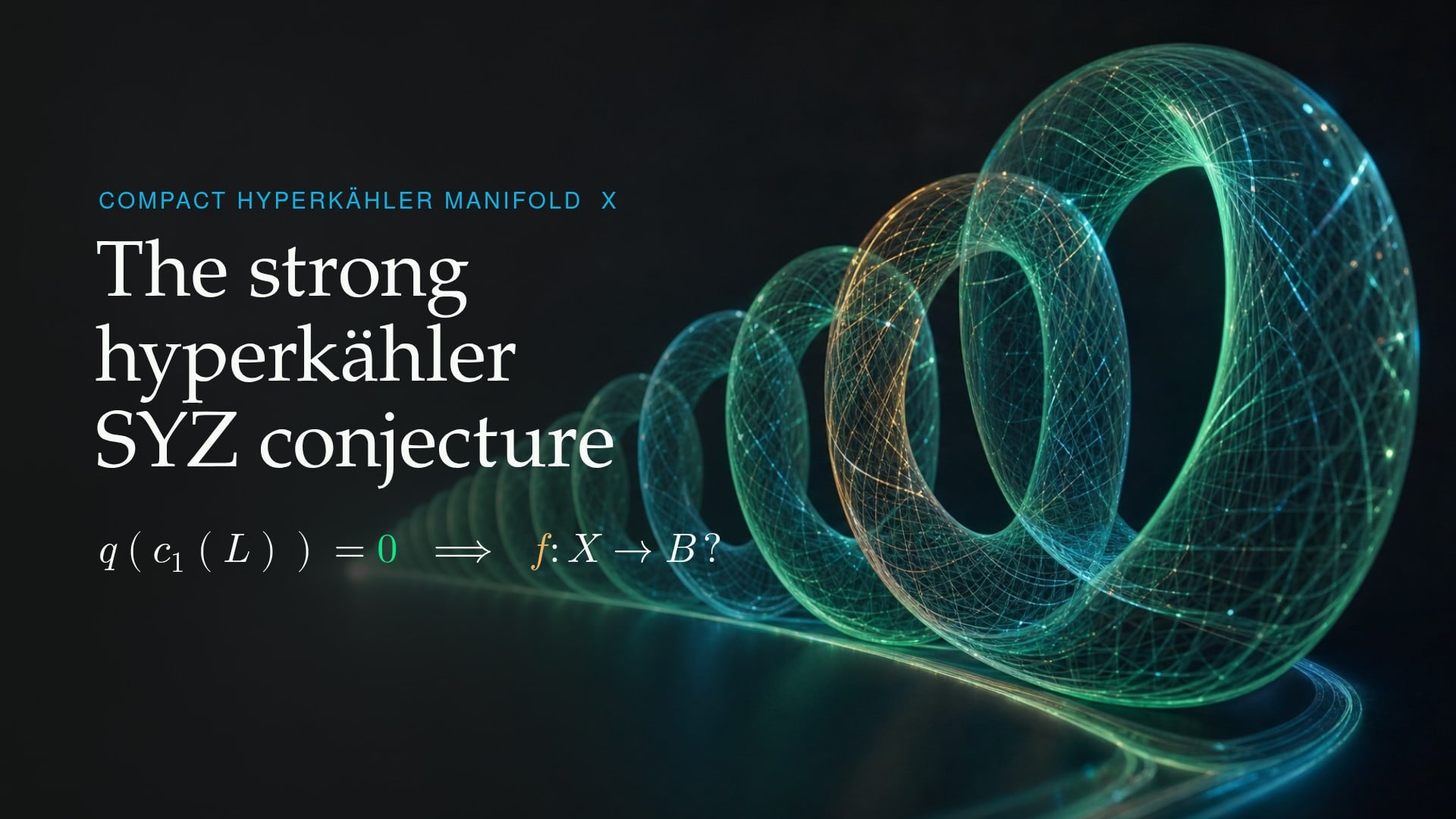
Work over a curve X over 𝔽_q with a split semisimple G and a level divisor D with arbitrary multiplicities. The cusp space C_D is a direct sum of orbit summands C_{D,O}, one for each nilpotent orbit O of the dual group, over ℚ and over Q̄_ℓ [1:11]. A function is in C_{D,O} when at every good place its Satake classes lie in R_{q_x,O} = r_O · H_O^c: a Jacobson–Morozov piece that sets the size, times a compact piece [1:44]. At D = 0 this is Gaitsgory–Lafforgue–Raskin Conjectures 3.4.5 and 3.4.6.
The rule, worked
The compact piece has absolute value one, so λ must equal h_O/2. For PGL2 (dual group SL2) the allowed values are λ = 0 (tempered) and λ = ½ (regular orbit). An entry of size q^{1/4} falls between them, so it is a violator [2:18]. For SL3 the allowed values are (0,0,0), (½,0,−½) and (1,0,−1).
Why violators cannot occur
On the top degree N of a spherical cohomological summand, Deligne's weight bound gives a floor 2d_x⟨λ,μ⟩ − C′, and derived Satake with Springer tests give a ceiling C + max d_x⟨μ,h_e⟩ [3:17]. If you take μ = mλ, the gap between the two grows like 2d_x m · min‖λ − h_e/2‖². For a violator this is positive, so the floor ends up above the ceiling [4:06]. Integrality and purity then make the orbit the same at every good place [4:42].