Recursos
Resumen
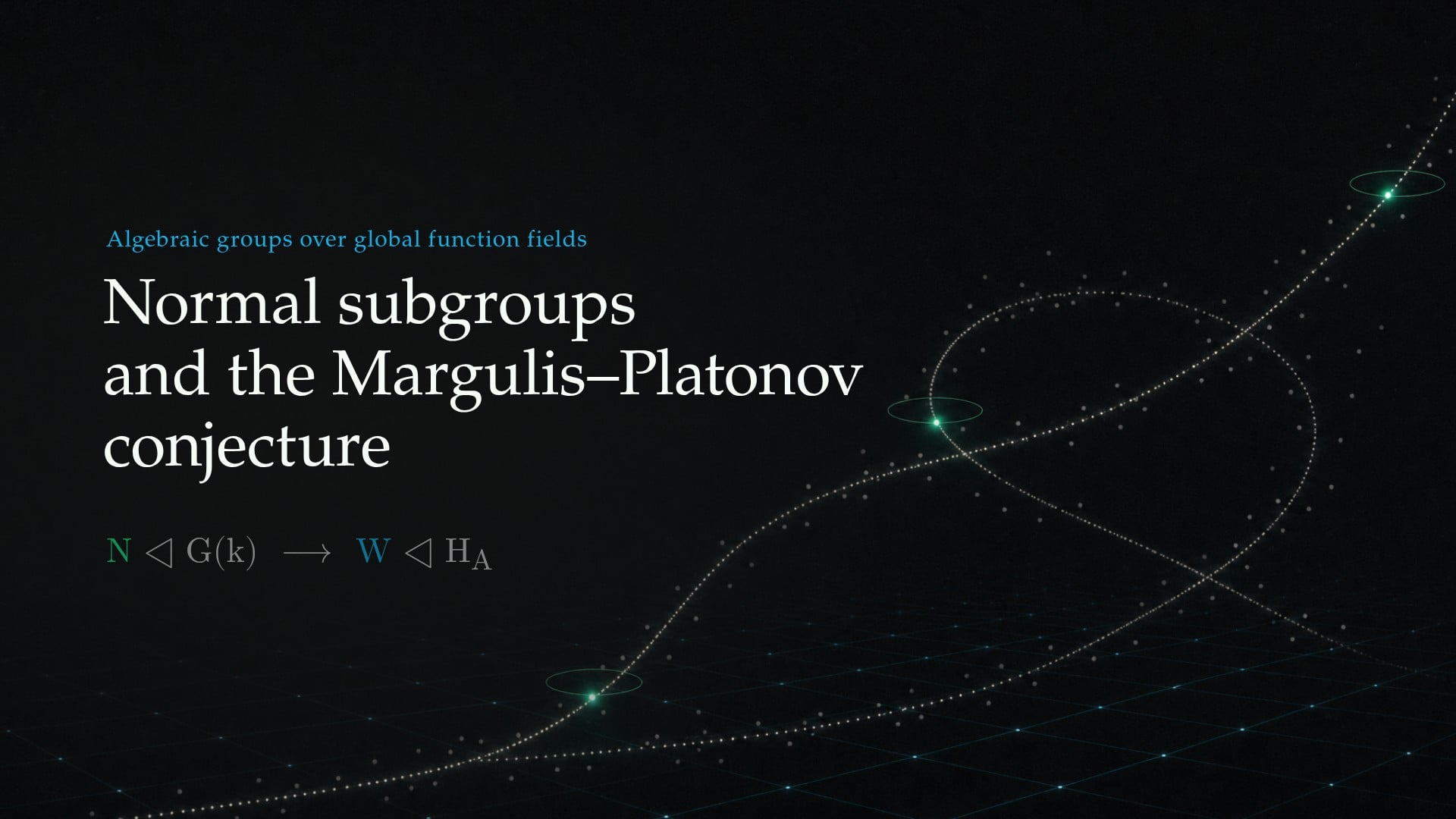
Take a Zariski-dense PGL_n local system with unipotent tame monodromy at several marked points of a curve in characteristic p > n. This class walks through how to turn it into a nonzero perverse Hecke eigensheaf on the stack of SL_n bundles with Borel level, and why each step is still nonzero at the end.
The theorem
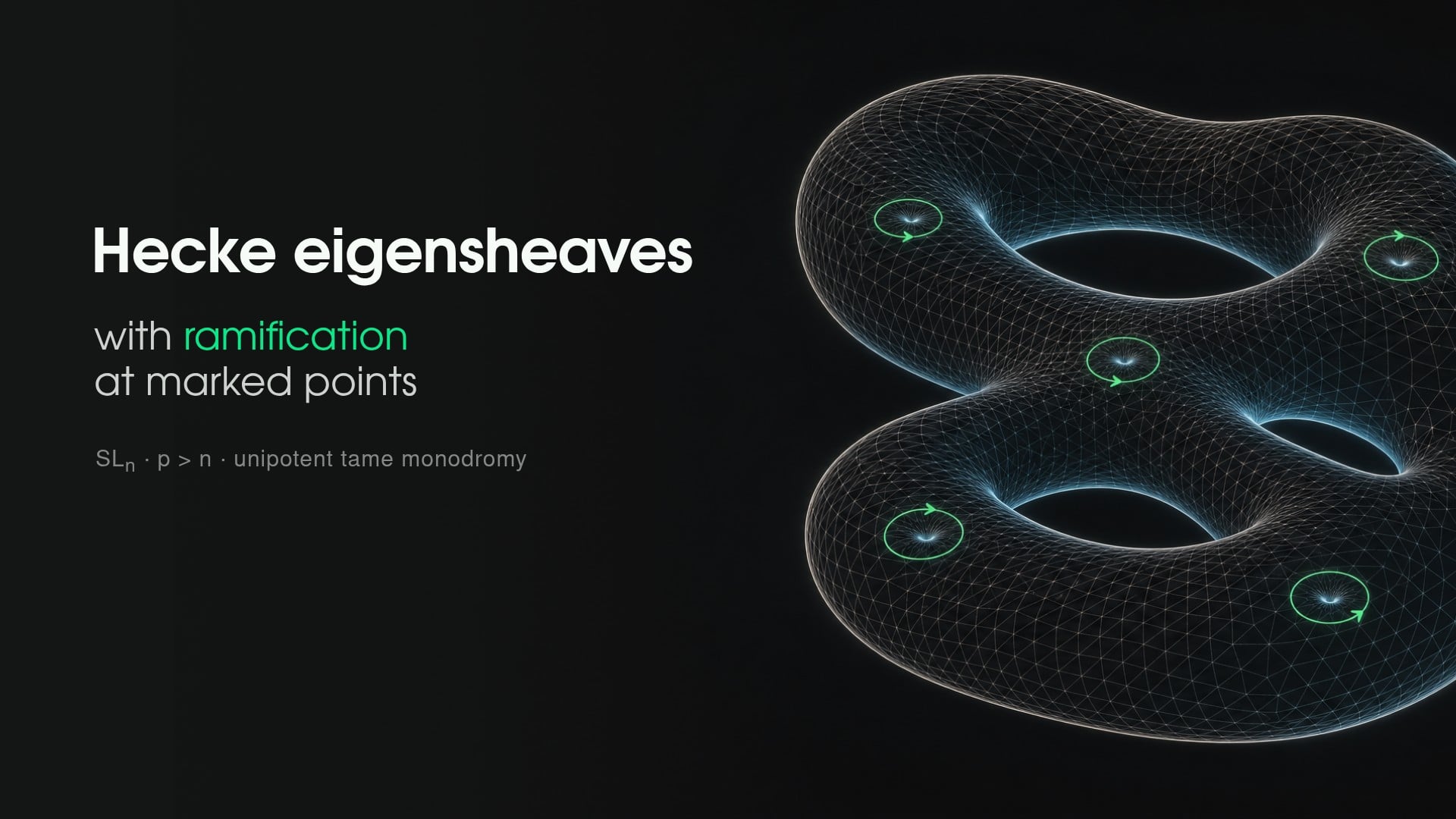
The monodromy at each puncture is recorded as level structure. The bundle stack is A = Bun_{SL_n,B,D}(X), which means bundles with a Borel reduction at every marked point [0:20]. Suppose the curve has genus ≥ 2, there are at least two marked points, p > n, the image of ρ is dense, and inertia acts by exp(t·N_i) with N_i nilpotent of any Jordan type, including 0. Then there is a nonzero, locally constructible, perverse M on A. It satisfies coherent Hecke eigen-isomorphisms and has SS(M) ⊂ Λ_D, the cone of Higgs fields that are generically nilpotent [0:40].
The two-step construction
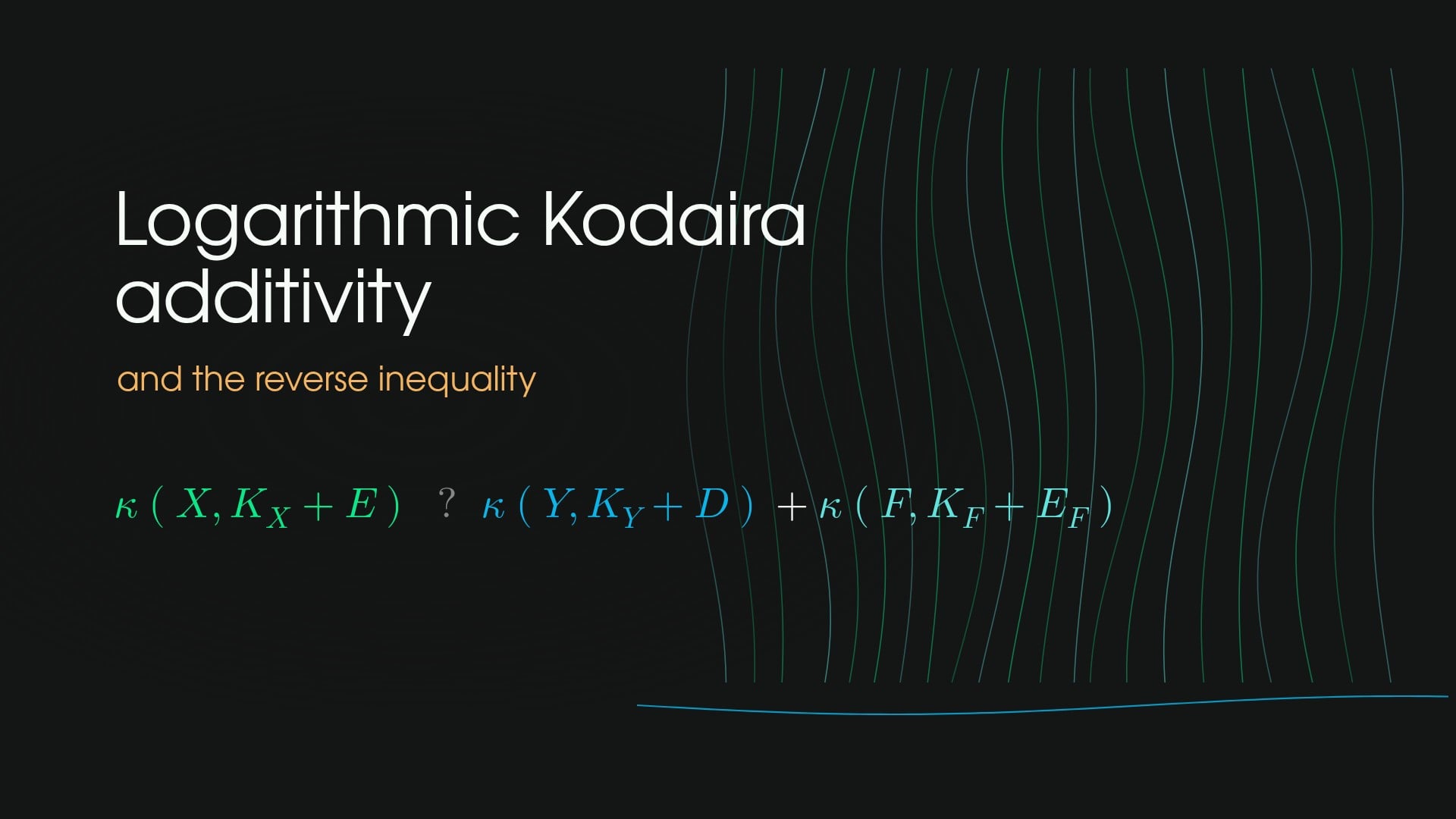
- Over ℂ [2:00]: glue two copies of the marked curve at their marked points to get a nodal curve. Reverse the orientation of the second copy so that its boundary monodromies are inverse to those of the first, at every node. Glue finite quotients using cyclic stabilizers. This gives a dense unramified parameter on the smoothing. Apply the unramified correspondence and take nearby cycles to the nodal fiber, where the stack is [(A₁⁺×A₂⁺)/T^s]. Next comes torus descent: unipotent monodromy keeps the pushforward alive. Then take perverse cohomology: density makes the Hecke functors exact [3:14].
- Over W(k) [3:56]: lift the marked curve (H²(X, T_X(−D)) = 0), extend the parameter over root stacks of ℓ-power order, run stage 1 on the generic fiber, and take nearby cycles again to get M.
Why it stays nonzero
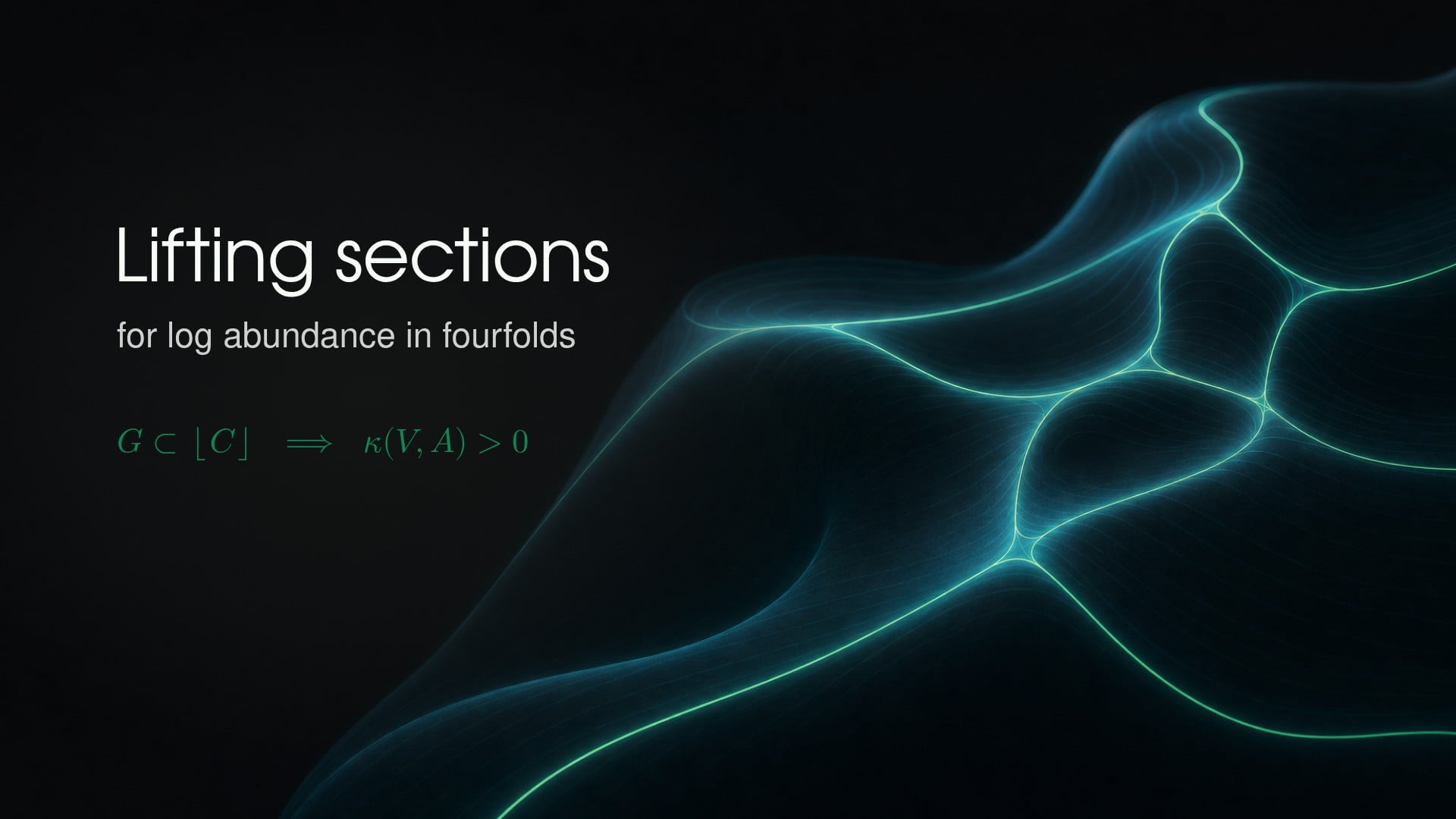
Nearby cycles of a nonzero complex can vanish. Detection (Theorem 4.2) says that if ΨF = 0, the closure of the nonzero-stalk locus misses the special fiber [4:06]. To rule this out, write a bundle with a nonzero stalk as a bounded Hecke modification of a reference bundle, and use properness to extend it over the trait. The locus then reaches the special fiber, so ΨF ≠ 0. The same local calculation over a field gives SS ⊂ Λ_D. Note that N_i = 0 does not remove the flag at x_i [5:08].
The rule to keep: trade ramification for a nodal degeneration, specialize with nearby cycles, and certify every specialization with a Hecke modification that reaches the special fiber.