Recursos
Resumen
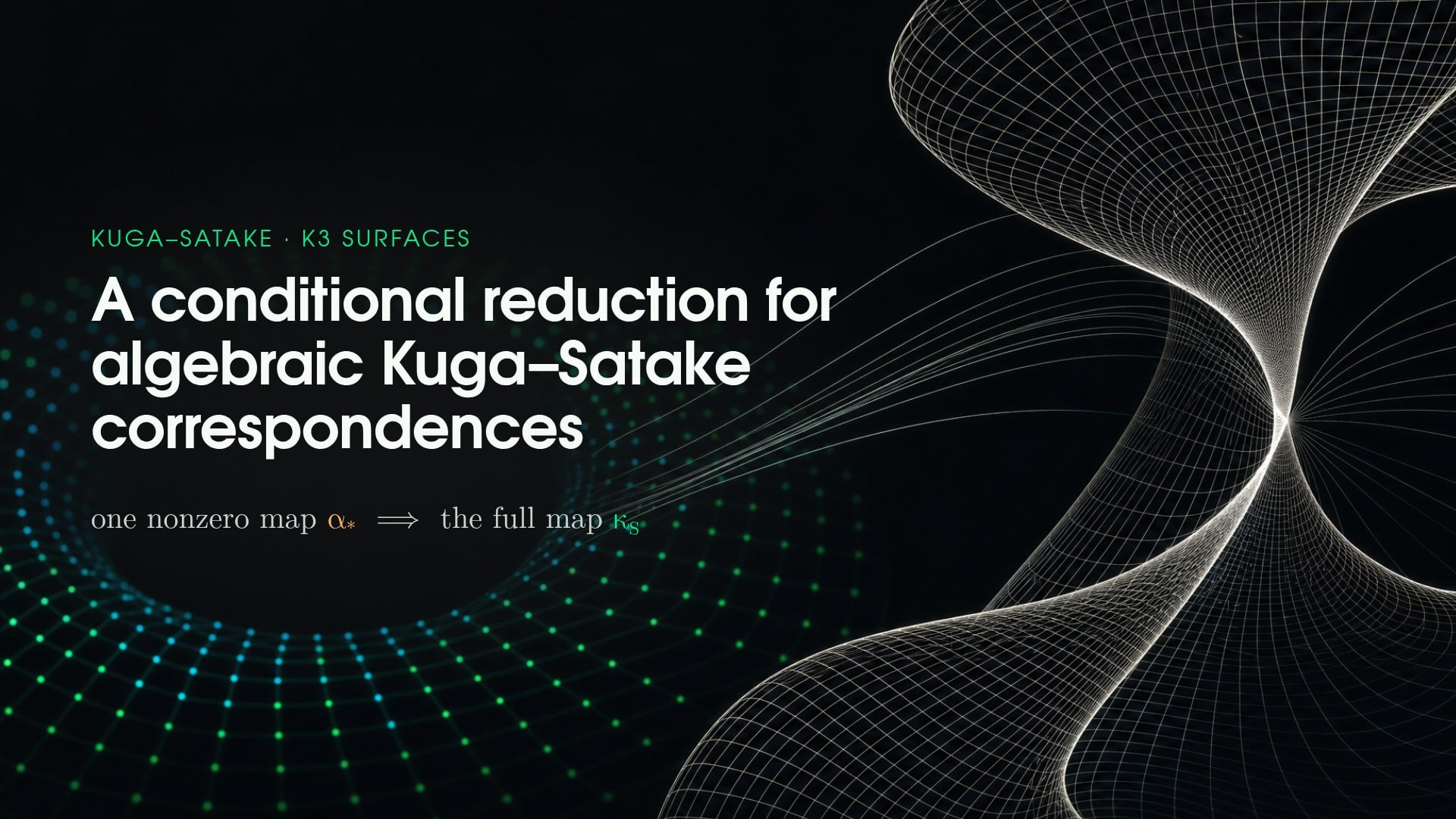
Take a diagonal complete intersection cut out by one or two equations of degree n, and trace how its Hodge conjecture on every power X^u comes down to one curve's Jacobian plus CM abelian varieties. Then predict, for any (m, c), which pieces you need.
The strategy: correspondence transfer
Proving the Hodge conjecture on X alone does not settle it for X^u, because X^u also has classes that couple different copies of X [0:06]. The way around this is a supply chain [0:35]. Start with "factories", varieties where the conjecture holds on every finite product: CM abelian varieties and products Jac(C_s) × M (Theorem 1.1). If rational algebraic correspondences from those factories span every cohomology degree of X, then the conjecture holds on every power of X.
The worked case: m = 5, c = 2
- Gale dual [1:08]: X = X_P is the set of points whose n-th powers lie in P. The orthogonal space Q = P^⊥ cuts out the dual, which here is a curve C.
- Coordinate multiplication: ([x],[y]) ↦ [x_i y_i] lands on the Fermat threefold F_n^3, because Σ x_i^n y_i^n = 0. Theorem 6.1 makes the pulled-back character line a perfect pairing. Contracting it against C gives a rational correspondence F_n^3 × C → X.
- Sort by support [1:58]: full support gives F_n^3 × C. A support missing one coordinate gives F_n^2 × (n³ points). Add hyperplane classes, and together these span H•(X).
- Make the sources CM [2:16]: Shioda–Katsura domination supplies Fermat cohomology from powers of Jac(F_n^1), which is CM. The Abel map supplies C from Jac(C). Every source then has the form Jac(C)^v × M with v ∈ {0,1}. The Fermat factor is replaced, not thrown away.
- Genericity [2:53]: C is an abelian cover of ℙ¹ with deck group (ℤ/n)^m/diagonal, branched at m points. For a very general X, C sits at a Hodge-generic point, and that locus does not depend on M.
The decision rule
With one equation [3:23], the dual has dimension m − d − 2 = 0, so it is just a finite set of points. CM sources alone are enough, and no parameter has to be excluded. With two equations and d ≥ 1, the dual is a curve, which is why the result needs "very general". In short [3:56]: find a dual that ships cohomology in by correspondences, then push every factor down to CM pieces and one generic Jacobian.