Recursos
Resumen
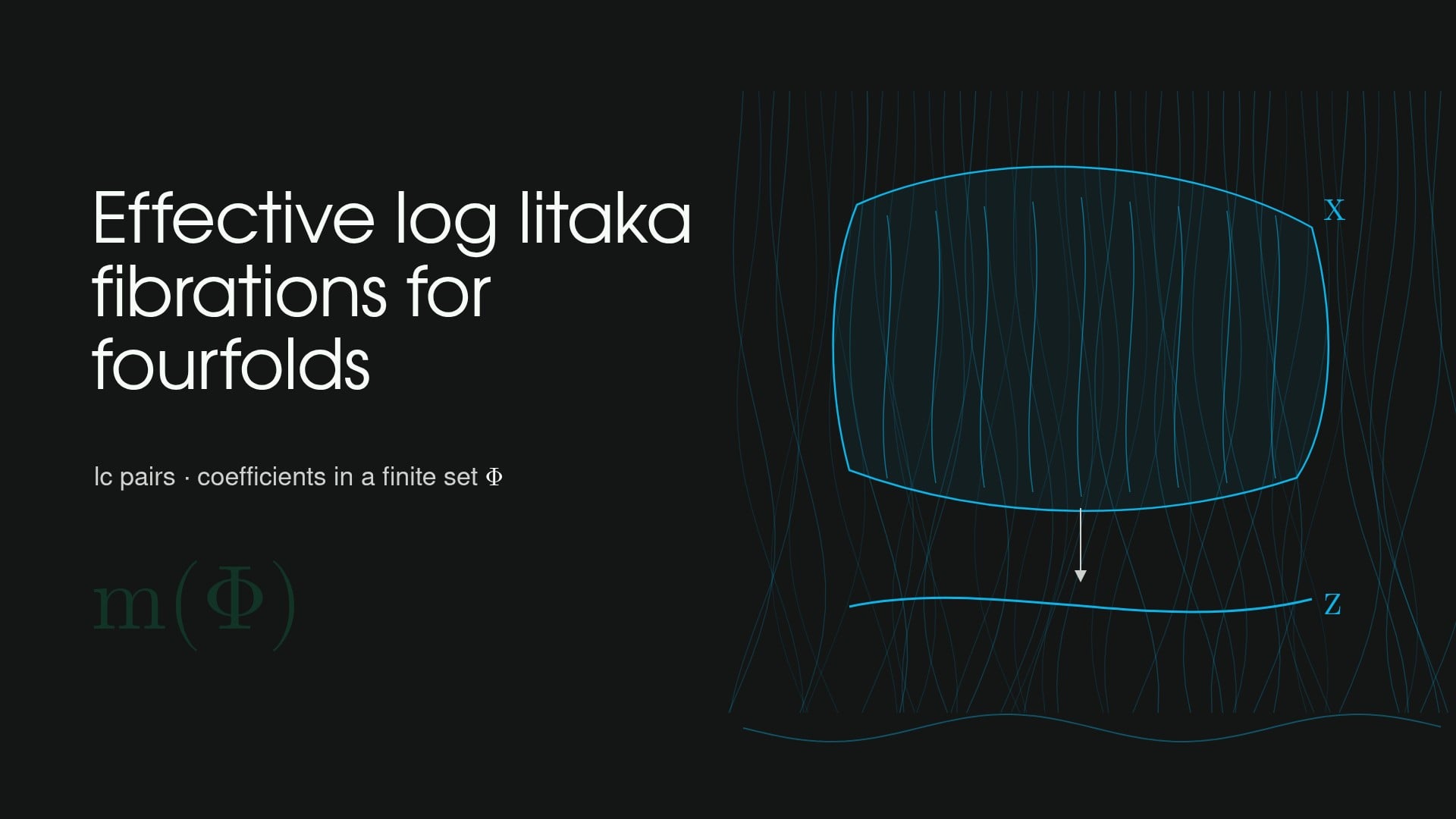
Take a fibration f : U → V over an open base with κ̄(V) ≥ 0 and its three numbers κ(F), κ̄(V) and Var(f). From them you can read off the lower bound for κ̄(U) and say which part of the proof produces it.
The inequality and its two branches
The base has to be measured logarithmically. Removing two points from ℙ¹ moves the Kodaira dimension from −∞ to κ̄(ℂ*) = 0 [0:00]. The main theorem (Popa's logarithmic variation conjecture) [0:41] says
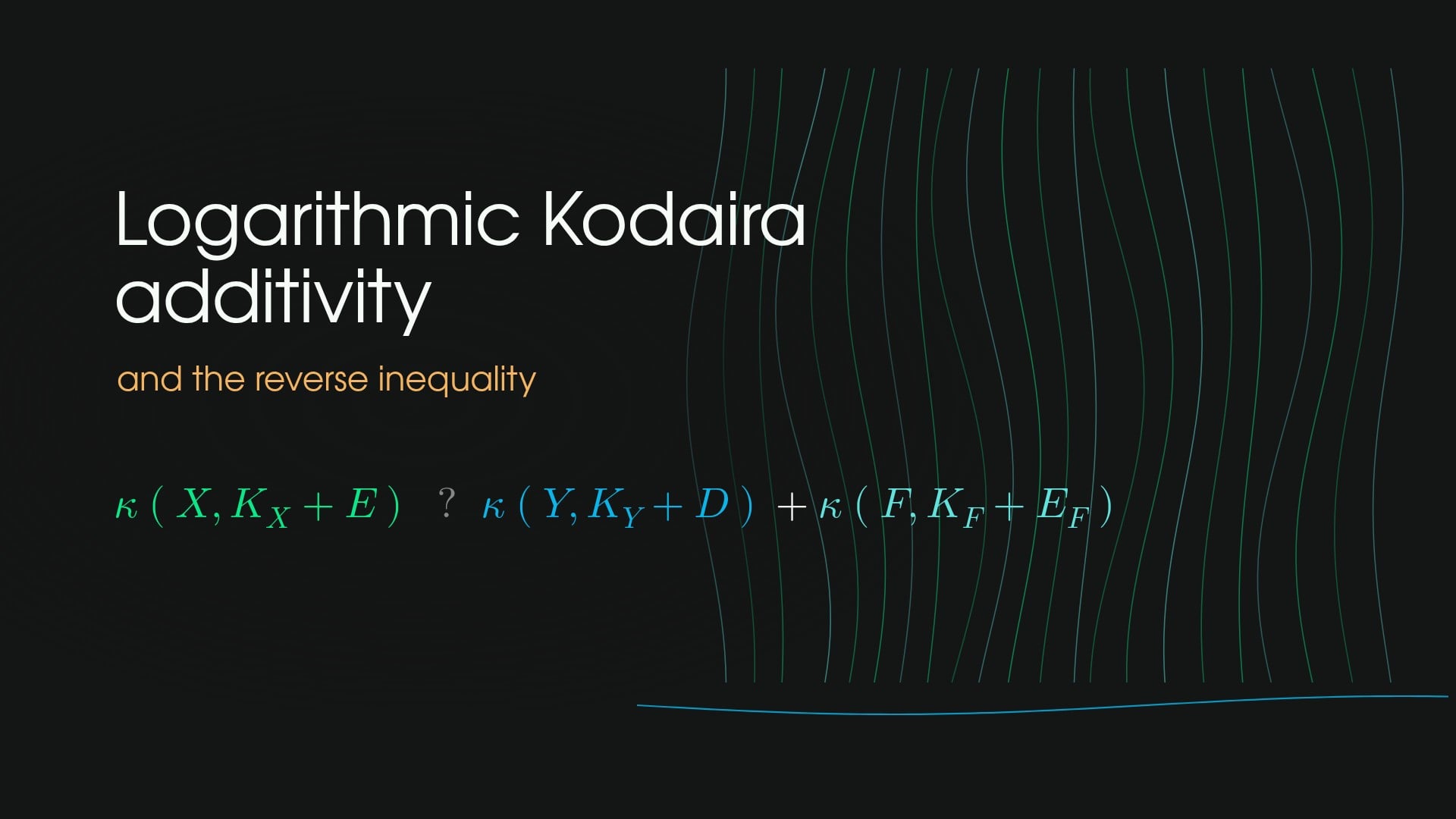
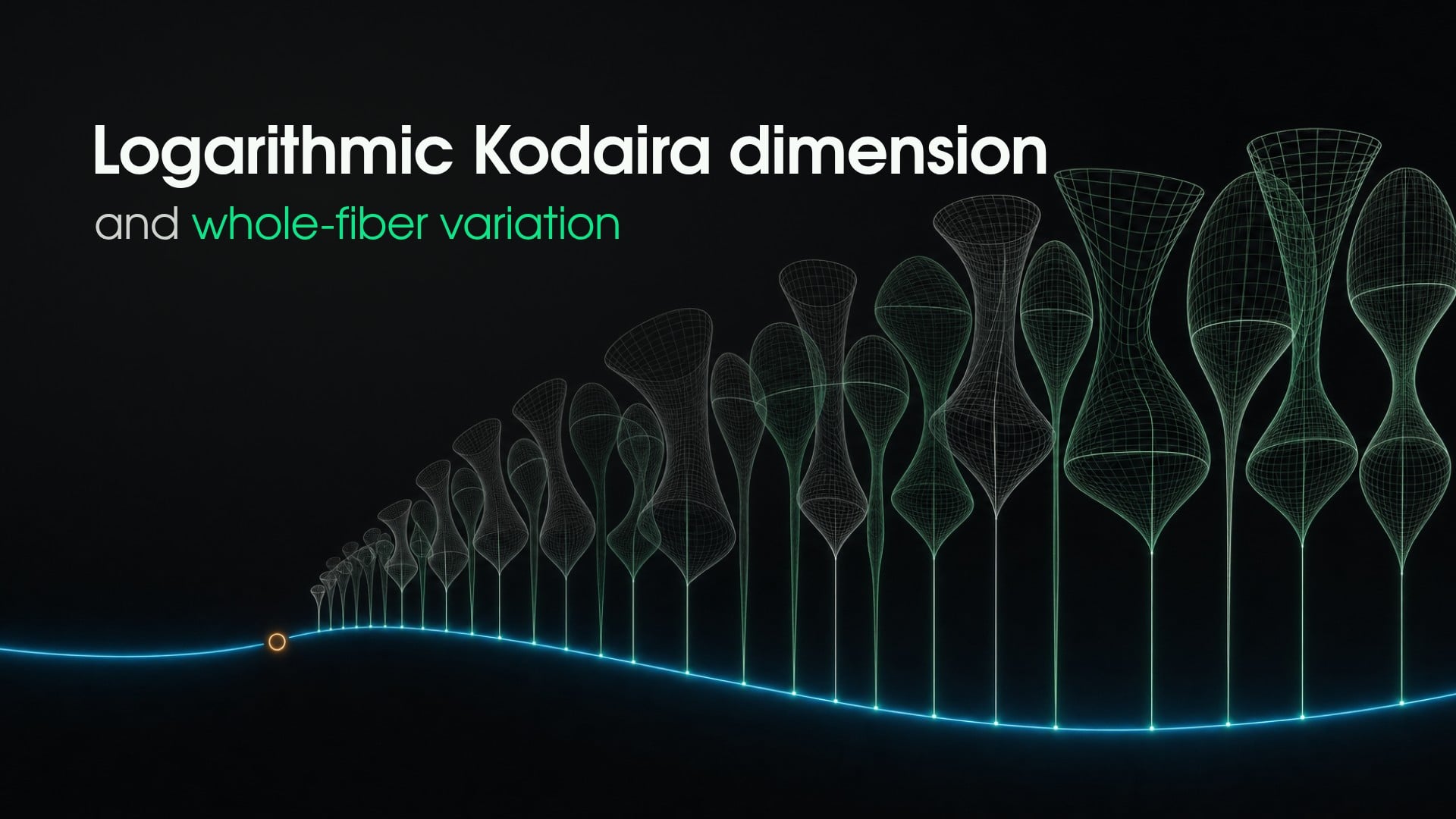
κ̄(U) ≥ κ(F) + max{κ̄(V), Var(f)}
Here Var(f) is the smallest transcendence degree of an algebraically closed field over which the whole geometric generic fiber is birationally defined. Think of it as the number of independent dials you need to produce every fiber. No abundance or good minimal model is assumed for F.
- Base branch: logarithmic subadditivity gives κ̄(U) ≥ d + κ̄(V), with d = κ(F) [1:30].
- Variation branch: the Iitaka map q : X′ → Z and the diagram X′ → W → Y, Z → T₀ give κ̄(U) = d + dim T₀. Everything then comes down to Var(f) ≤ dim T₀ [1:39].
How the variation branch is paid for
- J, the generic fiber of X′ → W, has κ(J) = 0. Its p-th root cover has a one-dimensional space of top forms, so the entire top Hodge step is one line. A rank-one eigenspace inside a bigger step is not enough [2:13].
- That line is rationally trivial along the h-fibers, so it is flat with finite monodromy. That forces birational constancy: a lifted vector field, with its poles contracted, flows one fiber onto the next.
- Constancy of J alone does not bound Var(f) [3:06]. Marked canonical models give k = b(V′). A multiplicity-one component makes the splitting cover unramified at moving divisors. Then purity and finite étale descent give k ⊆ F_b, and the whole fiber is defined over b, the algebraic closure of ℂ(T₀).
Reading it on a case
With κ(F) = 2, κ̄(V) = 1 and Var(f) = 3, the bound is 2 + max{1, 3} = 5 [3:56]. Subadditivity alone gives only 3, so the variation branch pays for the rest. In contrast, a smooth family over ℂ* with non-uniruled fibers is forced to be birationally isotrivial [4:26]. The rule: compute both branches, keep the larger, and name the mechanism behind it.