Recursos
Resumen
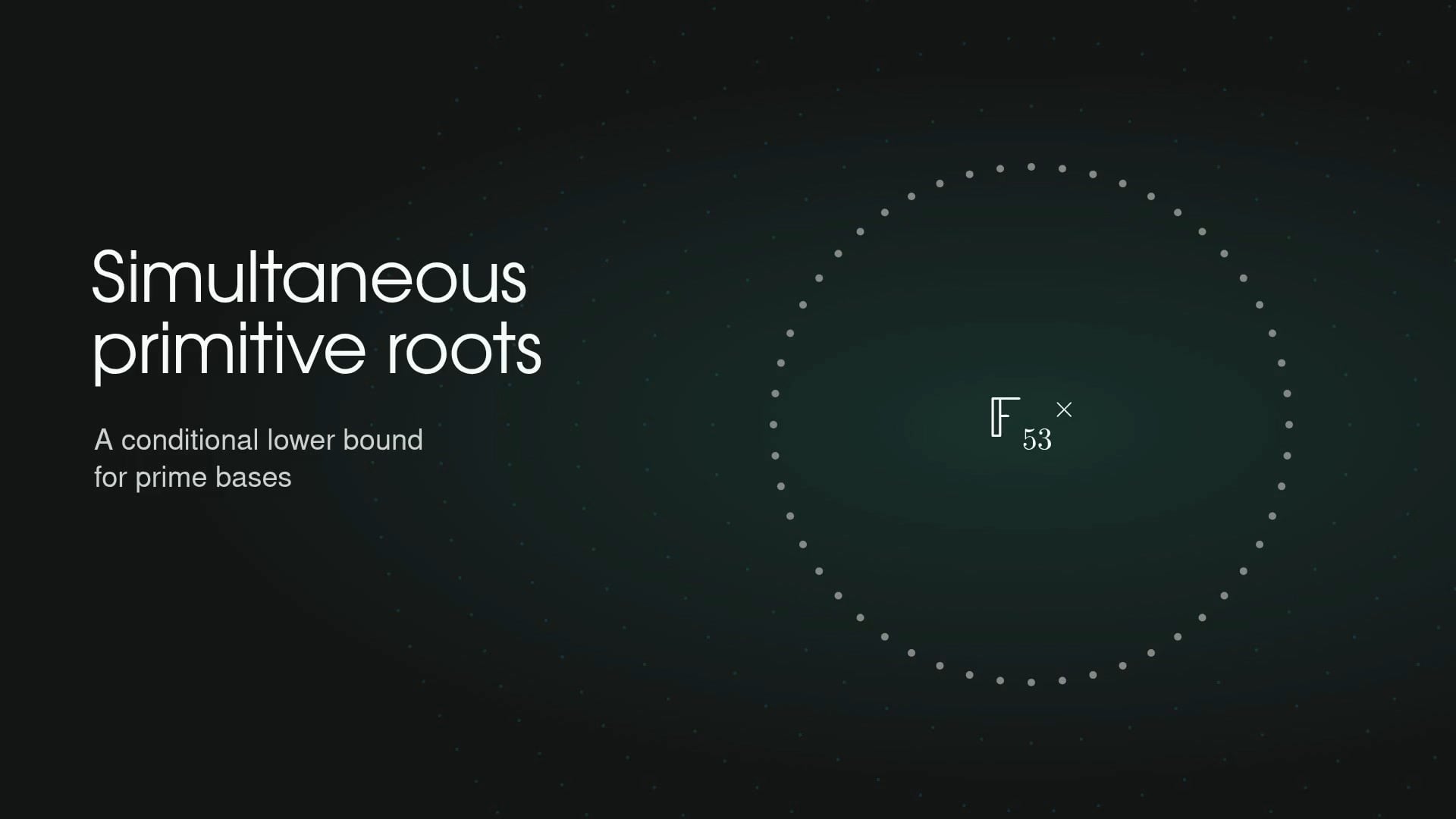
Take a finite set of prime bases and a prime p = 4rQ + 1 from the paper's reservoir. You should be able to explain why every base is a primitive root mod p for most such p. That means naming, for each prime that could divide the order index, the argument that rules it out.
The one number to watch
The order index ι_p(q) = (p − 1)/ord_p(q) equals 1 exactly when q is a primitive root. If a prime λ divides it, then q^((p−1)/λ) ≡ 1 (mod p). Think of p − 1 as a house with one door per prime factor [1:20]. For p = 53, the doors are 2 and 13, and 2, 3 and 5 are all primitive roots.
The prime reservoir (Proposition 2.1, built from Inputs 4.1, 5.1, 5.2 and Bombieri–Vinogradov) gives at least c x/L² primes p = 4rQ + 1 in a class a mod M [2:04]. Here Q > x^0.9 is prime, every prime of r lies between e^(L^0.1) and e^(L^0.3), and p ≡ 5 (mod 8). That leaves only three doors: 2, Q and the window primes ℓ | r.
One lock per door
- Door 2: residue class + reciprocity [2:54]. Choose a nonresidue mod each odd base and glue the choices with the CRT. For {2, 3, 5} that gives a ≡ 8 (mod 15), and 53 ≡ 8 (mod 15). Reciprocity makes every (q/p) = −1, so by Euler's criterion the index is odd.
- Door Q: size [3:57]. If Q divides the index, then j = (p−1)/Q < 2x^0.1 and p | q^j − 1. The product of q^j − 1 over those j has logarithm ≪ x^0.2. So at most about x^0.2/L primes are exceptions, which is negligible against x/L².
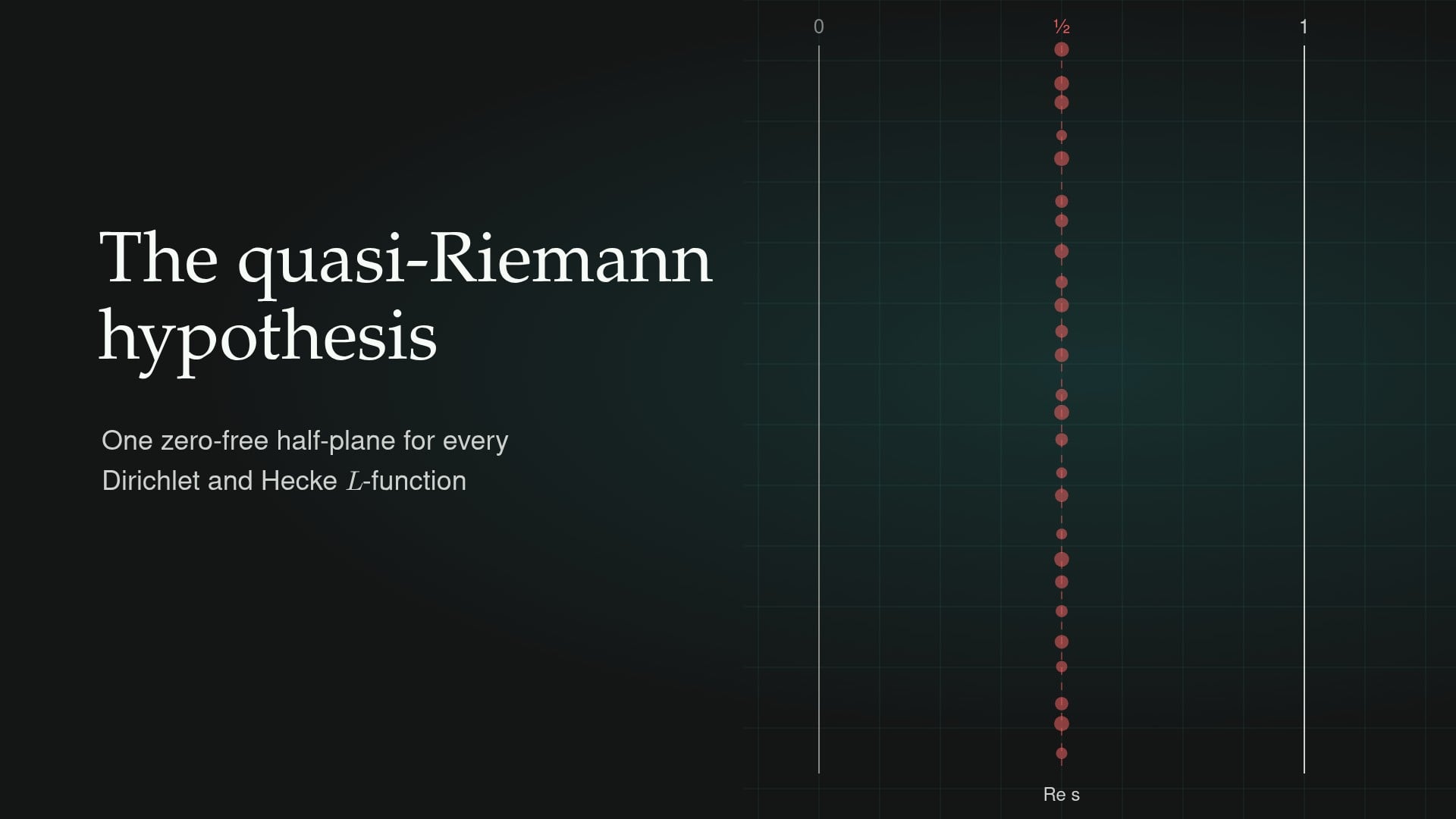
- Door ℓ: splitting count [4:32]. The two congruences mean that p splits completely in K = ℚ(μ_ℓ, q^(1/ℓ)), whose degree is ℓ(ℓ−1). The uniform zero-free region Re s > 1 − 10⁻⁶ (Input 3.1) carries over to ζ_K through an abelian tower. It bounds the split primes by x/(ℓ(ℓ−1)L) + x^(1−η).
Why the window
If r could contain ℓ = 3, the bound would be about x/(6L), which is larger than the whole reservoir [5:32]. Above e^(L^0.1), the sum of 1/ℓ² is tiny. Below e^(L^0.3), there are few enough ℓ that the accumulated x^(1−η) errors still vanish. With finitely many bases, the union of exceptions is o(x/L²). So at least c x/(2L²) primes in (x, 2x) have every base as a primitive root [6:17].
Your rule: in any primitive-root argument, list the doors of p − 1 and check that each one has its own lock: a residue class, a size argument or a splitting count. The four inputs are hypotheses. Their proofs are in the companion paper Primitive roots for every admissible integer base.