Recursos
Resumen
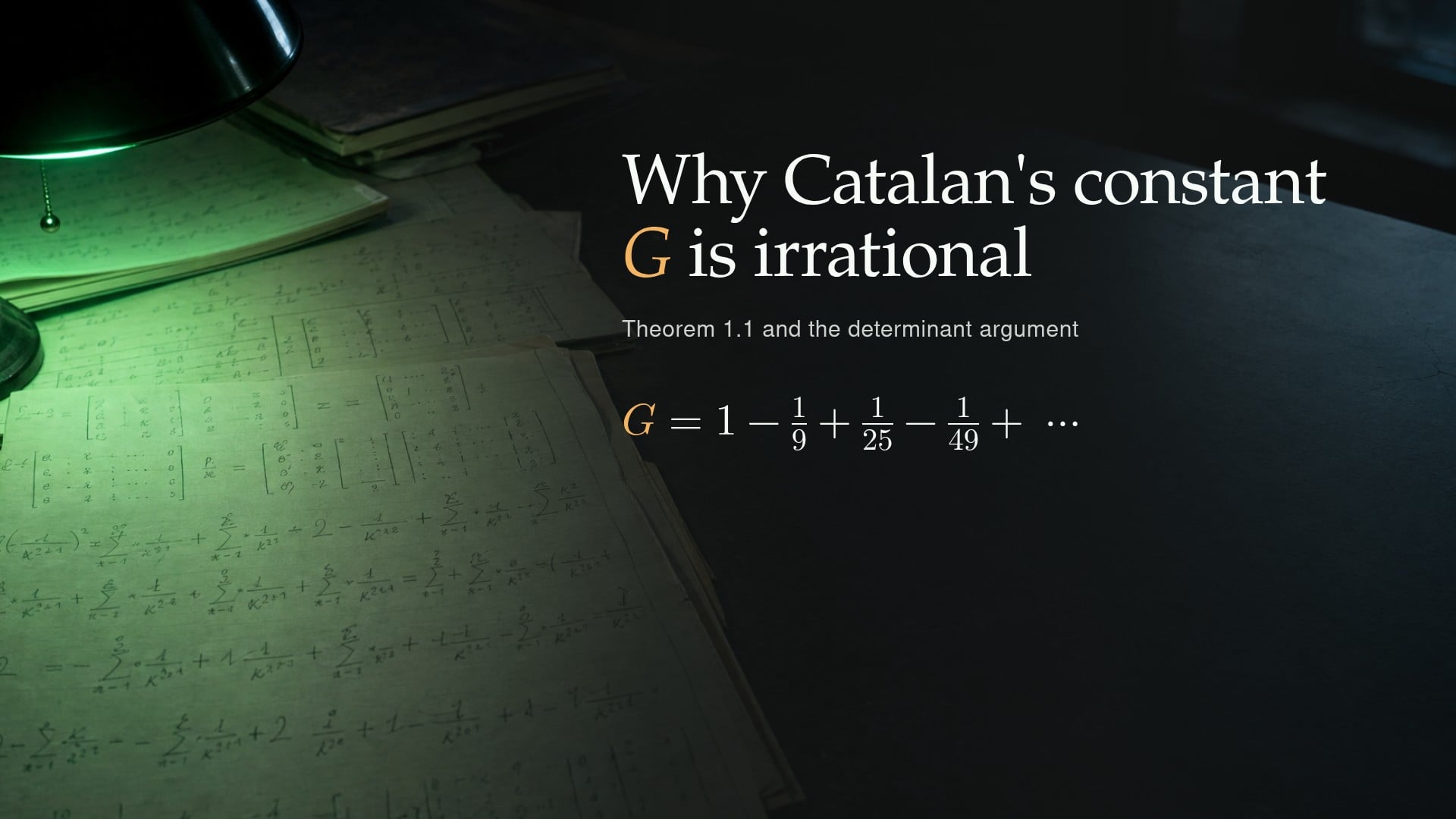
Take any zero-free region for Dirichlet L-functions and decide whether its width shrinks with the conductor or the height. That tells you whether a Landau–Siegel zero can survive. Then follow how one paper gets a fixed half-plane, Re s > 11/12, out of a mean-square bound for sextic-twisted Möbius sums.
The one question to ask
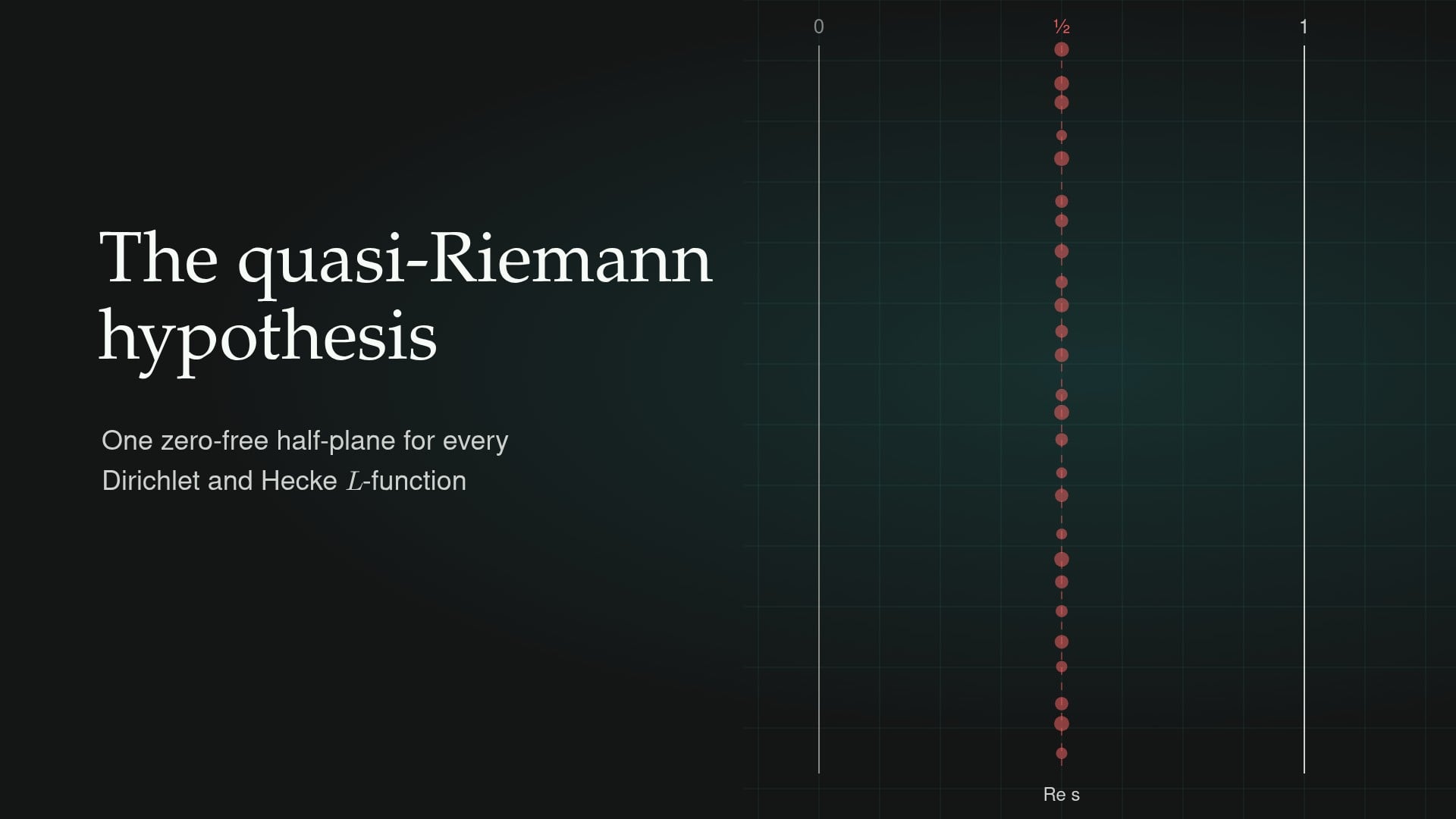
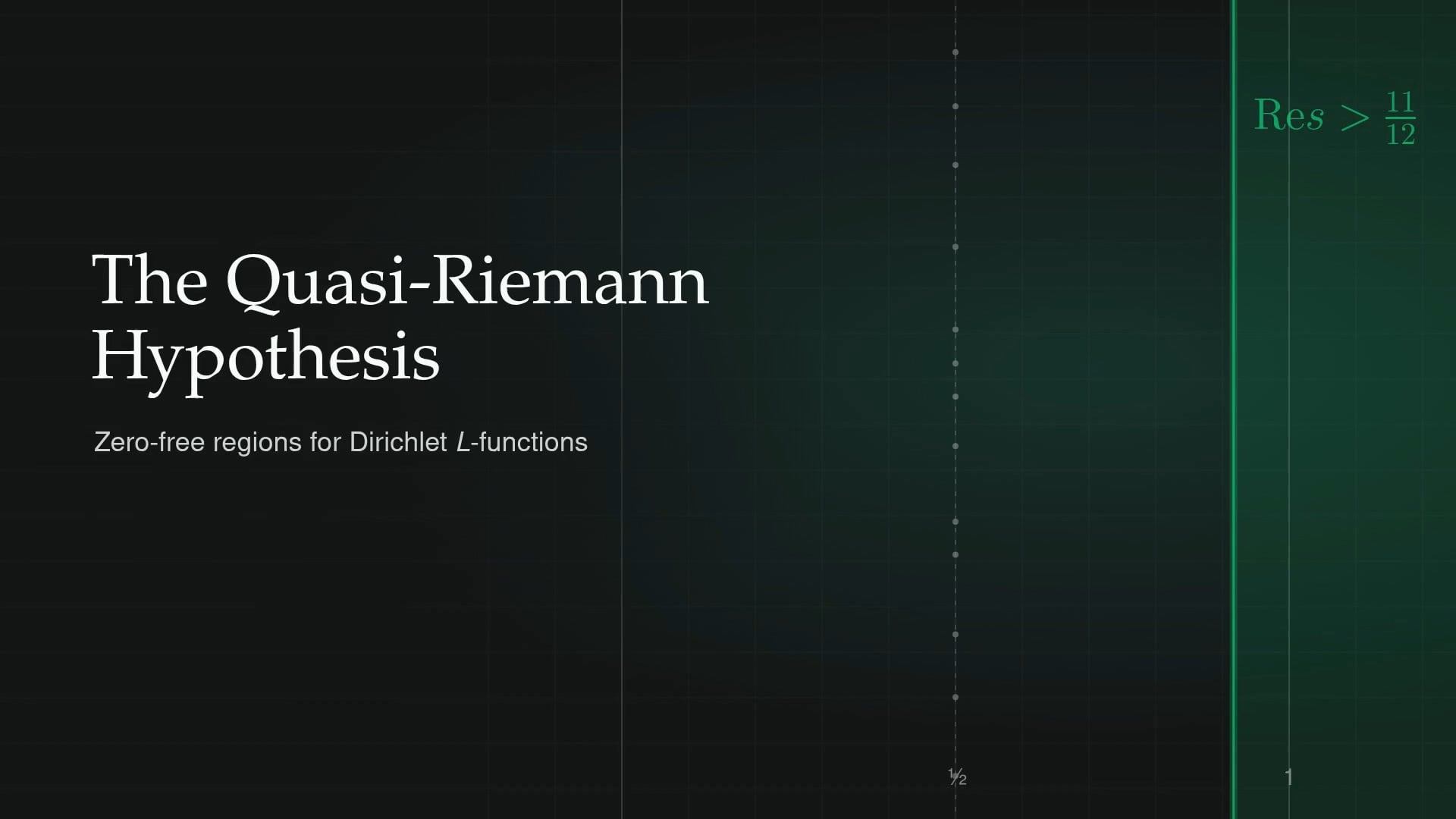
- The classical Grönwall–Titchmarsh region, σ > 1 − c₀/log(q(|t|+3)), gets thinner as q or |t| grows [0:19]. That leaves room for one exception per character: a simple real zero of a quadratic character, the Landau–Siegel zero [0:37].
- Vinogradov–Korobov is better for ζ, but its width still tends to zero with the height [1:06].
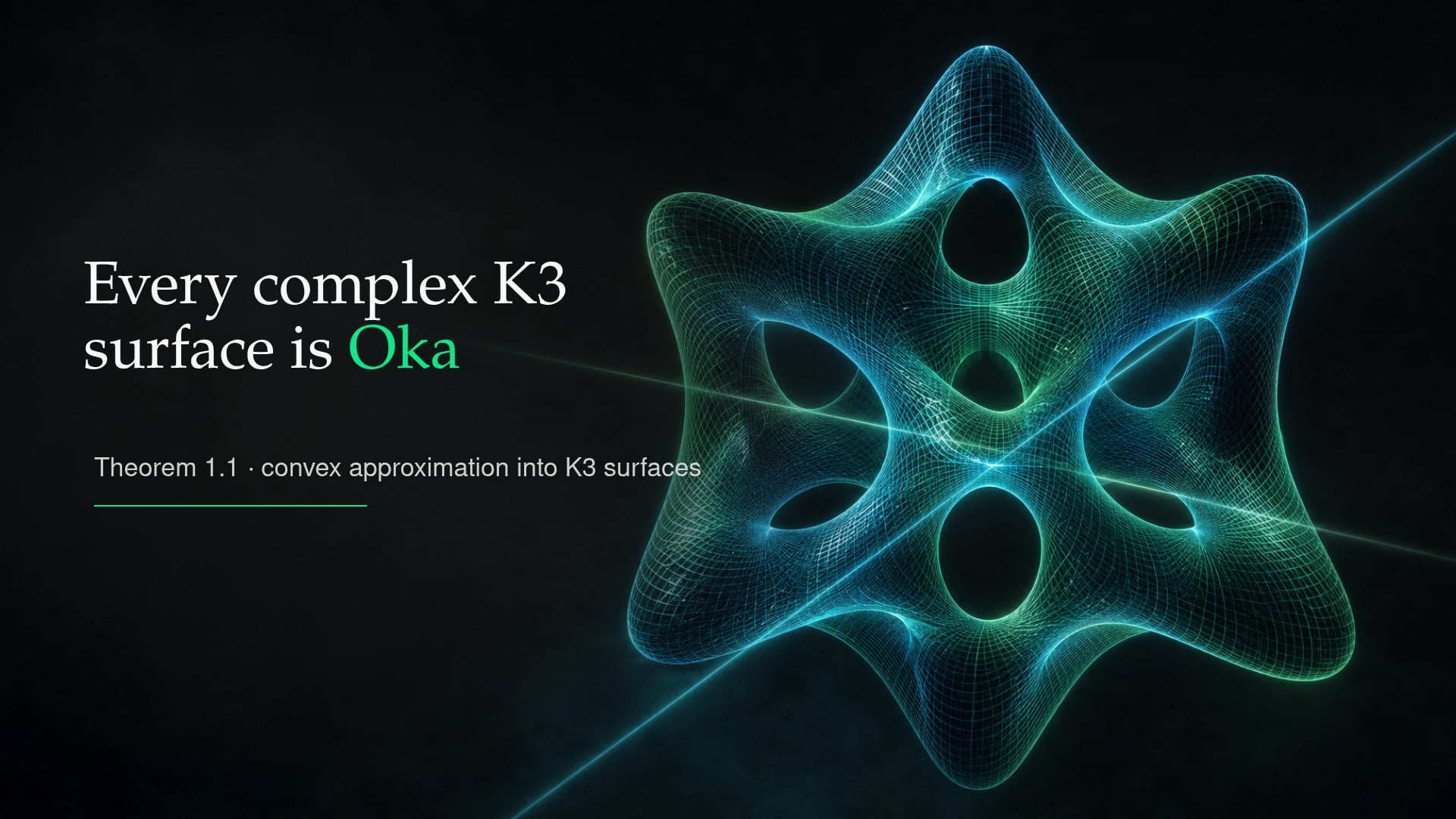
- Theorem 1.1 has no q and no t in it. Its width is fixed, so no real zero can sit near 1 and Siegel zeros are ruled out. For zeta, a statement like this is a quasi-Riemann hypothesis.
- The result is stated over K = ℚ(√−3), and Dirichlet L-functions follow from base change: L_K(s, χ∘N) = L(s,χ)·L(s,χχ₋₃) [1:50].
Where 11/12 comes from
- If the twisted Möbius sum A₁(D) saves a power of D, then 1/L stays holomorphic to the left of 1 [2:28].
- Twist by the sextic symbol (u/n)₆. The rows u = p⁶ all reproduce A₁(D), like stacking exposures of the same star [2:59]. The mean square over rows of norm up to H = D^{1+θ} is about D·H.
- Average over about Y/log Y such rows, with Y = H^{1/6}. That gives |A₁|² ≪ D^{11/6+…}, so |A₁| ≪ D^{11/12+…} [3:46].
How the mean square is proved
Poisson summation in u turns the sums into sextic Gauss sums. With μ these become cubic Gauss sums, which are the coefficients of Kubota's theta function. Automorphy then makes the twist quadratic (χ_p³), so the quadratic large sieve applies [4:28]. Möbius inversion removes the cube factors, and a second Poisson summation shortens the row range on each pass until the bound closes [5:00].
Next time you meet a zero-free region, first check which parameters its width depends on [5:31].