Recursos
Resumen
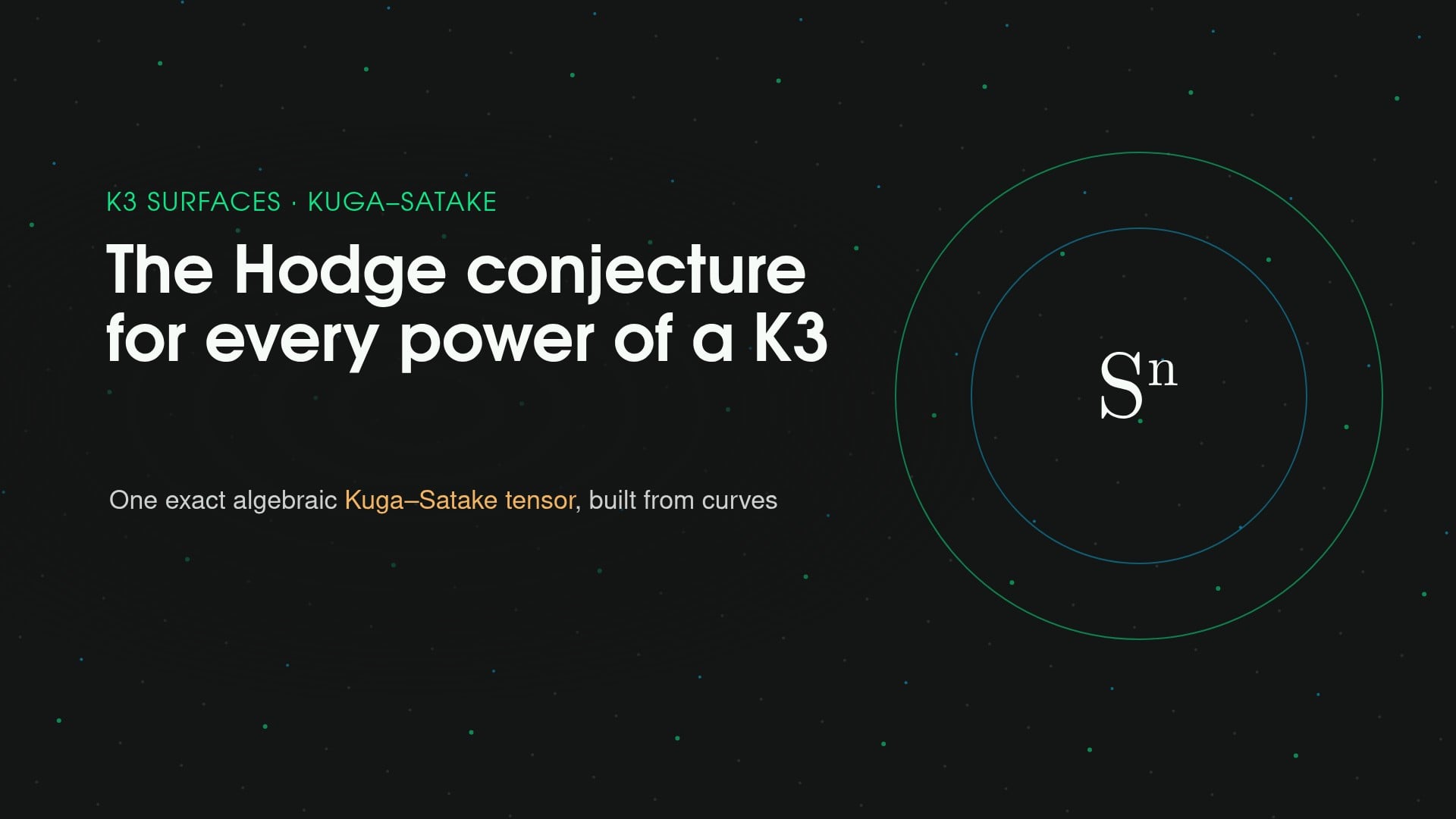
Take any power of a K3 surface and ask one question: is there a single exact algebraic Kuga–Satake tensor? Answering it is what proves the Hodge and generalized Hodge conjectures for every self-power. This class traces how the paper answers yes on a quadratic locus, and why curves, a double cover and two square substitutions are enough.
The criterion: one tensor settles every power
- The even Clifford algebra W = C⁺(T, q) is a weight-one Hodge structure, so W = H¹(A) for an abelian variety A. [0:49]
- Fix a nonisotropic w. The map j_w(v)(a) = vaw becomes the tensor ι_{w,E}: T → W ⊗ W ⊂ H²(A × A). [1:05]
- Watch out: an arbitrary algebraic embedding into abelian cohomology is not enough. The cycle must induce this exact map. [1:24]
- When it does, the exterior powers of T inject into End(W) and return correspondences come out. Invariant theory then gives HC, and a highest-weight bound by coniveau gives GHC. [1:44]
The quadratic locus
- V_P = U² ⊥ ⟨−1⟩⁴ has dimension 8 and signature (2, 6). If T_S embeds rationally and isometrically into it, the tensor is algebraic. This includes every ample P-polarized K3, with P = U ⊕ D₈(−1) ⊕ D₄(−1), Picard jumps included. [2:18]
- Quick check: if ρ = 10, then dim T_S = 12 > 8, so the surface is not on the locus. ρ ≥ 14 is necessary, not sufficient. [2:46]
Building the tensor from curves
- A double cover X of an abelian surface carries an 8-dimensional space U_X. A Gauss pencil gives a product C₁ × C₂ dominating X, so U_X ↪ H¹(C₁) ⊗ H¹(C₂). [3:19]
- Two square substitutions make the comparison from the auxiliary K3 to X algebraic. First, t = s + u² gives uniruled threefolds. Second, s = b + v² makes the conic split, and the difference of its two components gives a cylinder with factor −4. [4:11]
- Recovery: composing with Hodge maps on the curve factors and swapping them spans all Hodge maps into C⁺ ⊗ C⁺. The two half-spin pieces then give back the prescribed tensor. Buskin's theorem carries it to every target. [4:59]