Recursos
Resumen
Take a proof that claims a fixed zero-free half-plane and explain why it works: two bounds on one character sum force 1/L to continue past the rightmost zero, so that zero cannot exist.
The problem
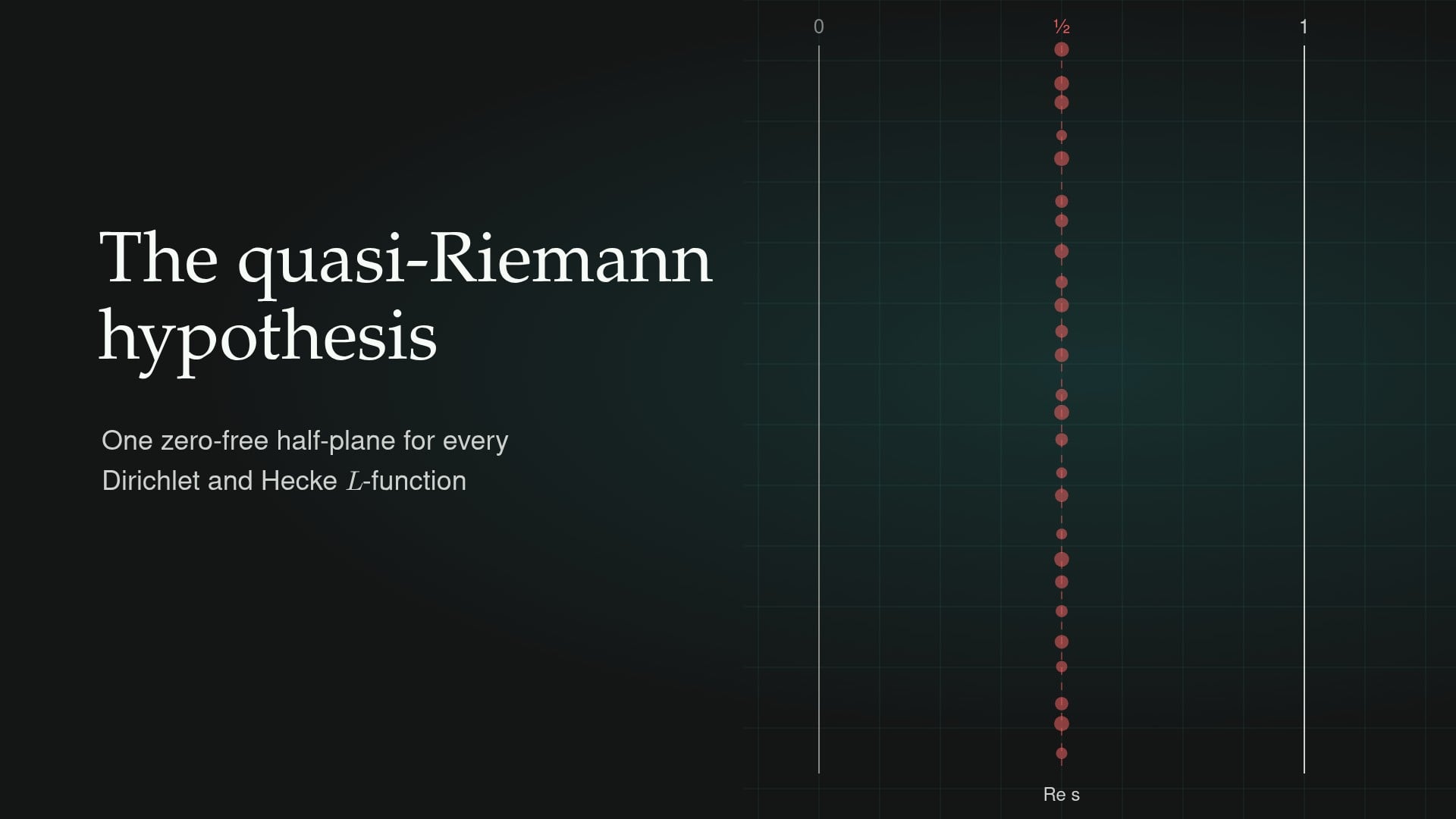
The quasi-Riemann hypothesis asks for one constant σ0 < 1 that works for every character, every conductor and every height. Classical zero-free regions don't give it, because they bend toward Re s = 1 and can allow one exceptional real zero [0:25]. Zero-density estimates don't give it either: they count zeros, and a small count is not zero [0:38]. The paper behind this lesson claims Re s > 7/8 for all finite-order Hecke L-functions over Q(√−3), all Dirichlet L-functions and ζ. It gets there in two stages, first 11/12 and then 7/8 [0:50]. This is not the Riemann hypothesis, which remains open.
The engine
- Build one sum and write it two exact ways [1:17]. Cubic theta reflection plus a large sieve give the low estimate |J| ≪ Z^{C(σ0)+ω}. Poisson summation gives rows. The principal row u = 1 is a Mellin integral f containing 1/L, and the remaining rows give the high estimate |J − f| ≪ Z^{C(β*)−σ}.
- Triangle inequality [2:24]: |f| ≪ Z^{C(β*)−ε*}, with *ε = min{Δ0 − ω, σ}**.
- Continuation [2:39]: the Mellin transform of f converges and is holomorphic for Re s > β* − ε*. For Re s > 1 it equals e^{(s−5/6)²}H/L, so 1/L continues into the strip. But β* is a supremum, so some zero ρ lies in that strip and gives a pole. That is a contradiction.
The check that matters
In stage I, ε* = min{Δ0 − ε, 1/4800}, which is tiny but positive [3:16]. The margins must not depend on the character. Otherwise the strip could shrink to nothing. When you read an argument of this kind, find the common signal, then check that both estimates beat Z^{C(β*)} by a margin that is uniform in η [4:00].