Recursos
Resumen
Take a supposed real zero β of a real Dirichlet L-function, with (1−β)·log q shrinking to zero, and follow how a recent preprint claims to turn it into a contradiction: a prime bias, a determinant that gains powers of p, and a floor that ends up above a ceiling.
The problem and the claim
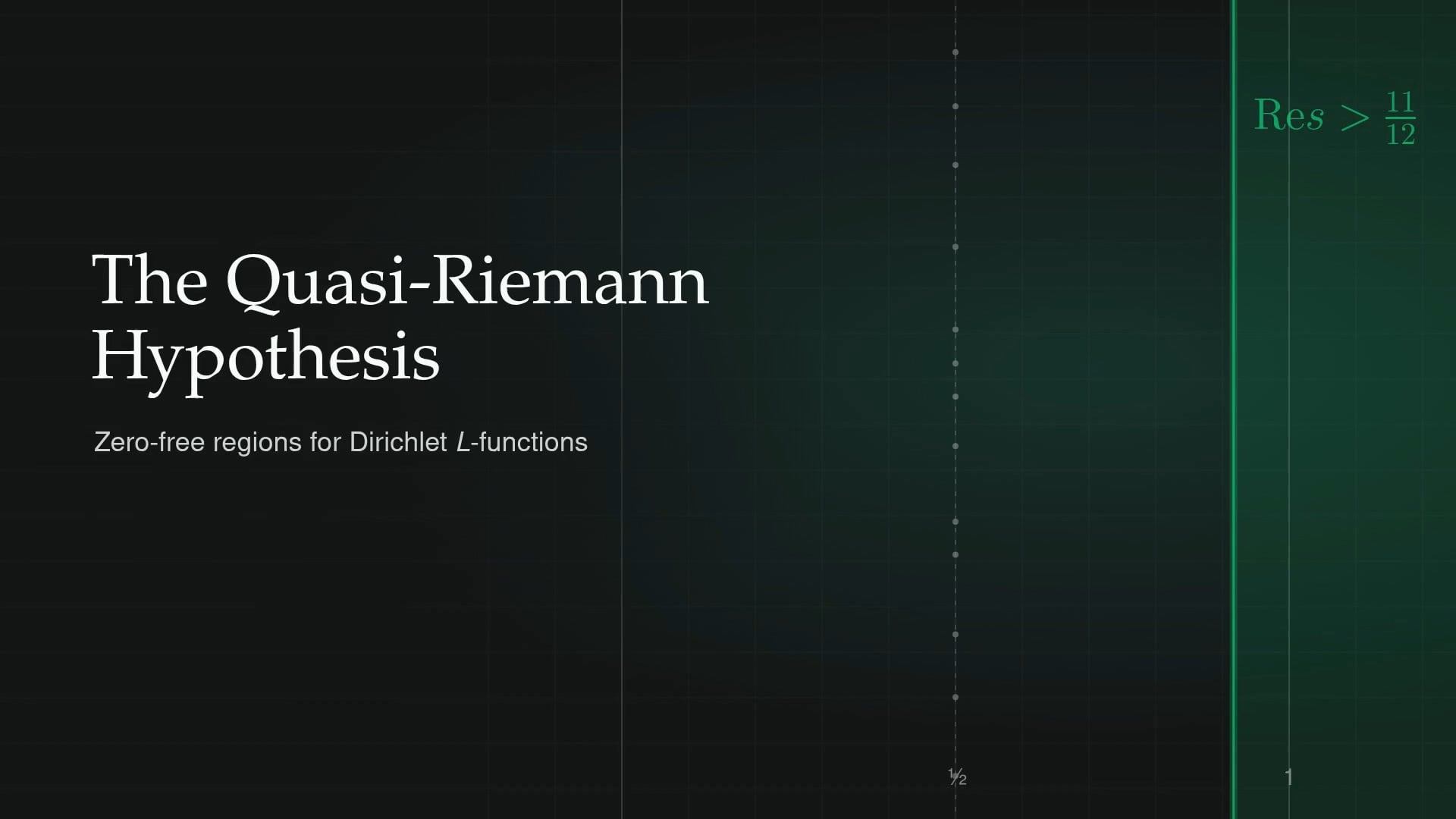
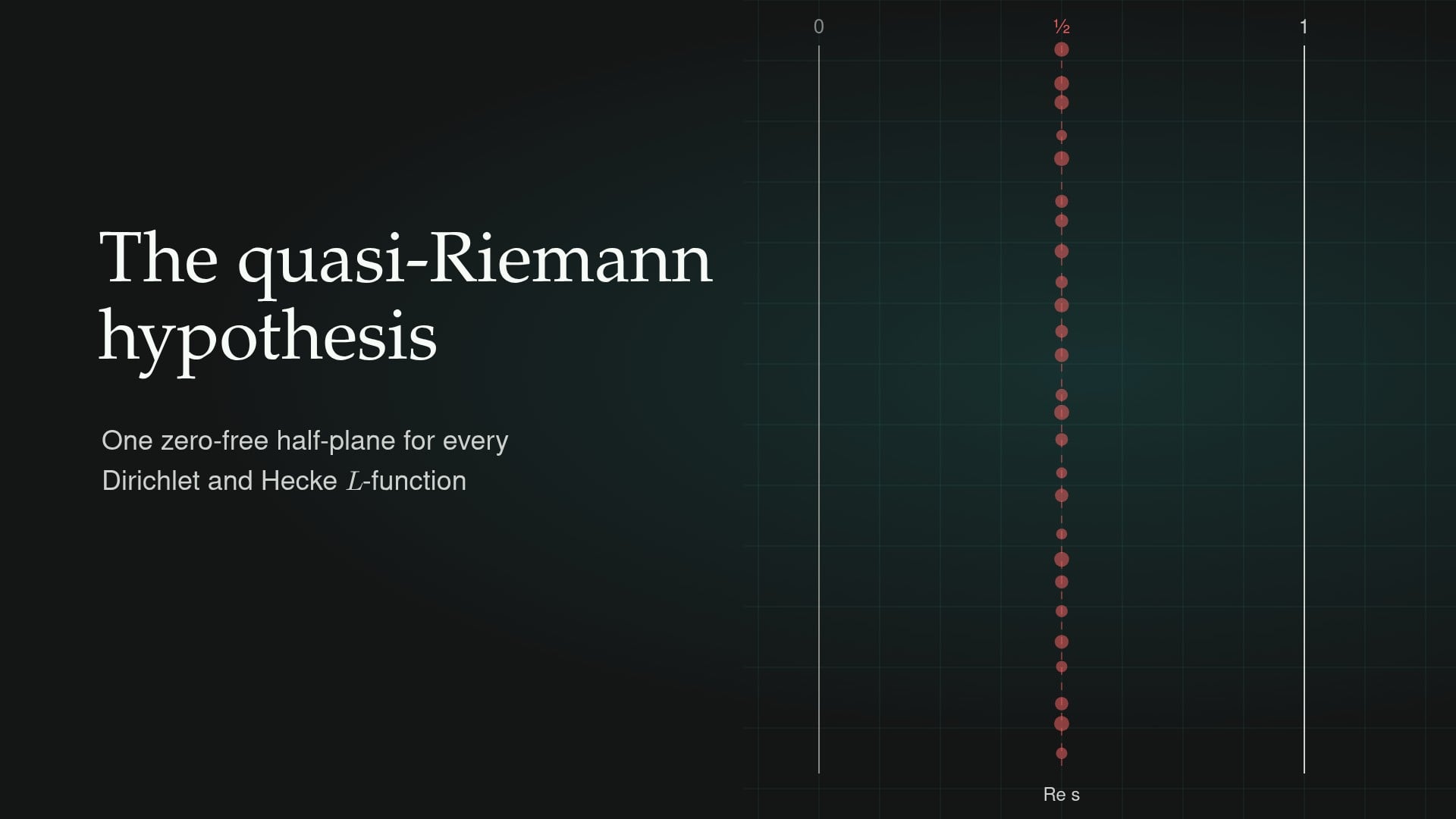
The classical zero-free region allows one exception: a simple real zero of a real character [0:08]. Siegel's bound L(1,χ) ≫ q^(−ε) is ineffective. Page's window 1 − c₂/log Q depends on the range Q, so one character can still sit inside it. The preprint claims an absolute c with (1−β)·log q ≥ c. Treat this as a claimed result, not an accepted theorem.
The mechanism, step by step
- The zero loads the coin [1:05]. At s = 1 + 1/log X, the nonnegative series −ζ′/ζ − L′/L is capped by Cℓ + (1−β)(log X)². When δ = (1−β)·log q is tiny, primes with χ(p) = +1 get starved. Almost all of the mass log X then sits on χ(p) = −1.
- The algebra [2:04]. K = Q(√d, √2), where σ flips √d and τ flips √2, and θₙ = n₁ + n₂a + n₃b + n₄ab is evaluated on a 4-D box. Each row of the matrix is θ^α₁·σ(θ)^α₂·στ(θ)^α₃. The rows are ordered by the weight α₁ + Hα₂ + Hα₃, so S₂/S₁ stays small [2:35].
- Frobenius does the attack (worked case d = 5, p = 7) [3:15]. Since χ(7) = −1, a⁷ ≡ −a and b⁷ ≡ b, so θ⁷ ≡ σ(θ). Replacing blocks of p first factors with θᵖ − σθ leaves Δ unchanged and divides every entry by pᵏ. As a result Δ ∈ p^(E_p), with E_p ≈ Σα₁/p. This needs p > H, so that the weight actually drops.
- Your turn [4:26]. For d = 5 and p = 3, θ³ ≡ στ(θ). Primes with χ(p) = +1 are not counted.
The squeeze, and how to use it
Divisibility gives a floor ≈ S₁·log U. Size, via Hadamard's inequality, gives a ceiling ≈ (S₁+S₂)·(log N + ½ log q + …). Because log N = ¾ log U, the right choices of H and N together with δ → 0 lead to 1 ≤ 7/8 [4:57].
When you read a proof like this, ask of every ingredient: does it raise the arithmetic floor, or hold down the archimedean ceiling? [5:50] The next thing to check is Lemma 3: why interpolation on the projected integer box is uniform in d.
Landau–Siegel zeros: how a determinant could forbid a real zero near 1

Clase 7 / 100