Recursos
Resumen
Take a nef divisor on a klt pair and decide how far up the positivity ladder it climbs: nef, then full nef dimension, then big, then numerically semiample. For each rung, you should be able to name the step of the Generalised Abundance proof that lifts it.
Why the conclusion is only numerical
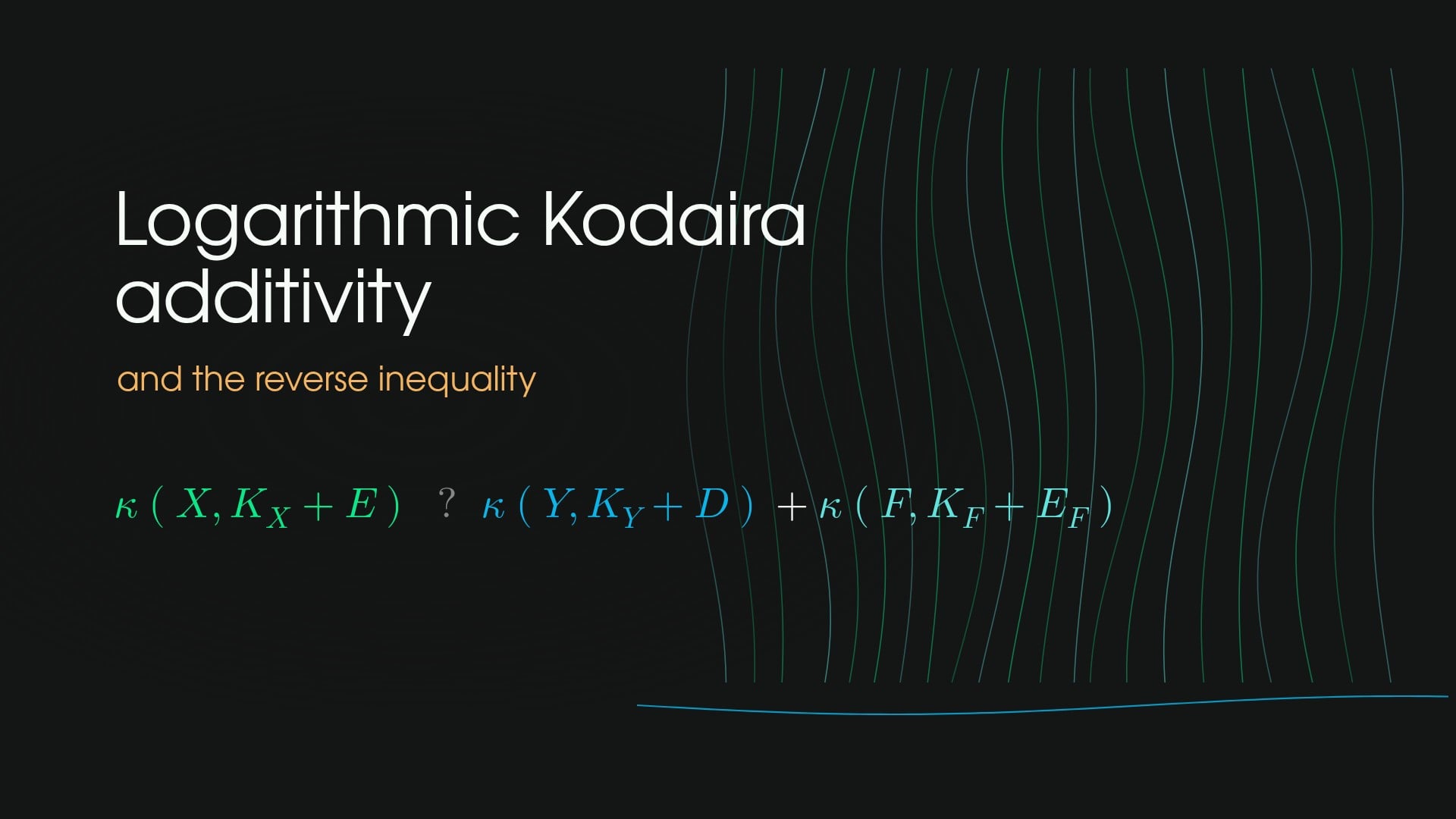
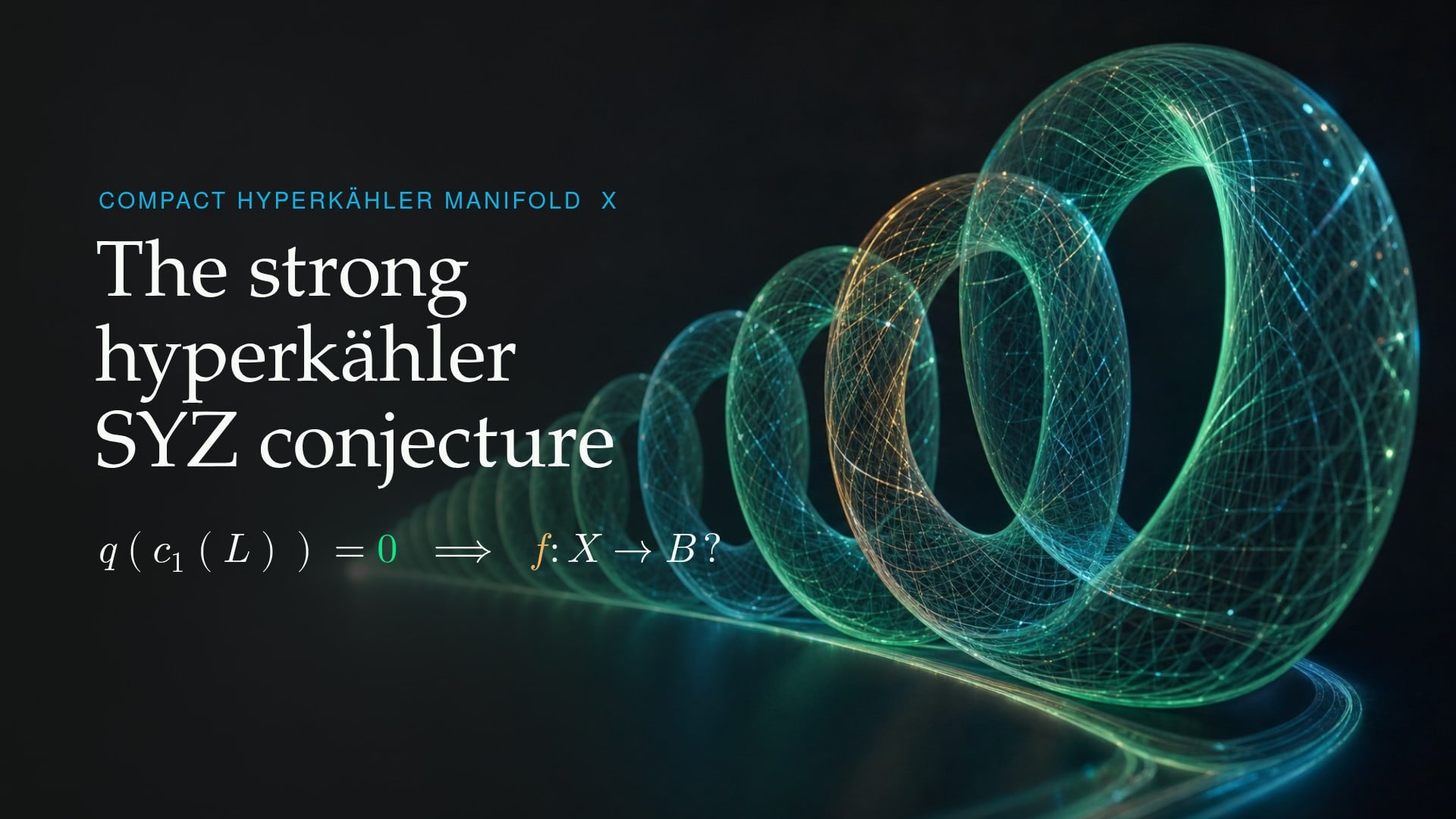
On an elliptic curve, a non-torsion line bundle of degree zero is nef, yet no power of it has a section. It still has the same degree as the trivial bundle, so it is numerically equivalent to zero, and zero is semiample [0:53]. That is why the theorem only claims that D = K_X + B + M is numerically equivalent to a semiample L when (X, B) is projective klt in characteristic zero, K_X + B is pseudo-effective, M is nef and D is nef [1:38]. With M = 0 this is ordinary klt abundance. When K_X + B ≡ 0, every nef divisor is numerically semiample.
The key step: full nef dimension forces bigness
- Full nef dimension means every curve through a very general point has positive degree. Big means positive volume, which is a stronger condition [2:37].
- Suppose L is not big. Then ample approximations P keep a bounded volume while P·C ≥ r → ∞ on very general curves. Bounded-degree curves (Birkar–Zhang) rule this out [2:59].
- Moving jet kernels give the scalar estimate ord_x(s) ≤ 4kρ: sections on X vanish only a little. On the bundle Z over X×X, the same method gives a large jet system [3:37].
- The Frobenius comparison spreads the data over a finitely generated ring and reduces mod p. There, one determinant is bounded from both sides, which is a contradiction, so L is big [4:28].
- An index-one cover extends this to every klt Calabi–Yau pair. Nef reduction and the canonical bundle formula then finish the argument, and the result descends to X [5:10].
Your decision rule
First ask one question: does every curve through a very general point have positive degree? If yes, jets and Frobenius make the divisor big. If no, nef reduction drops to a lower-dimensional base and induction takes over [5:28]. Either way, expect a numerical representative, not the divisor itself [5:58].