Recursos
Resumen
Take a fixed shift γ and an approximation function ψ that is not monotone. You should be able to say why adding up interval lengths tells you nothing, which sum does decide the question, and how a second-moment argument turns that sum into "almost every x".
Why length is not enough
With monotone ψ, Khintchine (and Szüsz, for a fixed shift) gives an almost-everywhere result as soon as Σψ(q) diverges [0:12]. Without monotonicity, the rows of approximation intervals can stack on shared centres. Rows 6, 12 and 18 with γ = 0 add length but hardly any new coverage [0:44]. Counterexamples by Ramírez, and by Chow, Hauke, Pollington and Ramírez, show that a shift does not fix this. A proof has to control arithmetic overlap.
Check it yourself [1:26]: in row 12, only 1/12, 5/12, 7/12 and 11/12 are new centres. That is 4/12 = φ(12)/12. Euler's totient measures the share of a row that is new.
The claimed theorem
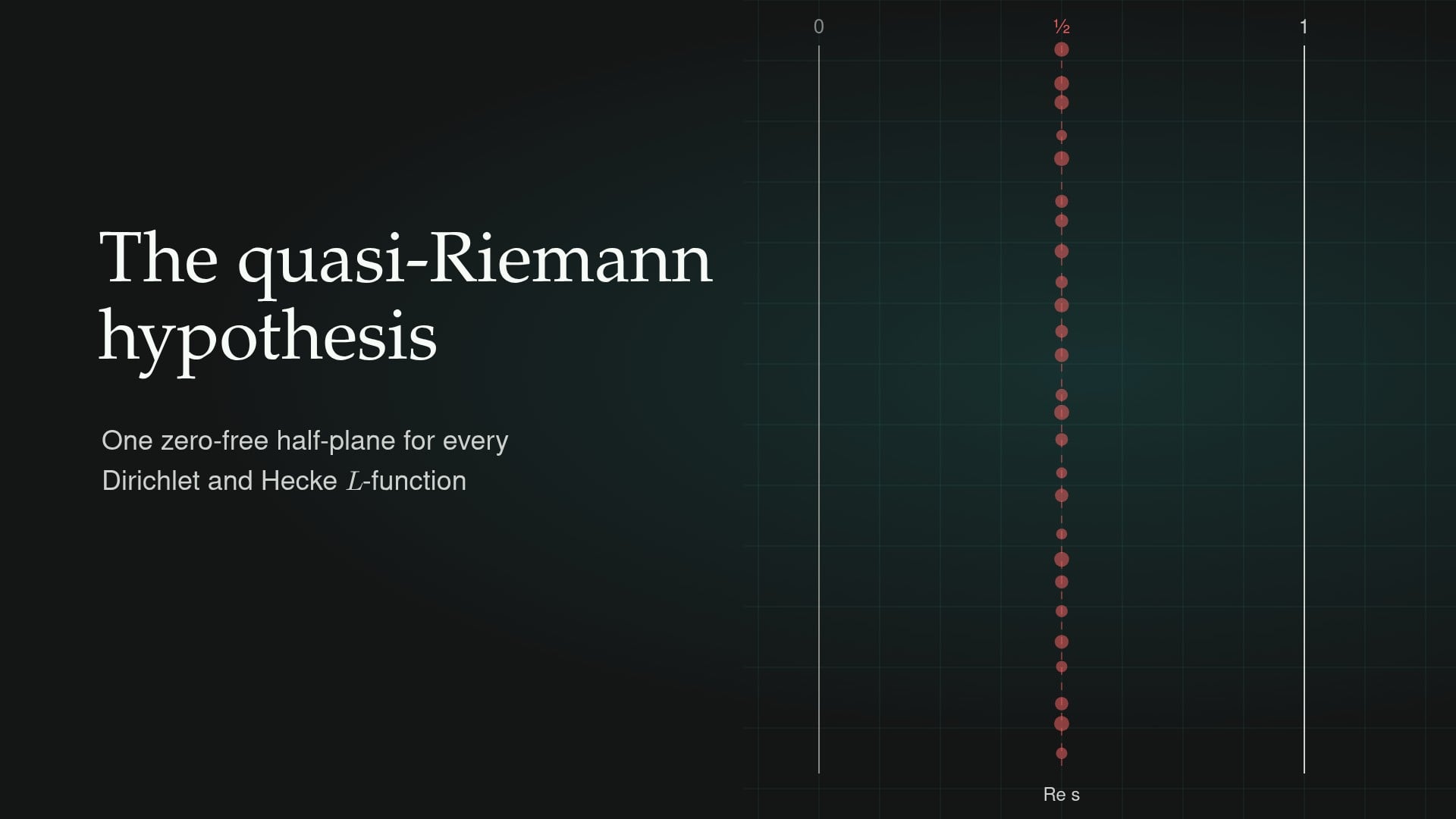
For every real γ and every finite-valued ψ, if Σ φ(q)ψ(q)/q = ∞, then for almost every x the inequality ‖qx − γ‖ < ψ(q) holds for infinitely many q [1:58]. "Weak" means the numerator a is unrestricted. The coprime version fails for nonzero rational shifts. γ needs no Diophantine condition.
How the proof works
- Set up a contradiction [2:35]: suppose a set E with |E| = μ > 0 avoids all late rows. Take late blocks with totient mass between w and 2w, and build a weighted interval train F that sits inside the approximation intervals.
- Two bounds that cannot both hold [3:00]: ∫_E F = 0. Equidistribution forces at least 0.3μ on an approximating union U. Cauchy–Schwarz caps the same integral at 0.25μ. This only works if the second moment of F is uniformly bounded (‖𝔼F‖₂ ≤ C₂).
- Prime-by-prime matching [3:46]: the trouble comes from close pairs. At each prime p, a plus label succeeds when p divides its numerator. Matched plus and minus portions keep exactly one of the two, so fluctuations are centred and their linear terms vanish on average.
- Rotation estimate [4:31]: for shifted close pairs, either few n in [N, 2N) bring nα near y, or α is close to a rational with a small denominator. That structured case is handled separately.
Your check [5:04]: give each row the weight φ(q)/q, then measure how much its centres pile onto the other rows. That overlap is what any proof has to pay for. Next comes the Hausdorff-measure version, obtained through mass transference.