Recursos
Resumen
Take an elliptic curve over Q whose two-power Selmer corank is at most one, and work out why its leading term matches the order of Sha exactly at the prime two, a stronger claim than the rank agreeing. The argument rests on one inequality, one cancellation and one transfer.
Why rank is not enough
Gross–Zagier and Kolyvagin turn analytic rank 0 or 1 into the same algebraic rank and a finite Sha. An Euler system, though, usually gives its point only after multiplying by a fixed integer m. That does no harm to rank, but the unknown v₂(m) hides the exact two-part [0:08]. At two, both real components (Ω integrates over all of E(ℝ)) and lattice indices (Reg ↦ m²·Reg) move the valuation [0:40].
The target: the discrepancy X
Theorem 1.1 says that when s₂(E) ≤ 1, rank = analytic rank = s₂(E), Sha is finite, and v₂(Q_E) = v₂(#Sha). The proof puts the exact claim into one number, X(E): the 2-adic valuation of the leading term divided by everything BSD predicts. The formula holds exactly when X(E) = 0 [1:03].
Three moves
- Bound: for non-CM curves with an ≤ 1, X ≥ 0. Kato's reciprocity law and determinant line switches keep valuations exact until an integral coordinate is reached [1:37].
- Cancel: the split-pair anchor gives twists E^h and E^hk with analytic ranks adding to 1 and X(E^h) + X(E^hk) = 0. Two nonnegative numbers that add to zero are both zero [2:08].
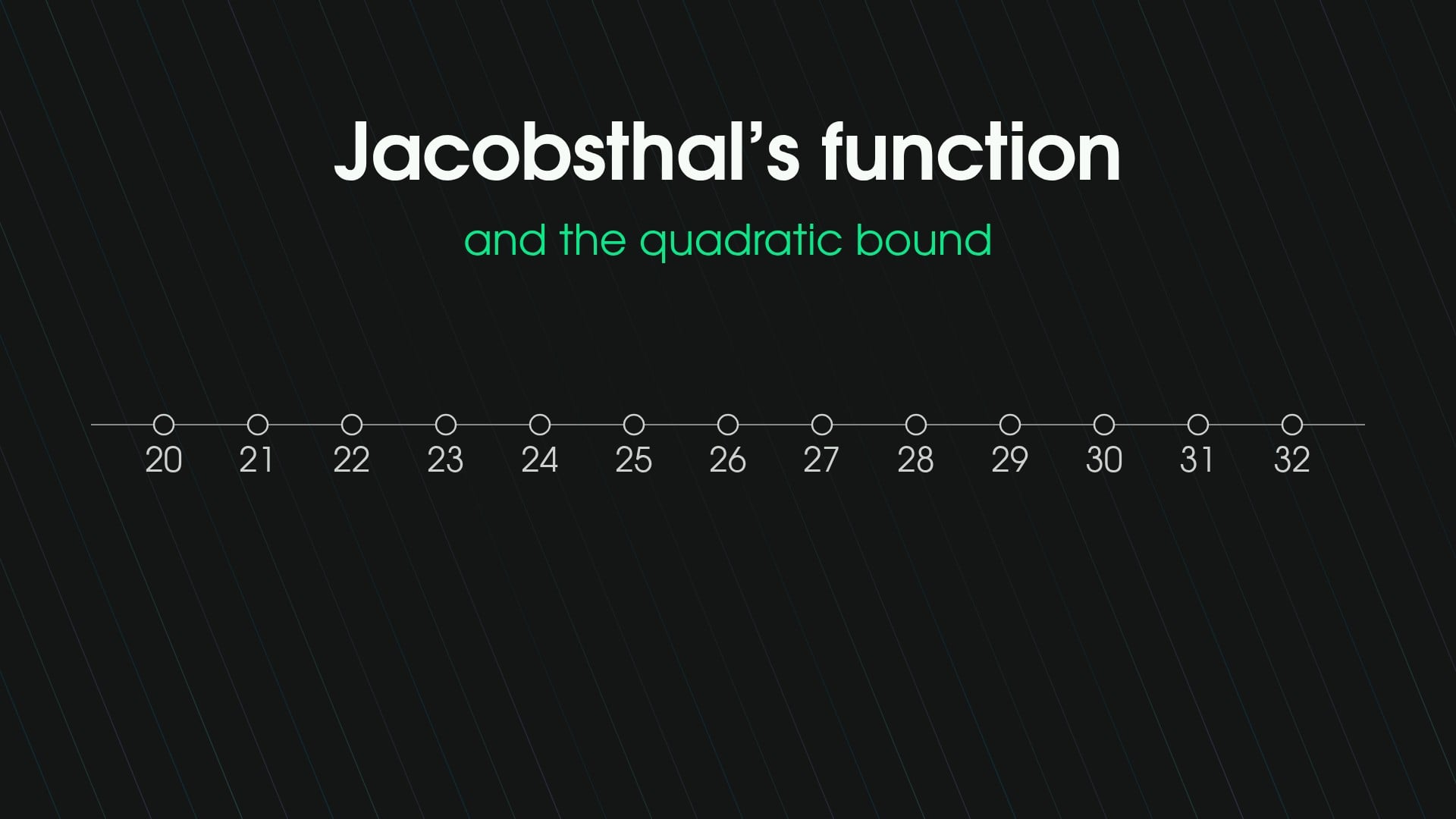
- Transfer: because k < 0, exactly one of h and hk is positive. Call it a. With h = −3 and k = −7, a = hk = 21. The second half of the positive comparison then gives an(E) = s₂(E) and X(E) = 0 [2:54]. CM curves get the same result from a separate comparison built on elliptic units. Gross–Zagier and Kolyvagin then return the rank and finiteness of the whole of Sha [3:37].
When you read an exact-formula argument at two, look for the bound, the cancelling pair and the transfer [3:56].